For Israel, the Clock Is Ticking on Hamas
Error: Contact form not found.

 by Yoav Limor / JNS.org

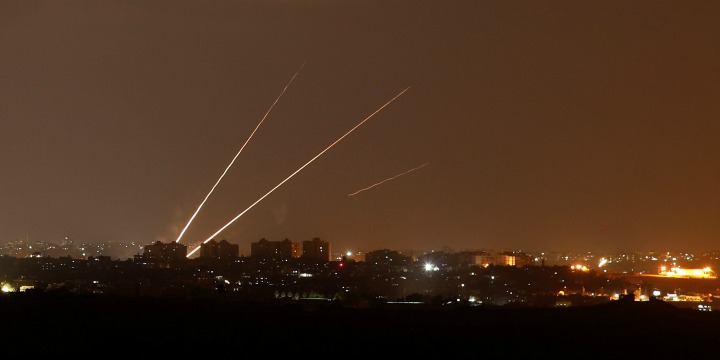
Streaks of light are pictured as rockets are launched from the northern Gaza Strip toward Israel, as seen from Sderot, Aug. 8, 2018. Photo: Reuters / Amir Cohen.
JNS.org – Last week, Israel was once again forced to decide whether it had lost its patience with Hamas, and was about to change the rules of the game.
Although certainly not the first time, the barrage of missiles fired at Sderot on Wednesday night and Thursday morning was unique both in scope and outcome. In particular, it showed how risky it can be to make military retaliation contingent upon the effectiveness of an attack.
With past rocket attacks that did not incur casualties, the IDF took care to ensure that the response was minimal, in order not to change the rules of the game. This led Hamas leaders to believe that everything was fine, and that if they just kept their heads down for a few moments, they would be able to carry on as usual.
It is nothing short of a miracle that last week’s events ended as they did, and that there were not more casualties in Israel. The obvious way to regard the rocket barrage from the Gaza Strip is as a “near hit.” From this point on, we must contemplate our response with the knowledge that next time, things may end differently.
It is doubtful that Hamas is interested in war. It has its back against the wall and is unable to advance its plans to restore calm. The main culprit for this is Palestinian Authority leader Mahmoud Abbas, who does not want to see Gaza rehabilitated so long as he is not the one in charge. Hamas is certainly not about to let that happen, which leaves all sides back where they started: Gaza under blockade, poor and agitated, with no resolution to the situation there in sight.
Israel is also finding it difficult to decide what it wants. A majority of the cabinet ministers are inclined to support a cease-fire, even though they know the path to this is long and winding — and more importantly, does nothing more than ensure quiet in the short term. The question is: How and when will we get there before any war breaks out?
Until now, Israel’s inclination has been to consider warfare as the last resort. Jerusalem has preferred every other option on the table, including “containing” months of kite and balloon terrorism and riots at the border fence. This policy has largely proved effective — until now.
Israel must now decide if we can continue with this approach, which appears to have run its course, and not just because the next exchange might prove far deadlier. It seems that Hamas really believes that Israel is wary of fighting.
It would appear the time has come to make it clear to Hamas that this is not the case. While doing so does not require a full-on war, it does require a genuine willingness to get to that point. A combination of aerial military action and diplomatic messages should be enough to make Hamas realize that it has crossed a line, and that if it does not change its path, this will result in an escalation.
On Wednesday night, it seemed that Hamas did not get the message, but it also seemed that Israel was more determined than in the past. It may be that now, too, the formula to quickly calm things down will be found, but this time Israel must ensure the almost daily back-and-forth comes to an end, and that residents of the Gaza periphery region can have their sanity restored.
Yoav Limor is a veteran Israeli journalist and columnist for Israel Hayom.