


Iranian Regime Leaders Vexed by European Union Stance on US Sanctions
Error: Contact form not found.

 by Ben Cohen


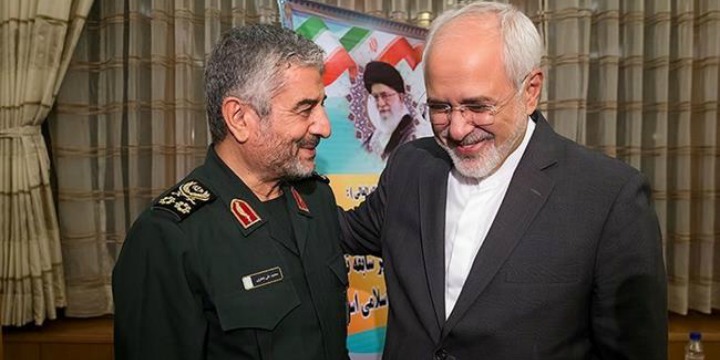
Iranian Foreign Minister Mohammad Javad Zarif (r) with Maj. Gen. Mohammad Ali Jafari, commander of the IRGC, in Tehran on October 9, 2017. Photo: Tasnim News Agency.
Iranian leaders communicated mixed messages over the weekend concerning their efforts to persuade the European Union to oppose tough US sanctions on the Tehran regime.
In an interview with Iran’s YJC news agency, Foreign Minister Javad Zarif – a key architect of the JCPOA, the 2015 nuclear deal rejected by US President Donald Trump in May – said that Iran was unhappy with the efforts of France, Germany and the UK to preserve the JCPOA, which provided Iran with massive relief from the international sanctions imposed after its clandestine nuclear weapons program came to light in 2003.
“What the Europeans have done until now is mostly talk political positions, rather than take practical steps,” Zarif said on Sunday.
He added: “If the deal really is an important security pact for the EU, then it should be prepared to accept the costs.” The Trump Administration has warned that countries who continue to trade with Iran after Nov. 4 – when a new round of banking and oil sanctions take effect – will face secondary sanctions.
Zarif’s interview appeared to contradict remarks made by Iranian Vice-President Eshaq Jahangiri on Saturday. In an interview with the regime’s official IRNA agency, Jahangiri claimed that it was the US, rather than Iran, who is “isolated.”
“Europe have ensured that the loss would be compensated by small and middle enterprises (SMEs) before the main US sanctions on oil and banking ties take effect,” IRNA quoted Jahangiri as saying.
IRNA said that Jahangiri has described “the international reaction to the US decision as a political achievement.” He added that “the Americans are now isolated since all countries, except for a few, have supported Iran’s position.”
IRNA said that Jahangiri had also stressed that “there has been no limit in doing business with Europe so far, including selling oil,” and that “some private European firms have left Iran with no great implication except for some agreements.”
Some of the world’s largest corporations, including oil giants Total and Lukoil, shipping company Maersk, airplane manufacturer Boeing, and mobile technology company Siemens, announced that they were pulling out of the Iranian market following the US withdrawal from the JCPOA.


