





The Israel-Hamas Deal: Escape From Oslo
Error: Contact form not found.

 by Gershon Hacohen

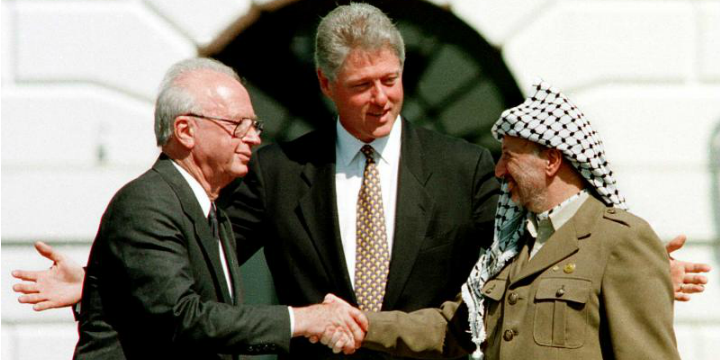
The signing of the Oslo Accords in Washington, DC, Sept. 13, 1993. Photo: Wikimedia Commons.
Both domestic and external opponents of the crystallizing deal between the Israeli government and Hamas view the nascent agreement as antithetical to the two-state solution. They argue that all of Gaza’s affairs, including the security issue, must be handled by the Ramallah-based Palestinian Authority (PA). By contrast, Prime Minister Netanyahu and Defense Minister Lieberman deem the preservation of the decade-long split between the PA-ruled West Bank and the Hamas-controlled Gaza Strip to be in Israel’s best interest.
Why, then, should the two keep their strategic goal hidden rather than spell it out? Because they wish to exploit to the full the strategic advantages of ambiguity. Astute strategy has always been built on craftiness, its hidden dimensions more important and significant than the overt. Real cunning is often manifested in a deal whose open dimension ostensibly involves unnecessary concessions or even losses, whereas beneath the surface it contains massive gains. In the words of the ancient Jewish Sages, “There is no blessing except for what is hidden from sight.”
To be sure, due to the need to disguise hidden motives and objectives, it is often difficult to respond effectively to criticism that focuses exclusively on the overt dimension of things. This is the position in which Netanyahu and Lieberman find themselves these days.
Knesset opposition leader Tzipi Livni has been attacking the Egyptian-brokered Israel-Hamas deal that bypasses the “moderate” PA President Mahmoud Abbas. This is how things appear to those who stubbornly adhere to the Oslo process, which will mark its 25th anniversary next month. But from the moment of its introduction some 80 years ago, the two-state solution did not have unequivocal Jewish support, not to mention its total rejection by the Palestinian Arab leadership from Hajj Amin Husseini to Abbas (despite the latter’s doublespeak on the issue). The decade-long split between Gaza and Ramallah may well be an obstacle to the realization of the Oslo process, but it is an opportunity for those wishing to extricate themselves from that disastrous path.
Those who adhere to the Oslo logic, as outlined by the Clinton “peace” parameters of December 2000 and accepted by prime ministers Barak and Olmert, describe the potential threat attending a failure to withdraw to the 1967 lines in dichotomous terms: “Either Israel will not remain a Jewish state or it will not remain a democratic state.” But in the meantime, there have been major developments that have put a question mark on this assertion, notably the transfer of 95% of the West Bank’s Palestinian residents and the entire Gaza Strip’s population to the PA and Hamas’ rule.
It is worth listening to Mahmoud Abbas, who opposes the deal. If such an eventuality is not favorable to Abbas, or, for that matter, to Muhammad Baraka, head of the Monitoring Committee of the Israeli Arabs, an organization that rejects Israel’s Jewish identity, then there must be something in it that holds hope for those seeking a new path. Ironically, extrication from the disastrous course set by the Oslo process has come to depend at this particular juncture on the emerging deal with Hamas.
Maj. Gen. (res.) Gershon Hacohen is a senior research fellow at the Begin-Sadat Center for Strategic Studies. He served in the IDF for 42 years. He commanded troops in battles with Egypt and Syria. He was formerly a corps commander and commander of the IDF Military Colleges. BESA Center Perspectives Papers, such as this one, are published through the generosity of the Greg Rosshandler Family.


