







Humanitarian Body: More Than 80,000 Yemeni Children May Have Died From Hunger
Error: Contact form not found.

 by Reuters and Algemeiner Staff


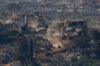
People walk past a house destroyed by an air strike in the old quarter of Sanaa, Yemen, Aug. 8, 2018. Photo: Reuters / Khaled Abdullah.
An estimated 85,000 children under five may have died from extreme hunger in Yemen since a Saudi-led coalition intervened in the civil war in 2015, a humanitarian body said on Wednesday, as the UN special envoy arrived in Yemen to pursue peace talks.
Western countries are pressing for a ceasefire and renewed peace efforts to end the disastrous conflict, which has unleashed the world’s most urgent humanitarian crisis with 8.4 million people believed to be on the verge of starvation.
Save the Children said that according to a conservative estimate based on United Nations data, approximately 84,700 children suffering from severe acute malnutrition may have died between April 2015 and October 2018 in the impoverished country, where a Western-backed Arab alliance is battling the Iranian-aligned Houthi movement that holds the capital Sanaa.
“We are horrified that some 85,000 children in Yemen may have died because of the consequences of extreme hunger since the war began. For every child killed by bombs and bullets, dozens are dying from hunger and disease and it’s entirely preventable,” it said in a statement.
The last available figure from the United Nations for the death toll from the conflict, seen as a proxy war between Saudi Arabia and Iran, was in 2016 and stood at more than 10,000.
The world body has not provided figures for the death toll from malnutrition but warned last month that half the population, or some 14 million people, could soon be on the brink of famine and completely relying on humanitarian aid.
The Armed Conflict Location & Event Data Project (ACLED), a database that tracks violence in Yemen, says around 57,000 people have been reported killed since the beginning of 2016.
The Saudi-led coalition intervened in Yemen in March 2015 to restore the internationally recognized government that was ousted from Sanaa in 2014 by the Houthis, who control the most populated areas of the Arabian Peninsula country.
But since seizing the southern port city of Aden in 2015, the coalition has faced a military stalemate and has been focusing on wresting control of the main port city of Hodeidah to weaken the Houthis by cutting off their main supply line.
No ceasefire yet
The coalition last week ordered a halt to military operations in Hodeidah, a lifeline for millions of Yemenis. A few days later the Houthis announced a halt to missile and drone attacks on coalition leaders Saudi Arabia and the United Arab Emirates along with their Yemeni allies.
However, Hodeidah has witnessed intense fighting in the past two days, mostly taking place at night, as each side tried to reinforce its positions during the de-escalation in hostilities.
“Loud bangs, shelling and gunfire could be heard all over the city until dawn,” a Hodeidah resident said on Wednesday.
A pro-coalition Yemeni military source told Reuters on Monday that a ceasefire in Hodeidah would start only after the UN Security Council passes a British-drafted resolution on Yemen.
Aid groups have warned against an all-out assault on the city, an entry point for more than 80 percent of Yemen’s food imports and humanitarian aid.
UN envoy Martin Griffiths arrived in Sanaa on Wednesday to meet with Houthi leaders to discuss convening peace talks in Sweden next month to agree on a framework for peace under a transitional government.
The Houthis failed to show up to peace talks in September. Kuwait has offered to provide planes for the parties to ensure the participation of both sides in Stockholm.
Griffiths faces a daunting challenge to overcome deep mistrust between all sides, including among allies, which makes any peace agreement fragile.
The draft resolution, seen by Reuters, calls for a halt to fighting in Hodeidah, a stop to attacks on populated areas across Yemen and an end to attacks on countries in the region.
It also calls for an unhindered flow of commercial and humanitarian goods across the impoverished country, including a large, fast injection of foreign currency into the economy through the Central Bank of Yemen and more aid funding.