






US Envoy Blames Houthis for Yemen Peace Deal Delays
Error: Contact form not found.

 by Reuters and Algemeiner Staff

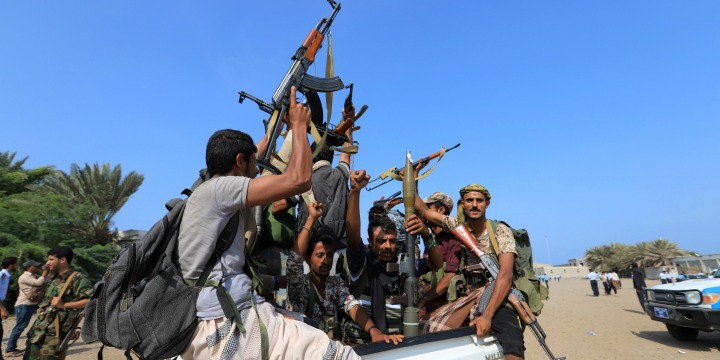
Houthi militants ride on the back of a truck in the Red Sea city of Hodeidah, Yemen, Dec. 29, 2018. Photo: Reuters / Abduljabbar Zeyad / File.
The US ambassador to Yemen blamed the Iran-aligned Houthi movement on Thursday for the stalling of a UN-led peace deal in the main port of Hodeidah and said the group’s weapons pose a threat to other countries in the region.
The Saudi-backed Yemeni government and the Houthis reached a ceasefire and troop withdrawal deal for Hodeidah, which is under Houthi control, at talks in Sweden in December. The pact was the first major breakthrough in efforts to end the four year war.
While the truce has largely held, the troop withdrawal by both parties has yet to materialize with each side blaming the other for lack of progress. The deal aimed to avert a full-scale assault on the port which is a lifeline for millions of Yemenis facing starvation.
“We are greatly frustrated by what we see as delays and stalling on the part of the Houthis in implementing what they agreed to in Sweden, but I have great confidence in the UN envoy and what he is doing,” ambassador Matthew Tueller told a televised news conference in the southern port of Aden, where the internationally recognized government is based.
“We are willing to work with others in order to try to implement these (Sweden) agreements and see whether the Houthis can in fact demonstrate a political maturity and start to serve the interests of Yemen rather than acting on behalf of those who seek to weaken and destroy Yemen,” he said.
Tueller said he had “not given up hope” that the deal would be implemented in Hodeidah, where thousands of Yemeni forces backed by a Saudi-led coalition are massed on the outskirts.
Tens of thousands of people have been killed in the war which pits the Houthis against other Yemeni factions backed by the Saudi-led coalition loyal to the government of Abd-Rabbu Mansour Hadi. The Houthis ousted Hadi’s government from power in the capital Sanaa in late 2014.
The conflict is widely seen in the region as a proxy war between Saudi Arabia and Iran. The Houthis, who control Sanaa and most population centers, deny being puppets of Tehran and say their revolution is against corruption.
The United States has sided with the Yemeni government against the Houthis and provides military support to the Saudi-led coalition, including help with targeting for Saudi air strikes.
‘Sever danger’ to region
The Sunni Muslim coalition twice tried to seize the port last year in a bid to weaken the Houthis by cutting off their main supply line. The United Nations and aid groups fear a full-on offensive may disrupt operations at the port that handles the bulk of Yemen’s imports and trigger mass starvation.
The alliance led by Saudi Arabia and the United Arab Emirates accuses Iran of smuggling weapons, including missiles which have targeted Saudi cities, to the Houthis. The group and Tehran deny the accusations.
Tueller said the United States was working with Yemeni authorities to prevent arms smuggling from Iran and to strengthen local security institutions.
“The fact that there are groups that have weapons, including heavy weapons and even weapons that can threaten neighboring countries, and those weapons are not under the control of the institutions of the state — this is a severe danger to the region as well as to Yemen,” he said.
The United States does not support groups that “seek to divide Yemen,” Tueller said, in an apparent reference to southern separatists whose forces have been taking part in coalition operations under the leadership of the UAE.
The complex war has revived old strains between North and South Yemen, formerly separate countries which united into a single state in 1990. A separatist leader warned this month that any peace deal that fails to address the south’s wish for self-determination could trigger a new conflict.


