










Setting Aside a Matzah for Israel’s Remaining Missing Soldiers
Error: Contact form not found.

 by Avi Weiss / JNS.org

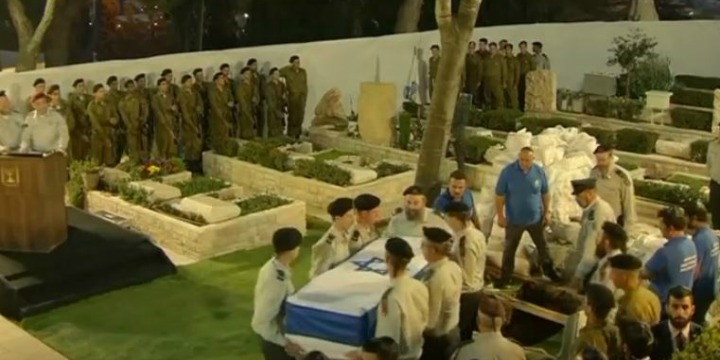
The funeral of missing IDF soldier Zachary Baumel, whose body was returned to Israel after 37 years, April 4, 2019. Photo: GPO screenshot.
JNS.org – Standing among thousands at the Mount Herzl Military Cemetery in Jerusalem, I felt that an important piece of my life was coming full-circle. For decades, I had led prayers and rallies imploring and demanding that Zachary Baumel, one of the Israeli soldiers missing in action from the 1982 Lebanon war, return home.
Together with Judy Lash Balint, head of AMCHA–the Coalition for Jewish Concerns, we organized rallies, vigils, and demonstrations all over North America on Zachary’s behalf. Often, his mother Miriam would speak. Never will I forget a talk she once gave at our synagogue.
“I believe,” she said, “my son is still alive. But with all my heart and soul, I would rather know the truth. I would rather know that he is dead than continue living in limbo.”
With her husband Yonah, they traveled the world, leaving no stone unturned, seeking any contact that could offer information about their son. Yonah died in 2009, never discovering the fate of his beloved son.
Zachary’s last letter to his parents was written during the ’82 war. He predicted that it would be a long time until he returned home. Never could he have imagined that it would be 37 years; he would be carried in a coffin to be laid to rest in a funeral with full military honors.
At his burial, Zachary’s sister Osna rose and declared that she was convinced that “the earth of Israel would embrace her brother.” She went on that when thinking about it further, she recognized that there was no need to make that request of the land; after all, Zachary had given his life for admat ha’aretz, “the Land of Israel.” The land would know on its own its obligation to embrace one of its heroes.
In her words: “There is absolute love between the son that gave everything for the land and the land itself, and there is a perfect union here. You are together now.”
Zachary’s homecoming was bittersweet, as it reminded us that our task is not yet complete. Missing in action with him were Tzvi Feldman and Yehuda Katz. Their whereabouts are unknown to this day.
During the 1980s and 1990s, AMCHA organized campaigns distributing dog tags and bracelets with the names of Zachary, Tzvi, and Yehuda, as well as Ron Arad, a young Israeli Air Force navigator who was missing in action.
We must continue this effort, adding the names Hadar Goldin and Oron Shaul, whom we know are dead but whose bodies Hamas, the brutal terrorist organization, refuses to return. We must also show concern for Avera Mengistu and Hisham al-Sayed, Israelis who wandered into Gaza never to be seen again.
For decades, too, we encouraged that a separate matzah be set aside at the Passover Seder, reciting this prayer:
This is the matzah of oppression inflicted on Israeli MIAs and on the remains of those who have not been returned for burial. We hold them all dear and shall strive with all our might to find them, to give them the dignity and honor and respect they rightfully deserve. We pledge our utmost to bring them to the day of deliverance.
At our Passover Seders this year, the same prayer must be recited for Tzvi, Yehuda, Hadar, and Oron.
During the campaign to free Soviet Jews, such a matzah of hope was set aside. We learned then that progress is possible only when world attention is captured and successfully focused on the issue at hand. Only then will international leaders be moved to act.
As Zachary’s brother recited Kaddish, throngs at Mount Herzl responded: “Amen.” He was finally home. But the “Amen” is incomplete, as others are still left behind. Their pictures should be displayed in the lobbies of our synagogues, Hillels, and JCCs. We must resolve that at every Shabbat morning prayer service, the names of those missing Israelis be mentioned.
And when we declare, “Next Year in Jerusalem,” we ought to hope that our MIAs who gave their lives for our homeland, experience the fulfillment of the words of the Prophet Jeremiah: “The children will return to their land — veshavu vanim li’gvulam.”
Jeremiah, of course, dreamt that the return be in life. Even if in death, however, the families of the MIAs and all of Am Yisrael should know that their loved ones were given the dignity of returning to our homeland to be buried with respect and honor.
Rabbi Avi Weiss is founding rabbi of the Hebrew Institute of Riverdale–the Bayit and founder of Yeshivat Chovevei Torah and Yeshivat Maharat Rabbinical Schools. He also serves as National President of AMCHA–the Coalition for Jewish Concerns.


