



Report: Iran Building Terror Network in Africa to Attack Western Targets
Error: Contact form not found.

 by Benjamin Kerstein

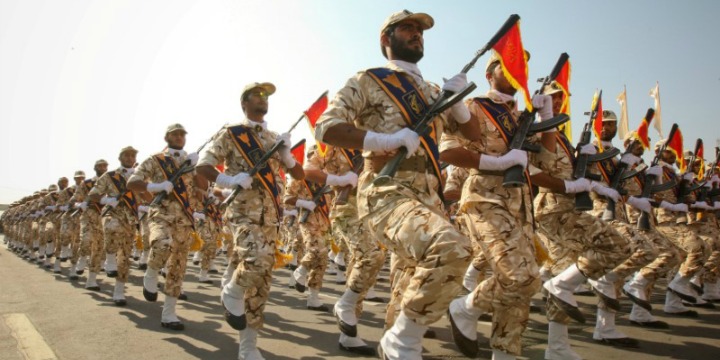
Members of Iran’s Islamic Revolutionary Guard Corps march in a parade in Tehran, Sept. 22, 2011. Photo: Reuters / Stringer / File.
Iran has established a terror network in Africa to strike American and other Western targets, it was reported on Tuesday.
UK daily The Telegraph quoted a “senior Western security source” as saying, “Iran is setting up a new terrorist infrastructure in Africa with the aim of attacking Western targets. It is all part of Tehran’s attempts to expand its terrorist operations across the globe.”
The network was said to be under the control of the Quds Force of the Islamic Revolutionary Guards Corps (IRGC), which conducts Iran’s foreign terrorist operations and is led by Qassem Soleimani.
It reportedly extended to countries such as Sudan, Chad, Ghana, Niger and Gambia, with potential targets including embassies, officials and military bases.
According to the report, the network was headed by the Quds Force’s elite Unit 400 under the command of Hamed Abdollahi, who has been fingered by the US as being involved in terrorist activity. Another senior member of Unit 400, Ali Parhoon, was said to be running the operation on the ground.
The existence of the network was revealed by an investigation in Chad. It found that Iran had recruited around 300 young men who were trained in terrorist activities in Syria and Iraq.
British officials believed that the network was set up after Iran signed a nuclear deal with the Obama administration and other Western powers in 2015.
The Telegraph stated that US diplomats had been warned about the terrorist threat, as had diplomats from other Western countries.
Iran has long sought a foothold in Africa to counter its relative isolation from the West and Far East. In 2016, The National Interest noted that from 2005-2013, then-Iranian President Mahmoud Ahmadinejad promoted the idea of a “South-South” strategy that sought to create a web of alliances in Africa and Latin America, to bolster the Islamic Republic’s international presence.
In 2010, Deutsche Welt noted that Iran was seeking economic and trade opportunities in countries such as Senegal, Nigeria, South Africa,and particularly Sudan, which shared Iran’s anti-Western ideology.
This push, however, failed, as many African countries ultimately chose to side with Iran’s adversaries in the West and the Arab world, particularly Saudi Arabia, including on the issue of the Tehran regime’s nuclear program and the sanctions against it.
In a 2013 article, The Tower noted that Iran also engaged in terrorist activity during this time. In 2010, Nigeria seized a massive weapons shipment bound for Iran, and in 2013 a Hezbollah cell was busted in the country.
Among Iran’s contacts in Nigeria was Sheikh Ibrahim Zakzaky, a prominent Shiite Islamist cleric promoted and funded by the Islamic republic, giving Iran influence over Nigeria’s Shiite community.
Most prominently, Iran used its African contacts to bolster its nuclear program, obtaining uranium overtly and covertly from Zimbabwe and Congo. It also sought to dodge sanctions by using Tanzanian ports for oil shipments.