


Saudi Arabia Promises Concrete Proof Iran Behind Oil Strikes
Error: Contact form not found.

 by Reuters and Algemeiner Staff

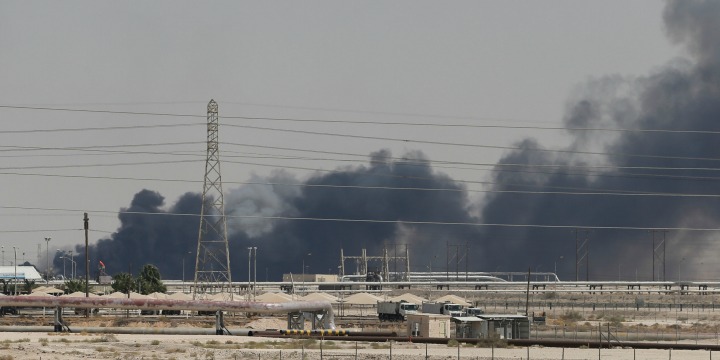
Smoke is seen following a fire at Aramco facility in the eastern city of Abqaiq, Saudi Arabia, Sept. 14, 2019. Photo: Reuters / Stringer.
Saudi Arabia promised evidence on Wednesday linking its main regional adversary Iran to an unprecedented attack on its oil industry, which Washington also blames on Tehran in a perilous escalation of Middle East frictions.
Iran, however, again denied involvement in the Sept. 14 raids, which hit the world’s biggest crude processing facility and initially knocked out half of Saudi production.
“They want to impose maximum … pressure on Iran through slander,” Iran’s President Hassan Rouhani said.
“We don’t want conflict in the region … Who started the conflict?” he added, blaming Washington and its Gulf allies for war in Yemen.
Yemen’s Houthi movement, an ally of Iran battling a Western-backed, Saudi-led coalition for more than four years, has claimed responsibility and said it used drones to assault state oil company Aramco’s sites.
However, the Saudi Defense Ministry said it would present “material evidence and Iranian weapons proving the Iranian regime’s involvement in the terrorist attack” at a news conference on Wednesday at 1430 GMT.
Whether Iran or an Iran-aligned group carried out Saturday’s attack, it still exposed the vulnerability of Saudi Arabia’s oil infrastructure and threw down a gauntlet to the United States which wants to curb Tehran’s influence in the region.
Concrete evidence showing Iranian responsibility, if made public, could pressure Riyadh and Washington into a response, though both nations were stressing the need for caution.
US President Donald Trump has said he does not want war and is coordinating with Gulf and European states.
Saudi Arabia’s Crown Prince Mohammed bin Salman said the hit on the world’s biggest crude exporter was a “real test of the global will” to confront subversion of international order.
His envoy to London, Prince Khalid bin Bander, told the BBC the attack was “almost certainly” Iranian-backed but: “We’re trying not to react too quickly because the last thing we need is more conflict in the region.”
‘Compelling evidence’
US Secretary of State Mike Pompeo was to meet Prince Mohammed in Jeddah on Wednesday to discuss the crisis before heading to the United Arab Emirates.
United Nations officials monitoring sanctions on Iran and Yemen were also heading to Saudi Arabia to investigate.
France, which is trying to salvage an international nuclear deal with Iran that Washington quit last year, said it wants to establish facts before reacting.
A US official told Reuters the strikes originated in southwestern Iran. Three officials said they involved cruise missiles and drones, indicating a higher degree of complexity and sophistication than initially thought.
The officials did not provide evidence or explain what US intelligence they were using for evaluating the attack that cut 5 percent of global production.
Saudi Arabia said on Tuesday the 5.7 million barrels per day of output lost would be fully restored by the end of the month.
Oil prices fell after the Saudi reassurances, having surged more than 20 percent at one point on Monday — the biggest intra-day jump since the 1990-91 Gulf War.
Saudi Arabia’s finance minister told Reuters on Wednesday the attack had no impact on revenues and Aramco was continuing to supply markets without interruption.
US efforts to bring about a UN Security Council response look unlikely to succeed as Russia and China have veto powers and are expected to shield Iran.
Russian President Vladimir Putin, who has offered to sell Riyadh defense systems, called for a “thorough and impartial” probe during a phone call with Prince Mohammed.
The assault exposed serious gaps in Saudi air defenses despite billions of dollars spent on Western military hardware and repeated attacks on vital assets during its four-and-a-half year foray into the Yemen war.
“The attack is like Sept. 11th for Saudi Arabia, it is a game changer,” said one Saudi security analyst.
Iran-US conflict
Already frayed US-Iran ties deteriorated further when Trump quit the nuclear pact and reimposed sanctions, severely hurting the Iranian economy. Iran has ruled out talks with Washington unless it returns to the pact.
Trump said he is not looking to meet Rouhani during a UN event in New York this month. Rouhani and his foreign minister may not attend the General Assembly at all if US visas are not issued in coming hours, state media reported Wednesday.
Washington and its Gulf allies want Iran to stop supporting regional proxies, including in Yemen, Iraq and Lebanon.
Despite years of air strikes against them, the Houthi movement boasts drones and missiles able to reach deep into Saudi Arabia, the result of an arms race since the Western-backed coalition intervened in Yemen in March 2015.
Iran’s clerical rulers support the Houthis, who ousted Yemen’s internationally recognized government from power in the capital Sanaa in late 2014. But Tehran denies it actively supports them with military and financial support.
Iran maintains the largest ballistic and cruise missile capabilities in the Middle East that could overwhelm virtually any Saudi missile defense system, according to think-tank CSIS, given the geographic proximity of Tehran and its proxy forces.
But even more limited strikes have proved too much for Saudi Arabia, including recent ones claimed by the Houthis on a civilian airport, oil pumping stations and the Shaybah oilfield.