








French National Assembly Set to Debate Antisemitism Resolution Amid Row Over Inclusion of Anti-Zionism
Error: Contact form not found.

 by Ben Cohen


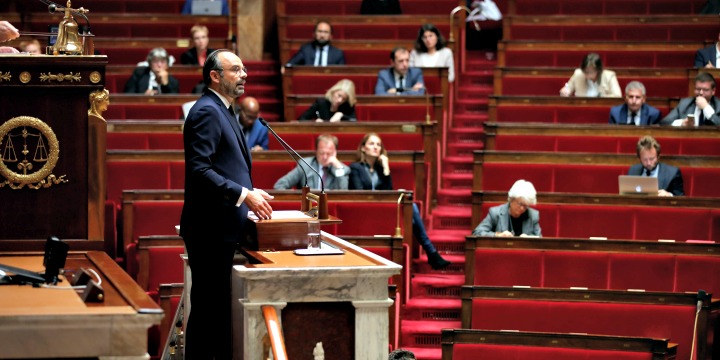
A session of France’s National Assembly. Photo: Reuters / Benoit Tessier.
The French parliament confirmed on Wednesday that it would discuss a resolution on the “resurgence” of antisemitism in the country that has so far been mired in political controversy, with critics of the text rejecting the inclusion of anti-Zionism among the “new forms” of Jew-hatred to have emerged more recently.
Originally scheduled for consideration last May, the National Assembly in Paris will now debate the resolution — proposed by Sylvain Maillard, the chair of the of the Assembly’s Study Group on Antisemitism — on Dec. 3rd.
At the heart of the resolution is a proposal to formally adopt the working definition of antisemitism used by the International Holocaust Remembrance Alliance (IHRA). The definition states that “manifestations [of antisemitism] might include the targeting of the state of Israel, conceived as a Jewish collectivity.”
The IHRA definition also cites as antisemitic many of the tropes promoted by anti-Zionist activists, such as “Denying the Jewish people their right to self-determination, e.g., by claiming that the existence of a State of Israel is a racist endeavor.” It asserts too that accusations that Jews are more loyal to Israel than to the countries in which they live, or that Israeli policy toward the Palestinians resembles the Nazi persecution of the Jews, constitute antisemitism.
While the IHRA definition has been adopted by dozens of governments, political parties and law enforcement agencies around the world — with Greece being the latest country to do so last Friday — several media outlets reported that there was reluctance among several French legislators to follow suit, because of concerns that criticism of Israel might encounter censorship.
However, the IHRA definition explicitly specifies that “criticism of Israel similar to that leveled against any other country cannot be regarded as antisemitic.”
The French newspaper L’Express reported on Wednesday that it had seen a revised version of text in which Maillard had “weighed his words more carefully.”
The paper said that the identification between anti-Zionism and antisemitism described in the original text was now expressed through the statement that “anti-Zionist acts can sometimes hide behind antisemitic realities.”
Speaking to L’Express, Maillard explained that he had wanted to find “a balance” in the text.
“There may be some anti-Zionist statements that are not antisemitic, but I want people to be aware of the reality that some will say ‘dirty Zionist’ when they mean ‘dirty Jew,'” he said.


