


Coronavirus and Muslim Clerics
Error: Contact form not found.

 by Edy Cohen

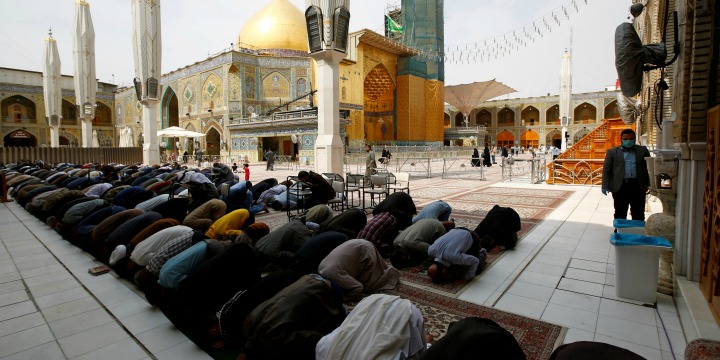
Shi’ite Muslim pilgrims pray at Imam Ali Shrine after Iraq’s Najaf authorities banned all non-residents visits, following coronavirus outbreak, in the holy city of Najaf, Iraq March 16, 2020. Photo: REUTERS/Alaa al-Marjani/File Photo.
On hearing initial reports of the deadly spread of coronavirus in China, many in the Arab world rejoiced. Arab social media threads called the virus Allah’s will to punish the Chinese for their cruel treatment of the Uighur Muslims of western China.
When the virus broke through China’s borders and landed in Iran, the Arab world was even happier. Images of Iran’s suffering as a result of coronavirus, and discussion of its rapid spread throughout the country, went viral on social media.
Again, many Arabs claimed this was Allah’s wrath, this time over Iran’s heinous treatment of Sunni Muslims in Iraq, Yemen, and Syria.
When the coronavirus first began infiltrating the wider Middle East after its initial outbreak in Iran, many in the Arab world thought it might be an Iranian conspiracy. Arab populations succumbed to widespread panic and fear. Governments throughout the region, scrambling to contain the virus, closed mosques and shut down most of society. Even Islam’s holy cities of Mecca and Medina closed their sacred sites — the first time public prayer has ceased in those cities since the time of Muhammad.
It’s hard to discern the current extent of coronavirus infection in these countries due to a lack of governmental transparency. Egypt and Jordan remain in complete denial about the threat of the virus, falsely telling their people and the world that they have yet to identify a single case.
The International Union for Muslim Scholars (IUM) released a religious edict forbidding Muslims from praying at mosques and calling on them to protect themselves from infection. The IUM urged Muslims to pray at home and stay away from holy sites.
On social media, it appears that many are placing their hope on Israel and the Jews to find a cure or develop a vaccine for the virus. A survey was distributed among Arabs asking whether they would purchase a vaccine developed in Israel. Placing their health first, the majority answered in the affirmative.
Iran’s Ayatollah Nasir Makarim Shirazi released a surprising statement on this matter. He said there is no prohibition in Islamic law against purchasing medicine or a vaccine from Israel, provided there is no other country from which to acquire it. In other words, the prohibition against doing business with the Zionist entity has exceptions.
In an unusual sermon, Jordanian MP, former minister, and lecturer at the University of Amman Muhammad Abdulhamid Qudah called the coronavirus a “soldier of Allah,” and said it had been sent to punish both the West and Muslims. He claimed Allah is angry with the world, especially Muslims, because they have failed to obey him.
Bashir bin Hassan, a controversial Salafist cleric in Tunisia, posted on his Facebook account, which has 500,000 followers, that the Chinese are being punished by Allah because of the siege they have set against the Uighur Muslims. According to the radical cleric, Allah has many soldiers, including both angels and viruses. He said that just as Allah drowned Pharaoh’s soldiers in the sea, he is similarly granting victory to the Uighurs.
Kuwaiti cleric Othman Khamis stated in a sermon on his YouTube channel that this is not the first time Allah has visited his wrath upon the world: he also sent a mosquito to kill Nimrod and unleashed the 10 plagues to punish the Egyptians. The coronavirus is thus another warning to humanity from Allah. The only solution is to return to him and follow his ways; only then will the virus disappear.
There is no doubt that coronavirus is a matter of serious concern not just to the West, but to the Arab world as well. Unfortunately, Muslim clerics are exploiting the precarious situation and inciting their constituencies throughout the region. They have millions of followers on their social media channels and can spread their messages to huge numbers of people very quickly. The clerics’ sermons have the ultimate purpose of instilling fear in their listeners to convince them to adopt a religious way of life.
Dr. Edy Cohen is a researcher at the BESA Center and author of the book The Holocaust in the Eyes of Mahmoud Abbas (Hebrew).
A version of this article was originally published by Israel Today and The BESA Center.


