




Netanyahu: ‘Very Strong’ COVID-19 Resurgence is an ‘Emergency Situation’
Error: Contact form not found.

 by JNS.org

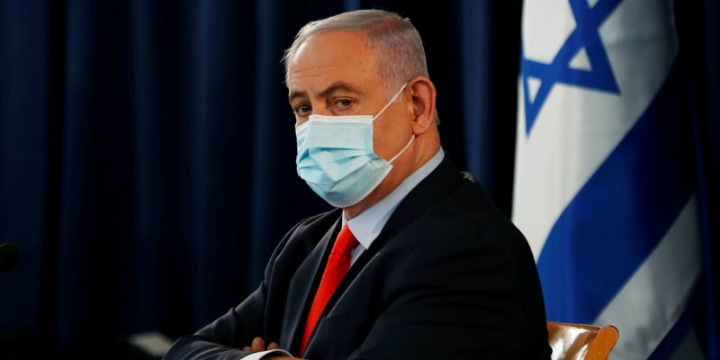
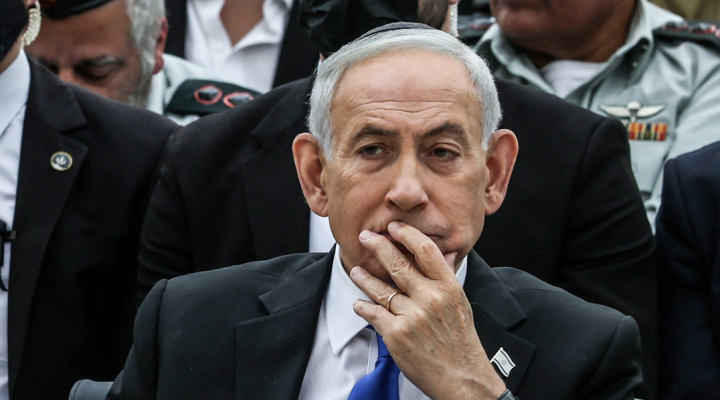
Israeli Prime Minister Benjamin Netanyahu wears a mask as he looks on during a weekly cabinet meeting, in Jerusalem, May 31, 2020. Photo: Reuters / Ronen Zvulun / File.
JNS.org – Israel is in the midst of a renewed, “very strong” resurgence of COVID-19 that will see “an increase and a doubling of the number of severe cases,” Israeli Prime Minister Benjamin Netanyahu said at the start of Sunday’s weekly Cabinet meeting.
“The World Health Organization has marked the Middle East as a focus of the global spread. This is not passing over Israel. It is here,” said Netanyahu, who added that the new outbreak posed a challenge for the state of Israel and its health system.
Four Israelis died of COVID-19 on Saturday, bringing the country’s death toll since the start of the pandemic to 330, according to the Israeli Health Ministry.
According to ministry data, there were 804 new cases recorded over the past 24 hours, bringing the total number of active cases in the country to 11,189, of which 86 are considered serious. There have been a total of 29,366 confirmed cases since the beginning of the outbreak, including 103 since midnight on Saturday.
Based on discussions with the health minister on Sunday morning and with other officials on Saturday night, said Netanyahu, “We must take additional steps beyond what the [coronavirus] Cabinet and the [Security and Diplomacy] Cabinet decided at the end of last week.”
If urgent action was not taken many Israelis would die, said the prime minister.
“We are in an emergency situation. We cannot approach Knesset legislation with the steps that we are taking, as if everything were normal,” said Netanyahu. “It is not, and it is on this basis that we want to advance both the means to make decisions and decision-making on a different scale and magnitude, in order to block the spread of the coronavirus. If we do not block the spread of the coronavirus, we will have neither health nor an economy; many citizens in the state of Israel will lose their lives.”
Therefore, said Netanyahu, there would be an additional Cabinet meeting this week to discuss both practical and legislative measures to address the crisis.
Meanwhile, on Saturday, the head of Israel’s Border Police tested positive for coronavirus, a spokesman from his office confirmed on Sunday.
Border Police commander Yaakov Shabtai had two days earlier attended a memorial service for those who fell during the IDF’s 2014 “Operation Protective Edge” in the Gaza Strip. Netanyahu, Israeli President Reuven Rivlin and Israel Defense Forces’ Chief of Staff Lt. Gen. Aviv Kochavi were also in attendance at the event, but according to the Health Ministry, none of the three will have to enter quarantine.
Nevertheless, Israeli Public Security Minister Amir Ohana decided on Saturday to self-quarantine, after meeting with Shabtai earlier in the week. At least two other senior Border Police officers who had been in contact with Shabtai also entered quarantine.
Amid the troubling COVID-19 surge in recent weeks, the IDF is considering canceling training for reserve soldiers, Israel’s Kan News reported on Friday.