




A Lesson of the Trump Presidency for Israel
Error: Contact form not found.

 by Eyal Zisser / Israel Hayom / JNS.org

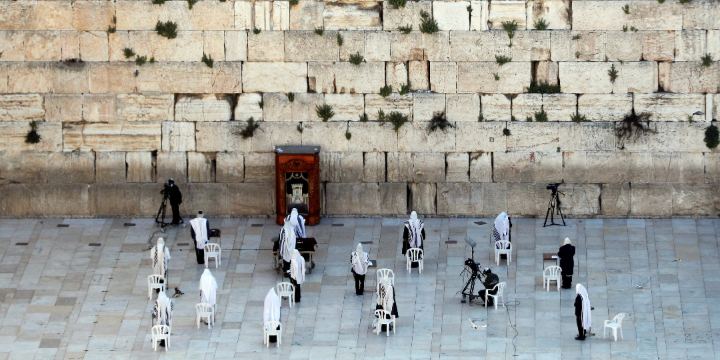
A small number of Jewish worshipers pray during the priestly blessing, a traditional prayer which usually attracts thousands of worshipers at the Western Wall on the holiday of Passover, amid the coronavirus disease (COVID-19) outbreak, in Jerusalem’s Old City, April 12, 2020. Photo: Reuters / Ronen Zvulun.
JNS.org – Although the media has hastily eulogized US President Donald Trump, he still has two more months in the White House, and it’s hard to imagine him letting them pass by without trying to leave one last mark. This pertains in particular to the Middle East, where his administration has notched more successes than anywhere else in the world.
Alongside advancing the peace process between Israel and the Arab world, Trump intensified pressure on members of the “axis of evil” — Iran, Syria, and Hezbollah — and brought them to the verge of economic collapse. Contrary to the advice from the experts and the policies of his predecessors, Trump adopted the dictum that “whatever can’t be achieved by force, can be achieved by more force,” thus forcing America’s enemies to backpedal.
In his final days in office, therefore, Trump can advance a series of measures that will determine his legacy in the region and shape the long-term face of the Middle East, perhaps beyond 2024 when he can again vie for the presidency.
Beyond getting more Arab countries to sign peace treaties with Israel, Trump could promote unilateral moves in the Palestinian arena, which would create facts on the ground and make it easier for the Jews and Arabs of Israel to make peace down the road. American recognition of Israeli sovereignty in the large settlement blocs, or taking the Palestinian refugees’ “right of return” off the table, would be consistent with the moves he’s already made and position the region, even at the Palestinians’ chagrin, at a more convenient and realistic starting point for achieving a real peace.
Trump could also amplify the already devastating pressure on Iran, Syria, and Hezbollah in a way that would bury Iran’s machinations even deeper. After all, in one fell swoop — the assassination of Quds Force commander Qassem Soleimani a year ago — Trump struck a serious blow to Iran’s capabilities. He needn’t shy away, therefore, from harsh measures that will devastate Iran and its allies, and neutralize, even for just a few years, their ability to inflict damage on others.
It’s possible, however, that Trump’s most significant contribution to Israel upon his departure is forcing it to revert to and strengthen the foundational principle of Israel’s foreign affairs and defense policy, whereby “Israel can and must rely only on itself.”
Washington was and will continue to be Israel’s closest friend and ally, but it was President Trump who openly stated what Americans believe in their hearts: We give Israel generous economic assistance so that it can defend itself and won’t need American soldiers to fight on its behalf. Indeed, we all know that when the moment of truth comes, Israel will only have itself and its capabilities to rely on.
This is an important lesson for Israel, coincidentally delivered by such a friendly administration. Ultimately, the Americans have their own interests and considerations, which will always come before Israel’s interests. There’s also a difference between friendship and even reliance. It was former Prime Minister Menachem Begin who said, at the height of a severe disagreement with the Reagan administration, which was unquestionably friendly to Israel in its own right, that Israel cannot become a vassal state that blindly acquiesces to Washington’s every dictate, and must pursue its own interests even if it means “fighting with friends” in the United States.
Eyal Zisser is a lecturer in the Middle East History Department at Tel Aviv University. This article first appeared in Israel Hayom.


