




Invisible Blockade: the Media Is Silent on the Palestinian Authority’s Gaza Sanctions
Error: Contact form not found.

 by Gidon Ben-Zvi

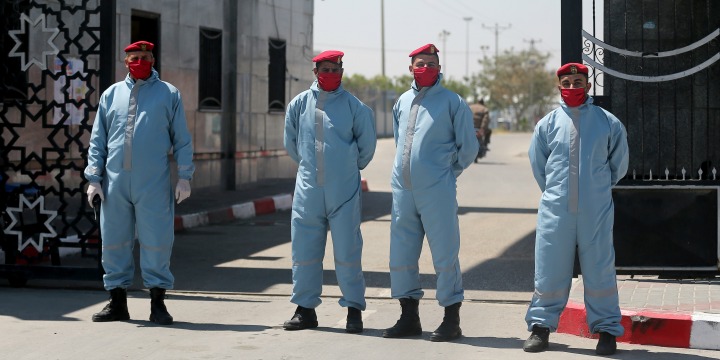
Hamas members wear protective gear as a precaution against the coronavirus disease (COVID-19), at the Rafah border crossing in the southern Gaza Strip, April 13, 2020. Photo: Reuters / Ibraheem Abu Mustafa.
Ever since Palestinian Authority (PA) President Mahmoud Abbas issued a decree for parliamentary and presidential elections to be held for the first time in over 15 years, major news organizations have ignored the fact that Ramallah long ago imposed crippling sanctions on the Gaza Strip, which have been to the serious detriment of its 1.8 million residents.
Instead, the precarious conditions in the Palestinian coastal enclave continue to be reflexively attributed to the joint Israeli-Egyptian blockade. The Abbas-induced forced welfare cuts and slashing of funding for electricity — among other punitive measures — in Gaza have gone largely unreported by the vast majority of international media outlets.
Not so for some local journalists, such as Khaled Abu Toameh, who recently tweeted a reminder of the true state of affairs:
https://twitter.com/KhaledAbuToameh/status/1353592792380043264
But Abbas has basically been given a free pass, even as nearly two million Palestinians have been paying the price for the political rivalry between his ruling Fatah faction in the West Bank and the Hamas Islamist terrorist group in Gaza. This blood feud dates back to 2006-2007, when Abbas was ousted from the enclave in an internecine war.
In response, the Palestinian Authority began ratcheting up economic pressure on Hamas by making life more difficult for Gazans; including, for example, by banning banks in the West Bank from transferring money to residents in the Strip. Indeed, human rights groups have documented arrests due to such “illegal” activity.
Abbas has similarly refused to deliver international aid intended for Gaza.
All this happened while the PA kept paying tens of thousands of its Gaza-based employees, despite most of them not having worked since Hamas seized control of the territory in 2007. Then, these salaries were suddenly cut in 2018. Around the same time, Abbas also slashed the salaries of thousands of Gaza’s civil servants and required many others to leave their jobs.
This has, as a corollary, contributed to the high unemployment and poverty rates in Gaza.
In March 2018, US special envoy Jason Greenblatt organized a conference at the White House to discuss possible solutions for alleviating the situation in Gaza. Abbas shunned the initiative and also rebuffed a request by Nickolay Mladenov, then-UN Special Coordinator for the Middle East Peace Process, for a tete-a-tete.
Three months later, a series of demonstrations demanding an end to the PA’s Gaza sanctions broke out in cities across the West Bank. While the PA’s crackdown on protesters was widely condemned in Palestinian and Arab media, international news organizations were again relatively silent, especially regarding the violence employed by Palestinian forces.
Mahmoud Abbas’ tactics appear to be geared toward fomenting unrest in Gaza through economic strangulation. Nevertheless, recent news coverage about prospective Palestinian elections has glossed over the PA’s ongoing policy of collective punishment.
In fact, international media outlets for the most part continue to portray Abbas as a “moderate” and thus Israel’s best potential peace partner. But the full picture, as is generally the case, is much more complex. That the PA president has inflicted harm upon his own people runs counter to the accepted, if deeply flawed, narrative.
By uniquely blaming Israel for the plight of Gazans, a significant story has been buried about the man who still seeks to lead the Palestinian people.
Gidon Ben-Zvi is an accomplished writer who left behind Hollywood starlight for Jerusalem stone. After serving in an IDF infantry unit for two-and-a-half years, Gidon returned to the United States before settling in Israel, where he aspires to raise a brood of children who speak English fluently — with an Israeli accent. In addition to writing for the Algemeiner, Ben-Zvi contributes to the Times of Israel, the Jerusalem Post, and CiF Watch, and blogs at Jerusalem State Of Mind.
A version of this article was originally published at HonestReporting.


