





How Tyrants Rise to Power
Error: Contact form not found.

 by Alan Zeitlin

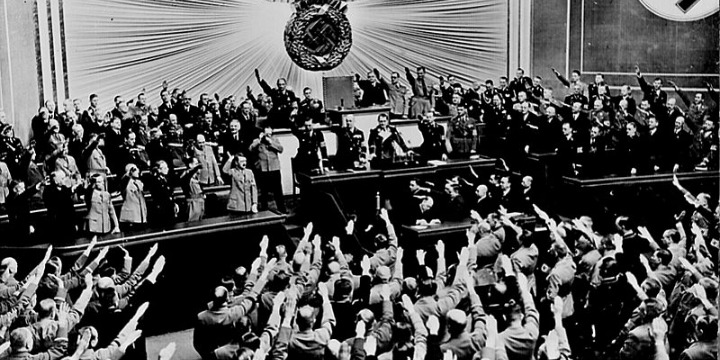
Nazi leader Adolf Hitler accepts the ovation of the Reichstag after announcing the ‘peaceful’ acquisition of Austria, in Berlin, Germany, March 1938. Photo: Wikimedia Commons.
Netflix’s “How to Become a Tyrant” is an exceptionally interesting series that examines how evil leaders like Adolf Hitler, Idi Amin, Saddam Hussein, and Muammar Gaddafi took and kept power. In each episode, a leader is examined, and the series explains how they employed the “tyrant’s playbook” to seize control of their nations.
In the first episode, one historian says: “It’s very easy for us to sit back and say ‘I would, you know, never fall for the seductive charms of a tyrant like Hitler.” But, he continues, “I promise you, you would.”
While it’s true to say that many Germans did support Hitler — and one could also argue that many people today, were they transported back into that time period, would support Hitler again — how dare he make such a sweeping generalization?
Many Germans did oppose Hitler — though far too many did so privately, and refused to publicly stand up due to fear of their own safety.
The episode paints the picture of Hitler as a man who was an expert at branding, and told the people what they wanted to hear — namely that the failure of Germany was not their fault, but due to a conspiracy by the Jews. Although people didn’t believe him at first, Hitler also promised to destroy the Jewish people.
If a similar leader emerged today and promised to eliminate an entire group of people, it’s highly unlikely that people in America and Western Europe would “fall” for this.
The best episode in the series is the one about Iraqi leader Saddam Hussein, and the horrific ways that he manipulated power. For example, Hussein told one government official that he could either see his wife raped and murdered — along with their children — or give a false speech claiming that he tried to overthrow the government. The man opted for the second choice, and as several hundred officials gathered, he would read off names of men, who would be led outside and shot in the head.
The series also shows how both Idi Amin of Uganda and Muammar Gaddafi of Libya tried to appear like common people — the former by initially driving himself is his own car and the latter by insisting in staying in tents when he traveled rather than lavish hotels. But unlike common people, they also engaged in torture, mass murder, and horrific human rights abuses to maintain their hold on power.
All in all, the series, which is narrated by Peter Dinklage, is compelling and expertly done — but the comment that most people would fall for Hitler was misguided and ill-advised.
The author is a writer and educator based in New York.


