











Dr. Shuki Friedman is the vice president of the Jewish People Policy Institute (JPPI) and a lecturer of law at the Peres Academic Center.
Elect Judges, Not Party Loyalists
×
Error: Contact form not found.

 by Shuki Friedman / JNS.org
Opinion
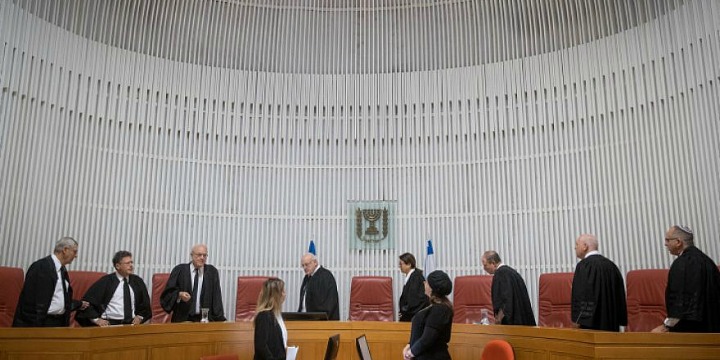
Supreme Court justices and president Esther Hayut arrive to the courtroom of the Supreme Court in Jerusalem. Photo: Yonatan Sindel/Flash90.
JNS.org – When Israeli Justice Minister Gideon Sa’ar published the list of candidates for the Supreme Court, ahead of the expected appointment of four new judges, a major public uproar promptly ensued. Journalists, politicians, myriad organizations and the Twittersphere began the witch hunt, painting each candidate in political colors of “friend” or “foe.”
This cacophony is not only repugnant; it’s dangerous. Though imperfect, the Israeli legal system is a professional and glorious one. Its blatant politicization would undermine the professionalism of judges and their ability to fulfill their central role: administering justice.
The Supreme Court, which wears two hats as both an appellate court and the High Court of Justice (HCJ), is the apex of the Israeli legal system. The heart of the justices’ task is to render decisions that extend to all areas of the law.
Israel’s Supreme Court has a crazy workload. To put it starkly, in 2020, some 9,231 cases were opened and 8,942 were closed. The number of cases left pending was 3,359.
One should keep in mind that a mere 15 judges are tasked with these thousands of cases. By contrast, the nine US Supreme Court justices deal with an average of around 80 cases a year.
In recent years, in the eyes of many Israelis, the Court, once the last bastion of professionalism and justice, has become the long arm of politicians. Are they from the right or the left? The answer, of course, depends on whom one asks.
The right sees the Court as a liberal stronghold that serves the left even when it is not in power. The left sees it, in many cases, as an instrument of the Zionist-right-wing conservative state. Right-wingers regard the judges as power-hungry activists who want to usurp control of important political decisions and crumble the Jewish nation-state. Leftists see them as nationalists who have abandoned Israel’s minorities and the residents of the territories, leaving them at the mercy of a racist and cruel state.
These distorted perceptions are reflected in the discourse surrounding Supreme Court appointments. A foreigner visiting Israel who read last week’s newspapers might very well have had the impression that this is a race for a key political office, not for the highest-level judicial-professional position in the land.
As soon as the list was published, a mad demonic dance began around the candidates. Each of them, in some cases rightly, and in many others—out of unfairness or ill will—was labeled as right or left, conservative or activist, patriot or traitor.
For some commentators, an old, out-of-context quote of a candidate’s particular interpretation was sufficient to disqualify him or her and negate his or her complexity and abilities in favor of a one-dimensional political label.
Consideration of the candidates’ bona fides—their performance as judges, their professional work and their writings as jurists—was relegated to a very meager place, if factored in at all.
The nature of the public discussion around the candidates and the reckless pronouncements about the legal system are a disaster for the state. I’m not naïve. The Israeli Supreme Court has in recent decades ruled on a number of high-profile ethical issues. In some cases, it seems that the Court has indeed breached the boundary of politics, which does not speak well of the country or the Court.
And yet, anyone familiar with the work of the Supreme Court and its justices—or anyone who has read its rulings, even the controversial ones—knows that Supreme Court justices often have no choice but to issue their rulings, as in many cases, politicians fail to make their own decisions.
When this happens, the judges act with legal-professional depth, not in accordance with a personal ideological agenda, their own or that of those who appointed them. Beyond that and no less important, the vast majority of the work of Supreme Court justices is a Sisyphean grind of daily legal work, of nitty-gritty decisions in legal disputes, rather than “glamorous” political issues.
The members of the Judicial Selection Committee would do well to examine the candidates on the basis of professional criteria and legal prowess—to conduct a comprehensive review of their professional activities, both legal and academic, and not on the basis of reductive labels designed to torpedo their nominations.
The opinions presented by Algemeiner bloggers are solely theirs and do not represent those of The Algemeiner, its publishers or editors. If you would like to share your views with a blog post on The Algemeiner, please be in touch through our Contact page.


