





New York Times Hires Journalist Who Blamed Israel for Palestinian Suicide Bombers
Error: Contact form not found.

 by Emanuel Miller


The New York Times logo. Photo: Wikimedia Commons.
The New York Times is once again facing tough questions about its objectivity and impartiality regarding its coverage of Israel.
It recently emerged that one of the Times‘ newest hires previously sought to justify and excuse terrorism against Israel — and, more specifically, blamed Israel for the actions of Palestinian suicide bombers who murdered hundreds of Israelis in the 2000s.
On November 3, the Times announced that it was welcoming a new reporter to its Jerusalem bureau. The press release on the Times’ website described Raja Abdulrahim as an “experienced foreign correspondent,” a “native Arabic speaker,” and a “strong storyteller and writer.”
But that’s only part of the story.
In June 2002, while a junior at the University of Florida, Abdulrahim penned a guest column for the school newspaper the Florida Independent Alligator titled, “Palestinians driven to bombing,” in which she claimed:
Another suicide bomber has attacked and the finger pointing has begun in every direction. But the fact is that the finger belongs not on the Palestinian Authority or some “Islamic militant group,” it belongs squarely on Israel and the Israeli Defense Forces.
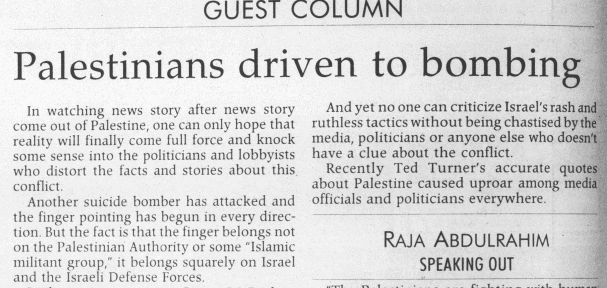
This column was written during the most intense period of Palestinian suicide bombings in Israel.
Between 2000 and 2005, 141 suicide attacks claimed the lives of 587 people. In 2002 alone, there were no less than 47 lethal suicide bombings, which left 238 people dead and many more injured.
Among those killed were Holocaust survivors and pregnant women along with their unborn babies, because Palestinian terrorists deliberately targeted civilians. They struck buses, cafes, discos, shopping malls, and busy streets in a bid to kill as many Israelis as possible.
And yet, Abdulrahim sought to blame Israel — not the Palestinian Authority government or Palestinian terror groups such as Hamas — for the carnage.
There is a term for this: Victim-blaming.
And for Abdulrahim, this was not an isolated occurrence. In September 2001, just weeks after the 9/11 attacks, she wrote a letter published in the Independent Florida Alligator contending that it would be erroneous to refer to Hamas and Iranian-backed Hezbollah as “fundamentalist” or “terror organizations.”
She continued by downplaying barbaric violence, risibly suggesting that these groups “are not ‘terrorizing’ Israelis, they are just defending their land and lives.”
In the same letter, Abdulrahim started a paragraph thus: “Ever since its occupation in 1948, Israel has killed innocent Palestinians…”
This phrase is deeply troubling, because it suggests that the formation of Israel resulted in the “occupation” of land it had no rightful claim to. And that is clearly not the case.
Does Abdulrahim believe that the Jewish people have a right to self-determination within any borders in the Land of Israel?
Will Abdulrahim Respond?
While the articles written by Abdulrahim date back two decades, it is important for her to at the very least address them, now that she has been given a regular platform at the New York Times to report on Israeli-Palestinian affairs.
If these were the words of a hot-headed, opinionated student, whose views were not yet fully formed, then she should say so, clearly and swiftly. If Abdulrahim now sees the world differently, it is imperative for her to reassure readers.
However, despite calls on social media for her to do just that, Abdulrahim has thus far remained silent.
Please, please tell me that those were the words of an overzealous teenager, and that you no longer believe this, @RajaAbdulrahim.
Because from here these statements sound like inexcusable victim-blaming and your impartiality and objectivity is called into question.
— (((Emanuel Miller))) (@emanumiller) November 5, 2021
But the buck does not stop with Abdulrahim.
Over the past year, HonestReporting has revealed numerous examples of contributors, essayists, and journalists working for well-known news outlets who have espoused anti-Israel and antisemitic views. Many have conflated terrorism with “resistance,” or sought to explain away violence directed against Israeli civilians. At least one journalist repeatedly compared Israel with the Nazis.
And the problem is not limited to traditional media either.
Just last week, HonestReporting documented how Twitter’s new Editorial Curator Lead for the Middle East and North Africa, Fadah Jassem, has a history of anti-Israel tweets, including at least one which apparently cited the notorious antisemite Louis Farrakhan.
After HonestReporting and others pushed for an explanation, Jassem issued an apology.
It is clear that lessons need to be learned: as a matter of basic policy, news outlets including the New York Times, the BBC, and others need to stop acting as megaphones for those who espouse anti-Israel or antisemitic views, especially when the ostensible job of such individuals is to report objectively on issues related to the Jewish state.
Until then, the integrity of the media as a whole is liable to be comprised.
Emanuel Miller is a writer-researcher for HonestReporting, a Jerusalem-based media watchdog with a focus on antisemitism and anti-Israel bias, where a version of this article first appeared.


