



The Murder of American Jewish Soldiers
Error: Contact form not found.

 by Mitchell Bard

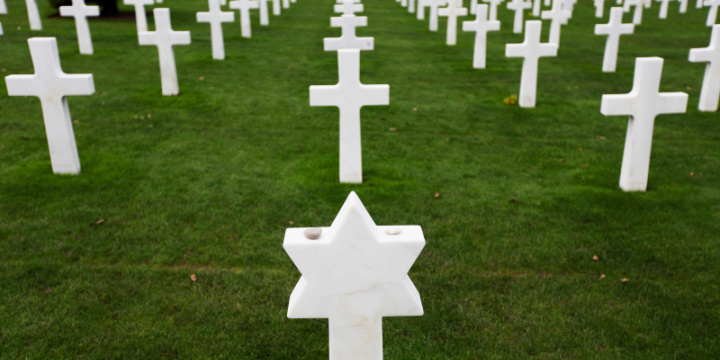
A Jewish headstone stands amid crosses at the American Cemetery and Memorial at Colleville-sur-Mer in Normandy, October 11, 2009. Reuters /Finbarr O’Reilly / France Conflict Anniversary Society
Approximately 600,000 Jews served in the United States armed forces in World War II. More than 35,000 were killed, wounded, captured, or missing. Approximately 8,000 died in combat. Those soldiers were casualties of war, but there were others among those who were captured who became victims of the Holocaust — singled out for death because they were Jews.
I documented many of the cases, as well as what the US government did and did not do to help the survivors or punish the perpetrators, in “Forgotten Victims: The Abandonment of Americans in Hitler’s Camps.” I recently ran across another story in which two Jewish soldiers were murdered — and, in this case, the perpetrator received the punishment he deserved.
On December 20, 1944, about 300 US soldiers were captured near Bleialf, Germany, by the Germany Army, along with 30 Germans who had been prisoners of the Americans. They were marched to the customs house, where two of the Germans informed the commander of the battalion, Captain Curt Bruns, that two Jewish soldiers who spoke good German and interrogated them were among the captives.
The trial record does not explain how the Germans knew the Americans were Jews. Jewish GIs were sent into battle with an “H” on their dog tags to identify them as “Hebrews,” despite the government’s knowledge of the “Final Solution,” and the risk to them if they were captured. The ostensible reason was so the correct chaplain could be called if a soldier was wounded or killed.
It’s unlikely the German POWs would have seen their interrogators’ tags. There is no doubt, however, about the attitude of Captain Bruns, who said, “The Jews have no right to live in Germany,” before summoning the prisoners.
Meanwhile, the rest of the prisoners were marched in the direction of Bleialf.
The two Jews who had been detained, Staff Sergeant Kurt Jacobs and Technician Fifth Grade Murray Zappler, should have been treated as prisoners of war. Instead, they were marched down the same road where they were shot beside the road.
It was not until February 13, 1945, that an American soldier found the bodies of the two men in a small hole. They were lying on their backs.
A trial was held in Luren, Germany, on April 7, 1945, before a Military Commission that charged Brun with the violation of the laws of war.
Margarethe Meiters lived in the customs house, and gave a sworn statement that a German lieutenant told her, “today we have captured a large number of Americans again. In Germany, there isn’t room for captured Negroes or Jews. Today we shot two Jews. … They were shot because the captured German prisoners identified them as two who had questioned them.” He then pointed to the place where they were killed.
Another prosecution witness, Anton Korn, a German POW, testified he was placed in a cell with Bruns in February 1945. The captain said he had sworn a holy oath to himself that if the war was won or lost, he was going to shoot every Jew in Germany.
Bruns testified that the first he heard of the men being shot was from a phone call from the regimental adjutant, and denied that he had given the order to kill them.
The German who had been in American hands and then identified the two Jews when he was recaptured testified that after the other soldiers were marched away, Bruns spoke to a sergeant who selected a firing squad of five or six officers. He said Bruns was at the customs house at the time that the Jews were executed, and insisted that he had not heard Bruns order the prisoners to be killed.
The court did not find Bruns’ claim that the regimental commander had given the execution order credible, because he arrived after the prisoners had been marched away.
Bruns was not accused of directly being involved in the execution, but he was charged with causing their murder. The evidence against him was circumstantial, but the commission found it sufficient to render a guilty verdict. The prosecution noted that all war crimes may be punished with death, and that the deliberate and unlawful murder of the prisoners in this case merited that penalty.
Bruns was executed on June 6, 1945.
Kurt Jacobs and Murray Zappler were not the only American Jewish POWs murdered by the Germans. And their stories deserve to be told.
Dr. Mitchell Bard is the director of the Jewish Virtual Library and a foreign policy analyst who has written/edited 22 books, including “The Arab Lobby: The Invisible Alliance That Undermines America’s Interests in the Middle East.”