


The War on Hillel
Error: Contact form not found.

 by Michal Cohen

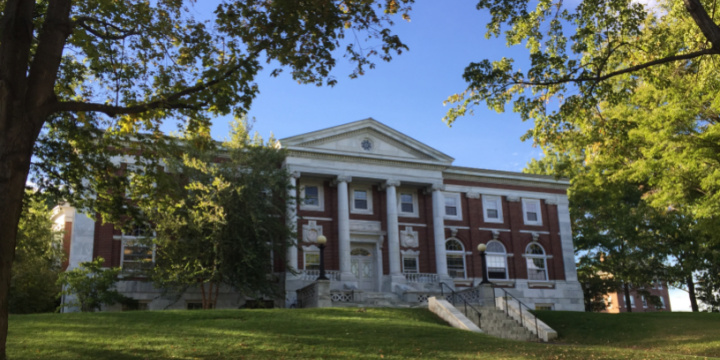
Eaton Hall at Tufts University in Medford, Massachusetts. Photo: Jellymuffin40/Wikimedia Commons
Student groups across the nation have waged war on Hillel in the name of justice and equality, even though Hillel acts as the largest Jewish student organization on campuses worldwide and is a hub for Jewish students by providing kosher meals, religious services, and safe spaces for Jewish students.
Hillel represents Jewish life on campus, and efforts to boycott Hillel go beyond any fair criticism of Israel, and well into pure antisemitism and Jew hate.
At Tufts University, Students for Justice in Palestine (SJP) called for the boycott of Hillel due to Hillel’s efforts to normalize dialogue between Israelis and Palestinians, and to present views of the conflict in a nuanced and multifaceted way.
According to SJP Tufts, promoting any semblance of normalization with Israel, such as through dialogue or advocating for a two-state solution, implies that Israel has a future in the region. But SJP doesn’t want Israel to exist.
While Tufts SJP released their statement opposing Israel’s existence, Israelis saw a wave of terror, where more than a dozen Israelis were murdered. Labeling those murders as “resistance” highlights the apathy that SJP has towards Israeli and Jewish life.
At American University, the Muslim Student Association (MSA) pulled out of an Interfaith Seder with Hillel, due to rising tensions in Israel, and Hillel’s support of a Jewish homeland. Not only is MSA applying a litmus test to their Jewish peers, but they are blaming the American University Jewish community for a conflict taking place halfway across the world — a conflict that Jews in the Diaspora have no control over.
Ninety percent of Jews support Israel’s right to exist. And while the MSA believes that boycotting over 90% of the Jewish community is a valid form of “criticism of Israel,” refusing to work with an organization central to Jewish life on campus is the denial of Jewish identity. But, as usual, Jews aren’t afforded the same treatment of any other minority group on campus.
At the University of Illinois at Urbana-Champaign, SJP protested the actions of the Israeli government at the Al-Aqsa Mosque. Eventually, they stopped directly in front of the Hillel building, where an object was thrown through one of Hillel’s windows. When asked why the protest stopped outside the Hillel building, a protester claimed that Hillel has “a very direct connection to Israel, and that’s why we’re targeting that area in specific.”
Targeting a Jewish organization whose stated mission is to support Jewish students worldwide is not only antisemitic, but scapegoats the Jewish community in the Diaspora for the actions of a foreign government.
Labeling Hillel a pariah on campus and claiming the Jewish community in the Diaspora influences the actions of the Israeli government won’t solve the Israeli-Palestinian conflict; instead, it will continue to push Jewish students out of campus life.
Universities grappling with the alarming rise of antisemitism all have the same response: look the other way in hopes that the student body moves on. Administrators can either sit by and let it happen, or they can act against systemic antisemitism plaguing campuses nationwide.
Michal Cohen is the Chief Marketing Officer of Jewish on Campus.


