






EU Not Ready to Agree on Russia Oil Ban, Leaders Say
Error: Contact form not found.

 by Reuters and Algemeiner Staff

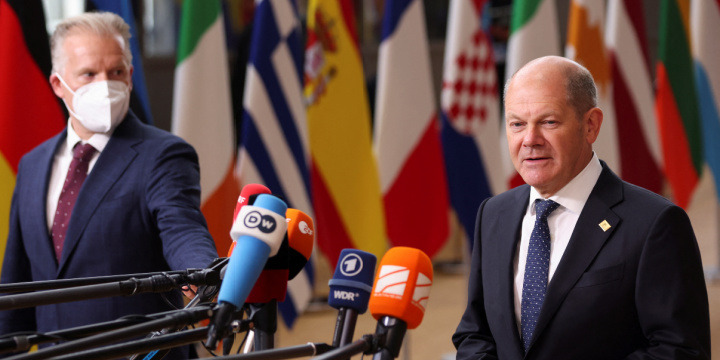
German Chancellor Olaf Scholz speaks to media as he arrives for the European Union leaders summit, as EU’s leaders attempt to agree on Russian oil sanctions in response to Russia’s invasion of Ukraine, in Brussels, Belgium May 30, 2022. REUTERS/Johanna Geron
European Union leaders will fail to agree on a Russian oil ban at a summit on Monday and Tuesday in Brussels, leaders said as they arrived, adding that weeks of haggling over the matter were not over even if they were hopeful for a deal later.
For sure, the leaders are set to agree in principle over a ban, a draft text showed, but they will leave all the details and hard decisions for later.
“We’re not there yet,” European Commission President Ursula von der Leyen said.
Estonian Prime Minister Kaja Kallas said it was more realistic to expect an agreement next month.
“I don’t think we’ll reach an agreement today. We’ll try to reach an agreement by the summit in June, this is the realistic approach by now,” Kallas said.
The next summit is scheduled for June 23-24.
Some complained harshly over the lack of deal.
“We’re getting a little bogged down in all of the details and we’re forgetting the big picture,” Latvian Prime Minister Krisjanis Karins said.
“It’s only money, the Ukrainians are paying with their lives,” he said, adding: “We can and we must support them, if only out of self interest because only when Russia is defeated can we in Europe feel safe.”
A draft text seen by Reuters — which may still be revised again — would confirm that an eventual sixth package of EU sanctions will include a ban on seaborne oil imports, with pipeline oil supplied to landlocked Hungary, Slovakia and the Czech Republic to be sanctioned at some later point.
However, the leaders will not finalize a deal on this now but, instead, they will ask diplomats and ministers to find a solution that would also ensure fair competition between those still getting Russian oil and those cut off.
Belgian Prime Minister Alexander De Croo said “these are not easy decisions,” adding: “I have no doubts that within the next days, the next weeks, decisions will be taken.”
With Hungary being the main holdout on a deal on a Russian oil ban, its prime minister, Viktor Orban, said as he arrived at the EU summit that things were not looking good on an oil embargo.
“There is no compromise for this moment at all,” Orban said. “We are ready to support the package … if there are solutions for the Hungarian energy supply security, we haven’t got that now.”
One tangible outcome of the summit should in any case be agreement on a package of EU loans worth $9.7 billion, with a small component of grants to cover part of the interest, for Ukraine to keep its government going and pay wages for about two months. However, a decision on how to raise the money will be made later.


