



BBC Radio Show Says Israel Is ‘Occupied Palestine’
Error: Contact form not found.

 by Hadar Sela

The BBC logo is seen at the entrance at Broadcasting House, the BBC headquarters in central London. Photo by Vuk Valcic / SOPA Images/Sipa USA.
The November 2 edition of the BBC World Service radio program “OS” (formerly known as “Outside Source”) led with an item (from 00:04 here) concerning the previous day’s general election in Israel.
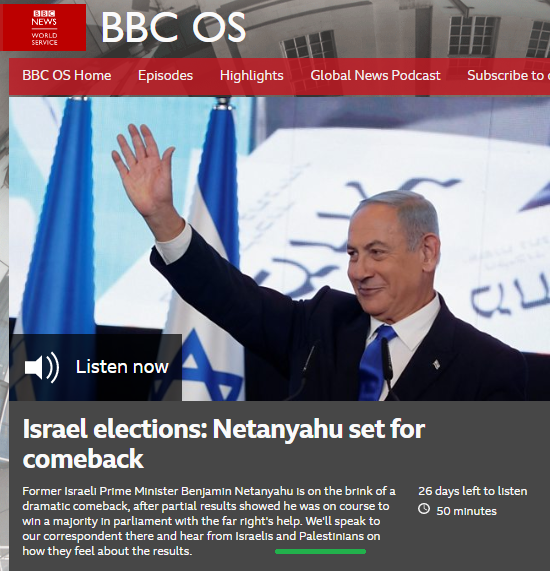
The format of the program includes voice messages sent by members of the public around the world. Following a report from the BBC Jerusalem bureau’s Tom Bateman, presenter James Reynolds told listeners (from 01:55):
Reynolds: “…we have received some messages from voters in Israel. The voters include Jewish Israelis who make up about 75-80% of the population and also the community known as Arab Israelis who make up a minority of about 20% of the population. Let’s hear a couple of messages.”
Of the two messages chosen by the OS team for worldwide amplification, only one in fact came from a person who had voted: a woman living in Lod, who stated that she had cast her ballot for the Jewish Home party.
The second message (from 03:30) came from an Israeli citizen who had chosen not to vote, and who presented herself in a manner that listeners may well have found confusing or offensive.
My name is Nasreen Randour [phonetic]. I’m a Palestinian living in occupied Palestine. I’m a business owner and an activist. I’m 43 years old and I’ve decided for the first time in my life not to vote [emphasis in bold added].
Reynolds did not bother to explain to listeners that a small minority of the Israeli citizens he previously described as Arab Israelis self-identify as Palestinian — and that people BBC audiences are used to hearing described as Palestinians vote in Palestinian Authority elections (if and when they take place) rather than Israeli elections.
Furthermore, no effort was made to clarify that Randour’s reference to “occupied Palestine” actually means Israel — rather than the areas BBC audiences usually hear portrayed as “occupied” — and that her obviously politically-motivated use of that term in fact negates Israel’s existence.
The same politically motivated terminology was repeated later in Randour’s contribution:
Now what’s been happening in the last three years in occupied Palestine is just unimaginable. Ever since the Palestinian society within occupied Palestine raised…we raised our heads and for the first time we got out of the closet with who we are, with our Palestinian identity…” [emphasis added]
Clearly Reynolds and his production team had two reasonable choices. One was to explain to listeners worldwide that the term “occupied Palestine” in fact constitutes a denial of Israel’s right to exist.
The second choice was not to broadcast overtly political messaging, which negates the existence of a sovereign country.
Notably, BBC World Service radio elected not to take either of those options, and instead gave worldwide amplification and mainstreaming to that blatantly offensive and antisemitic messaging.
Hadar Sela is the co-editor of CAMERA UK – an affiliate of the Committee for Accuracy in Middle East Reporting and Analysis (CAMERA), where a version of this article was originally published.


