










Israel Does Not Need Anyone’s Permission to Exist
Error: Contact form not found.

 by Naya Lekht

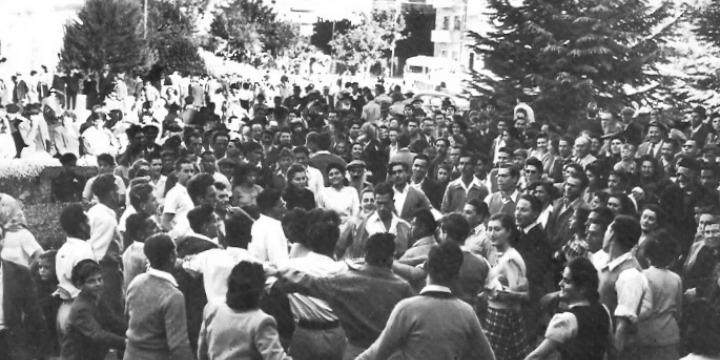
Jews in British Mandate Palestine celebrate the UN General Assembly’s passage of Resolution 181. Photo: Wikimedia Commons.
JNS.org – This November, Iraq is hosting a celebration to honor 90 years since the British gave it independence. Iraq will be joined by Jordan, which will mark 76 years since the British Mandate for Transjordan ended. In attendance at these ceremonies will be United Nations officials. A keynote speech will be delivered by British Prime Minister Rishi Sunak, who will reflect on Britain’s role in the creation of two major Arab countries.
Except this won’t happen.
After World War I, the League of Nations created five mandates in the Middle East: Syria, Transjordan, Palestine, Mesopotamia and Lebanon. All those mandates, with the exception of Palestine, became sovereign nation states, retaining the borders identified by the League of Nations. Not one of them had ever before held sovereignty over that territory. The Jews alone had once maintained a sovereign kingdom in the Levant.
Yet the only country still celebrating its right to exist by genuflecting before the world is Israel, which hosts annual celebrations of the 1947 UN Resolution 181 that partitioned British Mandatory Palestine into Jewish and Arab states.
This year is no different. For example, in Los Angeles, the Consul General of Israel is organizing a 75th anniversary celebration of the event.
Resolution 181 is now a staple in Jewish and Israel education in the Diaspora. When I attended Jewish day school, our teachers, with pride and tears in their eyes, would show us film of the outburst of applause and standing ovation as the UN consecrated the Jewish people’s right to their historic and ancestral homeland.
No one can deny that Resolution 181 was historic and significant. Israeli-American philosopher and computer scientist Judea Pearl called it “the encounter between the Jewish people and history.” But this mythology of the resolution has contributed to the Jewish people’s recurrent need for external recognition.
Seventeenth-century French philosopher Rene Descartes’ emblematic declaration, “I think, therefore I am,” was a pivotal moment in our understanding of the nature of knowledge, forging a philosophical connection between self-awareness and existence. Sadly, for the Jews, Descartes’ exultant affirmation reads more like, “The non-Jews think, therefore we are.”
This concept has long been applied to Israel, whose legitimacy is constantly in question, and to the Jew, who during his 2,000-year exile from the Land of Israel was considered a nuisance and later a pariah. The “Jewish Question” was, at its core, the non-Jewish world’s attempt to grapple with the existence of the Jew. During the French revolution, non-Jews gave an answer to this question: To the Jew as a citizen, everything; to the Jews as a nation, nothing. Tragically, many Jews embraced this form of partial acceptance.
This attitude continues today. We can blame our foes and detractors, but the buck stops with us Jews. We accept, far too often, that non-Jews have the right to dictate how we will be in the world.
Our veneration of Resolution 181 is one form of this. But it is even more egregious in the language we deploy. When we use the term “pro-Israel,” we accept the notion that Israel’s right to exist is still under consideration. When we call ourselves “unapologetic Zionists,” we suggest that the default option is to ask forgiveness for being Zionists. When we use the term “anti-Israel,” we permit our foes to say, “We don’t hate Jews, just Israel.”
This is a struggle of our own making. Judea Pearl reminded me, “We are a grateful people. We say modeh ani every morning. We say thank you for waking up.” What is wrong, Pearl asked me, with the desire to display our gratitude? Is it not noble?
There is nothing wrong with being grateful. But when the existence of the Jewish state is being called into question by everyone from the United Nations to Amnesty International, Students for Justice in Palestine and universities that have become hotbeds of anti-Zionism, excessive gratitude can easily slip into the Jewish desire for acceptance and recognition from non-Jews.
I dream of a time when the Jew stands with his head held high and declares, “We are, therefore we are.” We have another powerful word for this: hinenu. We are here.
Naya Lekht is a scholar on contemporary antisemitism and works with the Jewish community to bring pride and education in the history of the Jewish people and the Arab-Israeli conflict. She holds a Ph.D. from UCLA, where she wrote about Holocaust literature in the Soviet Union, where she was born.