



For the UAE and Others, It’s Business as Usual with Israel
Error: Contact form not found.

 by James M. Dorsey

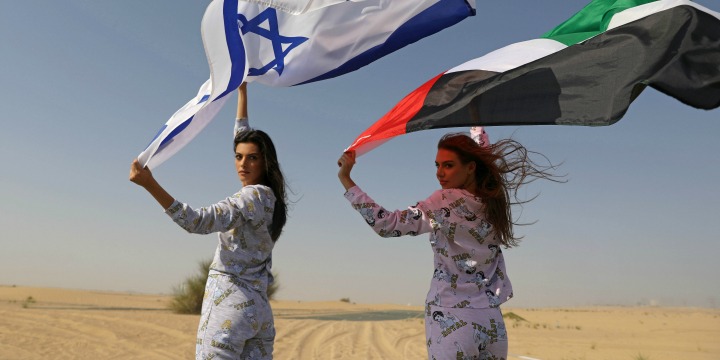
Israeli model May Tager, holding an Israeli flag, poses with Dubai-resident model Anastasia Bandarenka, holding an Emirati flag, during a photo shoot for FIX’s Princess Collection, in Dubai, United Arab Emirates, Sept. 8, 2020. Photo: Reuters / Christopher Pike.
For the United Arab Emirates, it’s business as usual as Israeli Prime Minister Binyamin Netanyahu’s newly formed government is generating controversy at home and abroad.
The UAE made that clear, when it welcomed an Israeli delegation to Abu Dhabi last week to discuss security, energy, tourism, education, tolerance, and water security. The Israelis flew to the Emirati capital days after a hard-line member of Netanyahu’s cabinet, Itamar Ben-Gvir, paid a provocative visit to the Temple Mount, a sacred place for Jews and Muslims.
The 20-person delegation, representing different ministries and headed by Foreign Ministry Director-General Alon Ushpiz, was in Abu Dhabi to prepare for a second Negev summit scheduled for the spring in Morocco. The first summit of foreign ministers of the UAE, Bahrain, Morocco, Egypt, and Israel met last year in the Israeli Negev town of Sde Boker to identify joint initiatives.
Last week, the four Arab states condemned Ben-Gvir’s visit. The UAE, together with China, asked the United Nations Security Council to discuss the visit, and postponed rather than cancelled a visit to Abu Dhabi by Netanyahu.
The UAE, Bahrain, and Morocco established diplomatic relations with Israel in 2020, while Egypt became the first Arab country to sign a treaty with the Jewish state in 1979.
The recent Israeli visit to the UAE, which started the same day that Israel slapped a travel ban on Palestinian foreign minister Riyad Maliki, signal that the UAE and other states are going through the motions with their protests about Israeli actions rather than telling Israel there will be serious consequences.
The ban on Maliki was part of a package of sanctions that also included seizing tax revenues that Israel collects on behalf of the Palestinian Authority (PA) and channeling them to Israeli victims of Palestinian violence, deducting the equivalent of payments made by the PA to Palestinian terrorists and their families.
In addition, Ben-Gvir, who oversees the Israeli police, banned the flying in public places of Palestinian flags “that show identification with a terrorist organization.”
Insisting that Palestinians have a right to oppose what he calls an occupation, PA Prime Minister Mohammad Shtayyeh warned that the measures could lead to the collapse of the Palestinian Authority.
“Israel wants to prevent even the most non-violent way of fighting the occupation,” Shytayyeh said.
The prime minister will likely attempt to exploit the willingness of the UAE to conduct business with Israel, as usual, to extract financial support and compensation. The question is whether the UAE and other states will seek Palestinian political concessions in dealing with the new Israeli government.
That would make things easier for the UAE and other Arab states dealing with Israel.
According to a recent survey, the popularity of forging relations with Israel has plummeted in the UAE and Bahrain in the last two years.
Arab soccer fans demonstrated their opposition to the normalization of relations with Israel during last month’s World Cup in Qatar, by refusing to interact with their Israeli counterparts and declining interviews with Israeli media. At the same time, Qataris and some athletes, including the Moroccan national team, wore pro-Palestinian armbands and waved Palestinian flags.
Aside from the benefits of a relationship with Israel, the UAE and other Arab states also see relations with Israel as a hedge against Iran, and a way to win support in the West.
An announcement last week that the UAE would begin teaching the Holocaust in history classes in primary and secondary schools across the country, drew immediate praise from the Biden administration.
“Holocaust education is an imperative for humanity, and too many countries, for too long, continue to downplay the Shoah for political reasons. I commend the UAE for this step and expect others to follow suit soon,” said Deborah E. Lipstadt, the US special envoy to monitor and combat antisemitism. Lipstadt was using the Hebrew word for Holocaust.
Dr. James M. Dorsey is an award-winning journalist and scholar, an Adjunct Senior Fellow at Nanyang Technological University’s S. Rajaratnam School of International Studies, and the author of the syndicated column and blog, The Turbulent World of Middle East Soccer.


