








US Loses Some Credibility in the Middle East, But All Is Not Lost for the Future
Error: Contact form not found.

 by James M. Dorsey


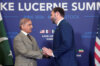
President of the United Arab Emirates and Ruler of Abu Dhabi Sheikh Mohammed bin Zayed Al Nahyan, Vice-President and Prime Minister of the United Arab Emirates, Ruler of Dubai and Minister of Defence Sheikh Mohammed bin Rashid Al Maktoum and Ruler of Sharjah Sheikh Sultan bin Mohamed Al Qasimi attend a Federal Supreme Council meeting at Mushrif Palace in Abu Dhabi, United Arab Emirates, May 14, 2022. Photo: United Arab Emirates Ministry of Presidential Affairs/Handout via
A recent poll of Arab public opinion suggests US credibility has taken a hit, but all is not lost. For this to happen, the United States needs to realize that Middle Easterners judge the US on glaring inconsistencies in its domestic and foreign policies, rather than on its cultural, technological, and economic attributes.
In addition, China is looming larger in the competition for influence in the Middle East. The United States’ credibility problem is compounded by what former Indonesian ambassador in Washington Dino Patti Djalal and Michael Sheldrick, co-founder of Global Witness, see as more broad resentment in the Global South against the West.
“The West is perceived to perpetuate double standards on issues ranging from climate action and responsibility to trade and accountability for human rights violations… They called for global solidarity during the pandemic while instead often pursuing vaccine nationalism. Western nations preach free trade but increasingly engage in protectionism,” Djalal and Sheldrick said in an op-ed.
Against that backdrop, the latest Arab Youth Survey conducted by public relations agency Asda’a BCW indicates the credibility problem the Biden administration needs to address to narrow the gap.
A healthy 72 percent of the survey’s respondents identified the United States as an ally. Even so, the US ranked seventh as an ally behind Turkey, China, Britain, Germany, France, and India.
That does not mean that the US is perceived to have lost influence in the region. Thirty-three percent named the US as the most influential power in the Arab world, followed in second place by the United Arab Emirates (UAE) at 11. Sixty-one percent of respondents said they would support US disengagement, even if more than 60 percent believe the US will be a more important ally than Russia or China in the next five years.
Similarly, the US ranks at 19 percent, second behind the UAE’s 24 percent, as the country Arab youth prefer to live in. The same is true for which country youth would like their country to emulate.
In other words, often unexplained contradictions in policy are catching up with the United States, but it retains sufficient ground to bridge the gap if officials recognize that credibility has become far more critical in a world of competing powers.
Moreover, the lack of credibility turns US criticism of human rights abuses and other illiberal and autocratic policies and actions in the Middle East into a liability rather than an effective policy tool.
Ideally, the United States and other Western nations would align their policies with their professed values. Of course, that would require an ideal world. The demands of realpolitik and increasingly polarized domestic politics ensure that it is, at best, wishful thinking.
But there are things the United States and others can do, at home and abroad, some of which are low hanging fruit.
The Biden administration could take heed of this week’s United Nations recommendations to end in Guantanamo Bay prison “cruel, inhuman, and degrading” violations of detainees’ fundamental rights and freedoms, including constant surveillance, grueling isolation, and limited family access.
In addition, the United States, together with its Western allies, could enhance its credibility by living up to promises like the pledge to provide $100 billion in climate financing to developing nations, and ensuring that countries from the Global South have a seat at the table.
Western leaders have begun to acknowledge that the ball is in their court. French President Emmanuel Macron told the Munich Security Conference in February that he was “shocked by how much credibility we are losing in the Global South.”
Joseph Borrel, the European Union’s foreign policy chief, echoed Macron at the same event.
“We cannot think about European security without looking at the global scene and engaging with other partners. I see how powerful the Russian narrative is, its accusations of double standards. We have to dismantle that narrative, cooperate with other countries, accept that the UN structure must be adapted,” Borrel said, referring to demands that the Global South has a permanent seat on the United Nations Security Council.
The United States’ key allies, the EU and Japan, appear to have taken the lead in attempting to regain credibility and trust. So far, they have taken small steps, but, by and large, they have yet to put their mouth where their mouth is. For the effort to gain momentum and for the United States to benefit, it needs to not only get on board with what Djalal and Sheldrick describe as “a thousand-mile journey” but get in the driver’s seat.
It takes only a glance at the Arab Youth survey to conclude that the stakes are high in the Middle East and across the globe. Credibility matters, perhaps more than ever since World War II.
Dr. James M. Dorsey is an award-winning journalist and scholar, an Adjunct Senior Fellow at Nanyang Technological University’s S. Rajaratnam School of International Studies, and the author of the syndicated column and podcast, The Turbulent World with James M. Dorsey.