

Blocs, Towns & Outposts: What Are the Settlements?
Error: Contact form not found.

 by Chaim Lax

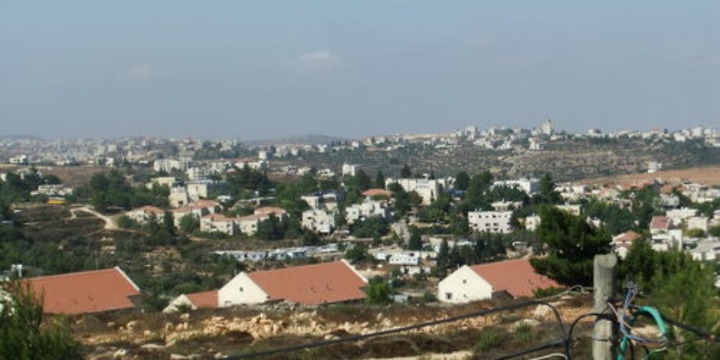
Illustrative: The Jewish community of Beit El in Judea and Samaria. Photo: Yaakov via Wikimedia Commons.
“Israeli settlements” are often cited as one of the most contentious issues in the Israeli-Palestinian conflict, dominating the discourse to the detriment of almost all other issues. Yet while the term has entered the popular lexicon, how much does the average person really know about the settlements?
In the first of a series of pieces looking at these Jewish communities, we will help define what a settlement is as well as take a look at the different types of settlement.
What Are the Settlements?
Put simply, the settlements are Jewish communities in territories that came under Israel’s control following the Six-Day War in 1967.
For the purpose of this piece, we will focus on the settlements that are in the West Bank (also known as Judea and Samaria), since there are no longer any Jewish communities in the Sinai Desert and the Gaza Strip, while the status of Jewish communities in eastern Jerusalem and the Golan Heights differs under Israeli law from those in the West Bank.
Currently, approximately 490,000 Israelis (5% of the total population of the Jewish state) live in Judea and Samaria, with settlements taking up between 4% to 7% of the West Bank’s land area.
Although the term “settlement” might conjure up images of religious Jews living in mobile homes on a dusty hilltop, the settlements are actually heterogeneous in their size and population. Some settlements, like Ariel or Ma’aleh Adumim, are home to thousands of residents, while others, like Masua and Ro’i, are home to only a couple hundred people.
While some choose to live in the settlements for ideological purposes (since Judea and Samaria are considered to be the birthplace of the Jewish people), others opt to live in them because they are generally cheaper than the big cities, but are still located within a reasonable distance from their places of work.
Additionally, a number of ultra-Orthodox Jewish communities have been built in the West Bank, due to overcrowding in cities with large ultra-Orthodox populations, such as Jerusalem and Bnei Brak.
The Consensus Blocs & the Outposts
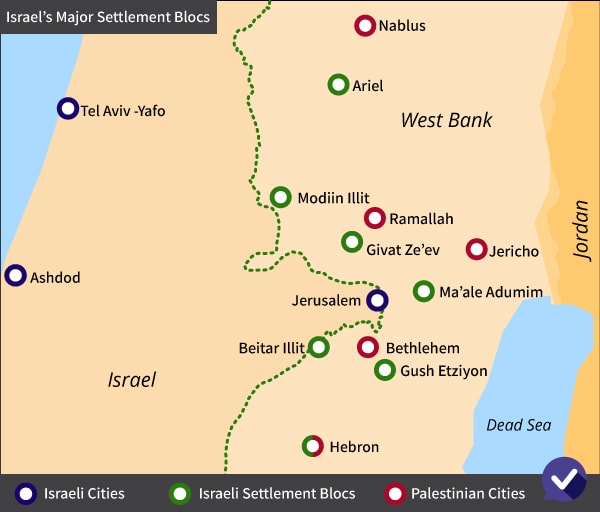
Of the 500,000 Israelis who live in the West Bank, 71% live in what are referred to as “consensus” settlement blocs. These are communities that Israel will most probably retain during a future peace agreement with the Palestinian government.
Of the five consensus settlement blocs, four (Ma’aleh Adumim, Modiin Ilit, Gush Etzion, and Givat Ze’ev) are located near the Green Line. Ariel, the consensus settlement bloc that is furthest from the Green Line, is located approximately 12 miles (19 kilometers) into the West Bank.
Aside from the consensus settlement blocs and established Jewish communities outside these blocs, there’s a third type of settlement in the West Bank: the outpost.
Outposts are Jewish communities that are built without government authorization, and are generally located far from the Green Line and other settlements. (When an outpost is built next to an established settlement, it is referred to as an “unauthorized neighborhood”). Outposts can range from a few people to a few hundred people.
Between the mid-1990s (when outposts first began to appear in the West Bank) and 2019, six outposts were legalized by the Israeli government. In general, outposts that are legalized by the government are built on state-owned land (as opposed to private Palestinian land).
In 2017, the Knesset passed the Regularization Law, which would allow for the legalization of outposts built on private Palestinian land as long as the owners were compensated financially. However, in 2020, the Israeli Supreme Court overturned this law.
In February 2023, the Israeli government legalized 10 more outposts, the majority of which are located next to established settlements. It is now up to the government to prove to the High Court that these outposts are located on public land before they can be officially recognized as legal settlements.
The author is a contributor to HonestReporting, a Jerusalem-based media watchdog with a focus on antisemitism and anti-Israel bias — where a version of this article first appeared.