



Archaeology or Politics: Does Newsweek Question the Existence of the Jewish Temple?
Error: Contact form not found.

 by Rinat Harash

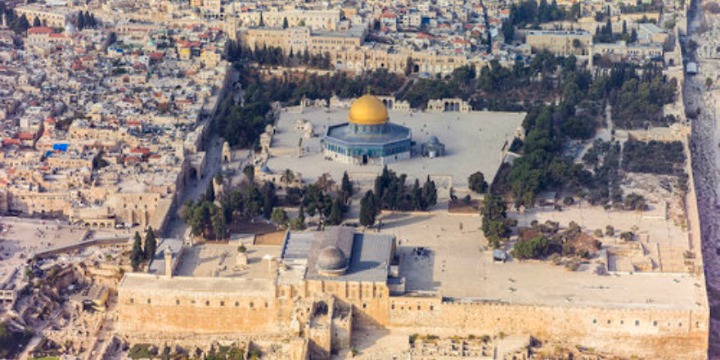
An aerial view of the Temple Mount in the Old City of Jerusalem. Photo: Wikimedia Commons.
It should have been a straightforward journalistic report on an archaeological find in Jerusalem.
Yet some media outlets needlessly managed to cast doubt on basic facts while covering the story, thus undermining the validity of Jewish history.
The reports — by Newsweek, the Science Times, and two archeological journals — generally followed a statement by the Israel Antiquities Authority (IAA) announcing the discovery of mysterious, three-millennia-old structures just outside Jerusalem’s Old City walls last week. According to experts, the structures date back to the period of the First Jewish Temple, which stood nearby.
Yet for some reason, these outlets decided to add a sentence questioning this Temple’s very existence — an undebated historical fact (here is a Britannica entry detailing its history from construction to destruction).
This is Newsweek’s version:
The structures were in use when the city’s First Temple was thought to have existed, researchers said.
The attribution to researchers is puzzling, and was obviously not included in the IAA announcement. It is doubly suspicious, because the next paragraph accurately paraphrases the IAA press release, from which one can clearly conclude that there is no scholarly question whatsoever regarding the existence of the Temple; it says that the location of the structures near the site of the Temple or Palace suggests it was connected to these prominent institutions.
It is unclear, then, what Newsweek’s source was for their mistaken historical caveat.
The Science Times goes further, using words like “claimed” and “believed,” which cast doubt on the very existence of the bedrock of Jewish heritage:
The scholars claimed that the buildings were used throughout the time that the city’s First Temple is believed to have existed.
And two archaeology publications, which are expected to be a bit more knowledgeable on the subject — Arkeonews and The Archaeologist (the latter seems to have relied on the former), made the same mistake while adding: “The structures were in use when the city’s First Temple was thought to have existed, researchers said.”
This also appeared in their articles: “According to scholars, the buildings were in use throughout the time that the city’s First Temple is believed to have existed.”
Was it all just poor phrasing, relating to the period of the Temple’s existence rather than to its actual existence? Hopefully.
Either way, it is poor journalism, which raises irrelevant and mistaken doubts that can only serve anti-Jewish and anti-Israeli agendas.