

Newsweek Ignores Arafat’s Terrorism, Excuses Abbas’ Antisemitism
Error: Contact form not found.

 by Rinat Harash

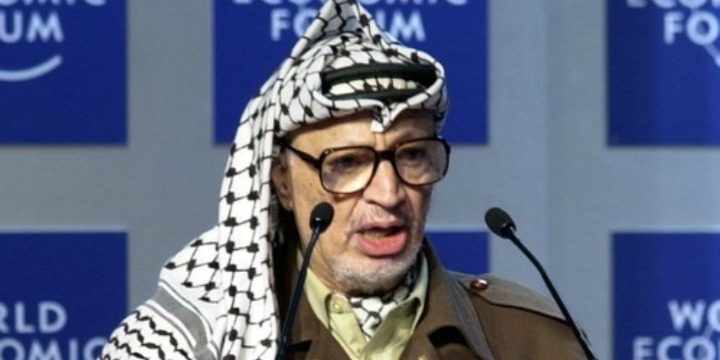
PLO leader leader Yasser Arafat. Photo: World Economic Forum.
Instead of giving its readers an in-depth and accurate understanding of a pressing news issue, Newsweek’s recent piece about the Israeli-Palestinian conflict does exactly the opposite.
But it does so in a subtle manner. By its structure, choice of interviewees, use of terminology and omissions, it blames Israel for everything that is wrong while making excuses for Palestinians — including the terrorism of their late leader Yasser Arafat and the antisemitism of their current President Mahmoud Abbas.
This theme is clear from the fear-mongering headline: “The Palestinian Dream is Dying — and It’s A Nightmare for Israel,” which sounds more like the title of an opinion column than of objective reporting.
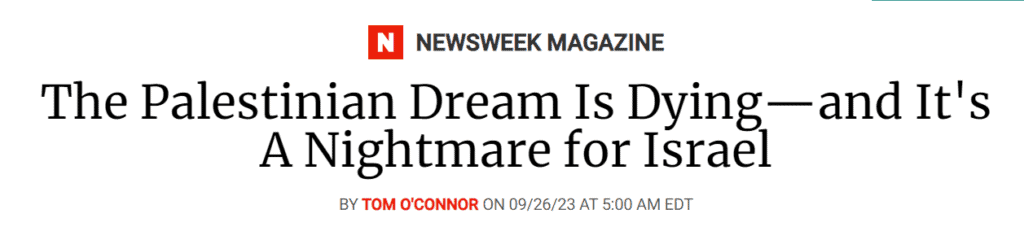
But opinions aside — the headline is subtly structured in a way that creates an illogical linkage, with its first part referring to passive dreamers and its second part pointing at those responsible for the dream’s failure. When people’s dreams are dying, it’s usually a nightmare primarily for themselves and not others.
The article’s accompanying video is also problematic. Captioned “Damage in Jenin Following Israeli Operation,” it provides no other context for the scenes of destruction — such as the fact that it was a counter-terrorism operation.
Writer Tom O’Connor — whom Newsweek’s website describes as an “award-winning Senior Writer of Foreign Policy and Deputy Editor of National Security and Foreign Policy” — has significant previous issues of similar behavior, having, among others, been responsible for two biased articles that the magazine had to retract and apologize for following HonestReporting’s complaints back in 2017.
Yet he continues writing for Newsweek on Israeli issues, and his current piece is littered with many more problems.
When the article delves into much-needed background and some quotes from Palestinian talking heads (one of whom practically justifies terrorism as an act of desperation), O’Connor’s bias really comes to the fore.
For example, the “peaceful” legacy of Palestinian terrorist leader Yasser Arafat and the mysterious “eruption” of the Second Intifada that he masterminded are described as follows:
The PA’s formation under Palestine Liberation Organization (PLO) guerilla leader Yasser Arafat marked an inflection point for Palestinians, who, for the first time, could envision a peaceful path to independent statehood. Such hopes were soon shattered, however, as violence resurfaced at the turn of the century with the eruption of the Second Intifada.
The term “guerilla leader” is particularly alarming, because it can be seen as inaccurate and legitimizing (some even might view it as glorifying). With O’Connor’s history and the entire context of the article, it is hard to see it in any other way.
The next paragraph briefly mentions some problematic Palestinian issues, such as political paralysis and corruption. But it ignores the daily attacks of Palestinian terrorists, the Palestinian Authority (PA)’s incitement to murder Israelis, and its despicable pay-for-slay policy rewarding terrorists (and their families) for slaughtering Jews.
O’Connor also subtly creates a false symmetry between terrorists who routinely target innocent Israeli civilians and those who act (quite rarely) against the Palestinian forces:
This political paralysis, along with mounting Palestinian frustration over controversial Israel-PA security agreements and growing allegations of internal corruption, has fostered a new generation of independent factions taking up arms in defiance of both Israel and the PA.
Against the backdrop of this flawed background, O’Connor dedicates two whole paragraphs to the details of the Israeli policy supporting settlement expansion and rejecting Palestinian statehood. Israeli counter-terrorism raids are described as “direct raids on the West Bank” and one of their targets — the Jenin refugee camp — is described as “restive,” a word more suitable to describe a crowd waiting for a concert than a hostile terror hub.
Making Excuses for Antisemitism
After quoting some experts from the Israeli side — that other analysts won’t necessarily agree with — O’Connor moves on to discuss the decline of the PA’s international legitimacy following Abbas’ recent antisemitic speech. Yet he fails to label it as antisemitic, while shamelessly attempting to explain why it has been misinterpreted.
O’Connor mistakenly claims that Abbas “acknowledged the persecution of Jews in Arab countries” — even though the Palestinian leader blamed it on Israel — and he includes apologetic comments from a Palestine Liberation Organization (PLO) Executive Committee member:
…the PA’s international legitimacy has only further sunk in the wake of Abbas’ speech at a recent Fatah meeting in which the Palestinian leader appeared to deny the antisemitic nature of the Holocaust…
Palestinian leadership continues to stand by its leader and his speech, which also acknowledged the persecution of Jews in Arab countries after Israel’s foundation and promoted a two-state solution to the Israeli-Palestinian conflict. PLO Executive Committee member Faisal Aranki rejects the deluge of criticism over Abbas’ words, arguing that the point was to express grievances about current realities.
O’Connor opines that:
Palestinians find themselves at risk of ultimately losing their dream of statehood, going the route of countless other disaffected ethnic groups such as Balochis, Basques and Kurds, all of whom have failed to gain independence through decades of diplomacy and armed struggle.
While this may be a legitimate view, the reference to “armed struggle” is a subtle euphemism for slaughtering innocent men, women and children. The failure to use the more accurate term “terrorism” reveals what underlies the entire piece: An empathic excuse of visionary murderers, while blaming their victims.
O’Connor’s piece is, at best, weak journalism, or, at worst, thinly veiled propaganda.
The author is a contributor to HonestReporting, a Jerusalem-based media watchdog with a focus on antisemitism and anti-Israel bias — where a version of this article first appeared.