





Moments of truth: Osama vs. Obama
Error: Contact form not found.

 by Petra Marquardt-Bigman


Arch terrorist Osama Bin Laden.
In a first reaction to the violent assaults on the American embassies in Egypt and Libya on this year’s anniversary of 9/11, Marc Lynch prefaced his commentary in Foreign Policy with a warning that has become almost obligatory:
“It would be a tragic mistake to allow the images from Cairo and Benghazi to undermine American support for the changes in the Arab world. The protestors in Cairo and Benghazi are no more the true face of the Arab uprisings than al-Qaeda was the face of Islam after 9/11. We should not allow the actions of a radical fringe to define our views of an entire group.”
Unfortunately for Lynch, it is debatable if al-Qaeda was “the true face … of Islam after 9/11.”
As Lynch knows full well, beginning in 2003, the respected Pew Research Center surveyed Muslim views on Osama bin Laden, and the results don’t necessarily justify his rosy view. While Pew researchers usually work hard to highlight the silver lining when they present the results of their surveys, some of their findings were rather shocking.
This is particularly true for the support bin Laden once enjoyed in supposedly moderate Indonesia: in 2003, it was 59 percent, and by 2011, a bit more than a quarter of Indonesians still expressed positive views of bin Laden. The numbers for Jordan were similarly alarming: in 2003, 56 percent of Jordanian respondents expressed “confidence” in bin Laden “to do the right thing regarding world affairs,” and by 2005, this number had even grown to 61 percent. A year later, Pew recorded a “most striking decline” to just 24 percent, which was attributed to “al Qaeda suicide attacks in the nation’s capital, Amman.”
While bin Laden’s most loyal admirers were always found among the Palestinians – 72 percent in 2003, declining to “only” 34 percent by 2011 — there were several other countries where the al Qaeda leader enjoyed at times the “confidence” of some 40 percent of the Muslim population.
When it comes to Egypt, the numbers also don’t quite support the comforting view that the mob that attacked the US embassy represents a “radical fringe.” In 2011, 22 percent of Egyptians viewed bin Laden positively, and results published earlier this year show that both al Qaeda and the Taliban were viewed favorably by 19 percent of Egyptians.
Anyone who wants to see this as a “radical fringe” should note that exactly the same percentage of Egyptians were willing to express a favorable view of the US in the most recent Pew survey. So if the attackers of the US embassy in Cairo represent just a “fringe,” favorable views of the US among Egyptians are likewise just a “fringe” phenomenon.
The same holds true for the Muslim countries surveyed by Pew: results published last June show that on average, some 24 percent of Muslims have “confidence” in President Obama in general, though only 15 percent approve of his international policies; likewise, only 15 percent of Muslims have a “favorable” view of the US.
Compare these numbers with the 2011 numbers for bin Laden: in the eight Muslim populations that were surveyed, the al Qaeda leader achieved similar or better ratings in six – including, sadly enough, among Israel’s Muslim Arabs.
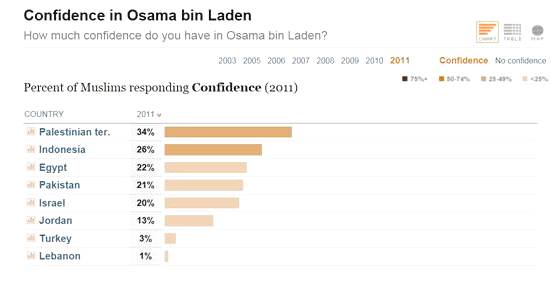
Pew's Osama Bin Laden poll. Photo: Screenshot.
Given the surge of popular support for Islamist groups all over the Middle East in the wake of the so-called “Arab Spring,” it should also not be forgotten that in reaction to the news of bin Laden’s demise last year, Egypt’s Muslim Brotherhood issued a statement that referred to the al Qaeda leader with the honorific term “sheikh.”
So perhaps it’s time to realize that we should not only worry about the “tragic mistake” of exaggerating Muslim extremism, but also about downplaying it?


