Wednesday, July 15th | 1 Av 5786

Subscribe

Hakeem Jeffries Announces He Will Not House Minority Leader Hakeem Jeffries (D-NY) has come out against a bid to cut off US military aid to Israel, while calling for a “major reset” of Washington’s relationship with the Jewish state. In a “Dear Colleague” letter to fellow Democrats on Tuesday, Jeffries said he would vote against an amendment led by Rep. Thomas Massie (R-KY), and co-sponsored by Rep. Ro Khanna (D-CA), that would strip roughly $3.3 billion in annual military financing for Israel — while preserving $500 million for missile-defense programs such as Iron Dome — from the fiscal 2027 National Security, Department of State, and Related Programs Appropriations Act. The House could vote on the measure as early as this week. Aligning himself with the ranking Democrats on the Appropriations and Foreign Affairs committees, Reps. Rosa DeLauro (D-CT) and Gregory Meeks (D-NY), as well as the advocacy group J Street, Jeffries called the proposal too sweeping. “As written, it is overly broad in that it prohibits or would limit the use of funds for longstanding initiatives related to humanitarian aid, refugee resettlement, peace-building and US Embassy operations,” he wrote, adding that the “so-called Massie amendment” would restrict US efforts to confront Hamas, Hezbollah “and other terrorist organizations in the region who are sworn enemies of both the United States and Israel.” Citing deep divisions within the party over Israel, Jeffries said leadership would not pressure members to follow his lead. “There are good faith reasons that will result in Members voting in a variety of different ways with respect to the amendment,” he wrote, noting that the caucus was not whipping the vote. At the same time, Jeffries argued that US policy toward the region “must change,” tying his call for a “major reset” to criticism of what he termed the “far-right Netanyahu government.” He wrote that America’s commitment to “Israel’s right to exist as a Jewish and democratic state and homeland for the Jewish people must remain ironclad,” while urging strong US support for the creation of an independent Palestinian state. Israeli governments have long rejected the establishment of a Palestinian state along Israel’s borders, warning that it would pose an existential security threat and leave major population centers exposed to attack. Jeffries also said Gaza must undergo “complete reconstruction and modernization” and that “Hamas must be disarmed and removed from power.” Jeffries further signaled that the next US-Israel aid agreement should require Israel to cover more of its own defense costs. The current 10-year memorandum of understanding, signed under President Barack Obama in 2016, provides Israel about $3.8 billion annually — $3.3 billion in military financing and $500 million for missile defense — and expires in 2028. “Israel has an advanced economy and is capable of paying for its own sophisticated weapons, as the Prime Minister recently acknowledged,” Jeffries wrote, adding that any future arrangement should mirror US defense agreements with other Western allies and “strictly adhere to our human rights laws and values.” His stance placed him between the two poles of a party increasingly split over Israel. Hours after his letter circulated, the chair of the Congressional Progressive Caucus, Rep. Greg Casar (D-TX), sent a competing letter urging Democrats to back the Massie amendment, and progressives including Rep. Alexandria Ocasio-Cortez (D-NY) said they would vote to cut the aid. Support for Israel among Democratic voters has fallen sharply during the war in Gaza. An Associated Press-NORC poll conducted in June found that 52 percent of Democrats say Israel has committed genocide against Palestinians, while a Pew Research Center survey found that roughly 80 percent of Democrats hold a negative view of Israel. In April, a majority of Senate Democrats — 40 of the caucus’s 47 members — voted for at least one of two resolutions to block certain arms sales to Israel, though the measures failed. Supporters of continued assistance say it preserves Israel’s qualitative military edge and bolsters a key US partner against Iran-backed groups, while critics want aid conditioned on Israeli policy changes, particularly over the conduct of the war in Gaza. The upcoming vote is expected to underscore the widening gap between the party’s pro-Israel wing and its growing bloc of aid critics. for Amendment to Strip Israel Aid

May 19, 2024 10:57 am

Israel Launches Strikes Across Gaza as U.S. Envoy meets Netanyahu

×

Error: Contact form not found.

avatar by Reuters and Algemeiner Staff

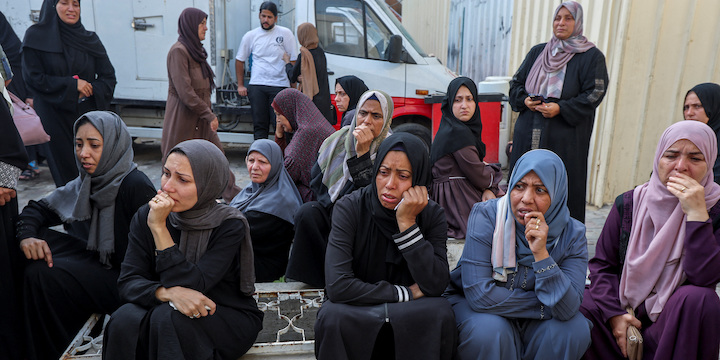
Mourners grieve during the funeral of Palestinians killed in an Israeli strike, at Al-Aqsa hospital in Deir Al-Balah in the central Gaza Strip, May 19, 2024. Photo: REUTERS/Ramadan Abed

Israeli planes and tanks pounded areas across the Gaza Strip, residents said, as White House national security adviser Jake Sullivan met Israeli Prime Minister Benjamin Netanyahu on Sunday amid U.S. calls for a more focused military campaign.

Sullivan was expected to press for Israel to go after Hamas terrorists in a targeted way, not with a full-scale assault on the southern Gaza city of Rafah, the White House said before the discussions.

Israel has been pushing into the city that it says is the last bastion of Hamas forces. Hundreds of thousands of Palestinians have fled the area that was one of their few remaining places of refuge.

Israeli forces also pushed deeper into the narrow alleyways of Jabalia in northern Gaza overnight and into Sunday, returning to an area that they said they had cleared earlier in the conflict, residents said.

The Israeli military has said its operations in Jabalia – the largest of Gaza’s eight historic refugee camps – are precise and meant to stop Hamas from reestablishing its grip there.

The Israeli military said it was “operating to identify armed terrorist cells and … conducting dozens of strikes to assist the forces operating on the ground” in the Jabalia area.

TALKS, TUNNELS, THREATS

Ahead of Sunday’s talks, an Israeli official said Prime Minister Benjamin Netanyahu and his senior aides would try to reach agreement with Sullivan about the need for press ahead with the Rafah push.

Past U.S. misgivings about the feasibility of Israel’s humanitarian measures may have been allayed by the evacuation around half of the city’s Palestinians in 12 days, said the official, who spoke to Reuters on condition of anonymity.

“We’ve shown that this is not only necessary, but doable,” added the official.

The official said Israel would also air concerns about dozens of tunnels it says its forces have found under Rafah, running into next-door Egypt – which has condemned the military sweep.

“These tunnels are used by Hamas to supply itself with weapons and ammunition, and could potentially be used to smuggle out of Gaza hostages or Hamas senior operatives,” Deputy Israeli State Attorney Noam Gilad said during a hearing at The Hague on Friday, in a rare detailing of allegations that Egypt’s state information service previously dismissed as untrue.

Netanyahu has said the operation in Rafah, where Israel believes that as much as a quarter of Hamas’ fighting forces are holed up, could be completed within weeks.

Washington worries for the hundreds of thousands of displaced Palestinians sheltering there, and has cited a need not just to evacuate them but also to ensure adequate alternative accommodation.

The Gaza Civil Emergency Service said in a statement rescue teams have so far recovered the bodies of 150 Palestinians killed by the army in recent days, and that 300 houses had been struck by Israeli aerial and ground fire.

Hamas started the war with its invasion of southern Israel and massacre of 1,200 people on Oct. 7. About 125 of the 253 people abducted in the terrorist onslaught are believed to remain in captivity in Gaza. Israel responded with a military campaign aimed at freeing the hostages and destroying Hamas, which rules Gaza.

The U.S. military said on Friday trucks had started moving aid ashore from a temporary pier built by its forces, the first to reach the besieged enclave by sea in weeks.

The Popular Resistance Committee (PRC), an armed group that fights alongside Hamas in Gaza, released a statement saying the pier had been built to ease political pressure on Israel, and that any Israeli or U.S. troops on its territory would be considered a legitimate target.

On Saturday, Hamas also raised concerns about the pier, warned against any foreign military force in Gaza, but made no direct threats.

In March, when President Joe Biden announced his country’s pier construction plans, he said: “No U.S. boots will be on the ground.”

Share this Story: Share On Facebook Share On Twitter

Let your voice be heard!

Join the Algemeiner

Algemeiner.com

This field is for validation purposes and should be left unchanged.
Email a copy of to a friend
This field is hidden when viewing the form
This site is protected by reCAPTCHA and the Google Privacy Policy and Terms of Service apply.