







US Legal Adviser Says Iran War Justified by Tehran’s ‘Aggression’ Over Decades
Error: Contact form not found.

 by Reuters and Algemeiner Staff

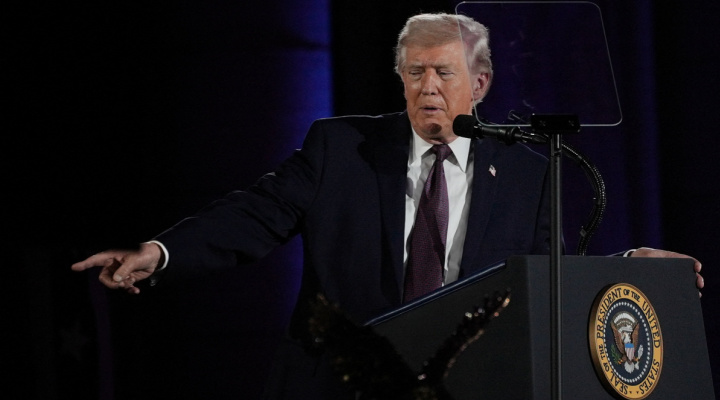
US President Donald Trump points as he delivers a speech during the National Republican Congressional Committee (NRCC) annual fundraising dinner in Washington, DC, US, March 25, 2026. Photo: REUTERS/Ken Cedeno
The US State Department’s top lawyer has argued that President Donald Trump’s war with Iran was launched in self-defense and to defend US ally Israel, arguing the bombing campaign was not the start of a new war but the continuation of an ongoing conflict.
State Department Legal Adviser Reed Rubinstein made the arguments in a statement released days before a May 1 deadline for the Trump administration to obtain approval for the war from Congress under the 1973 War Powers Act or move to end it.
The US and Israel began air strikes on Iran on Feb. 28, killing Iran‘s then-Supreme Leader Ayatollah Ali Khamenei and much of the country’s leadership in the initial attacks. Trump said at the time the strikes, which happened just days after inconclusive talks between US and Iranian negotiators, were aimed at destroying Iranian missiles and annihilating its navy and preventing Tehran from obtaining a nuclear weapon. Trump also urged Iranians to overthrow their government.
Many legal experts say the attacks were unjustified under the United Nations Charter, which states that member states must refrain from using force or the threat of force against other states except when force is authorized by the UN Security Council or used in self-defense.
The U.S. was “engaged in this conflict at the request of and in the collective self-defense of its Israeli ally, as well as in the exercise of the United States’ own inherent right of self-defense,” Rubinstein said, citing what he called “Iran‘s malign aggression over decades” since the Islamic Revolution of 1979, including attacks by Iranian proxies on US forces and Israel, Iranian missile strikes against Israel in 2024, and Tehran’s pursuit of nuclear weapons.
“In truth, the United States is acting well within the recognized contours of international law relating to the use of force and self-defense,” he added.
Iran has long denied accusations by Western powers that it is seeking to develop nuclear weapons.
The statement, entitled “Operation Epic Fury and International Law,” was posted on the State Department’s website on Tuesday but, unlike most of the department’s statements, it was not sent to the media or published on official social media channels.
Iran responded to the US and Israeli attacks by launching missiles and drones against US targets, its Middle East neighbors, and shipping, snarling the vital Strait of Hormuz waterway. The war, which has sparked an energy shock and concerns about wider economic fallout, has been paused since an April 8 ceasefire.
Opinion polls show the war is unpopular with Americans, who have seen the prices of fuel, food, and other products jump during the past eight weeks. Reuters/Ipsos poll results released on Friday showed a clear majority of Americans blame Trump for surging gasoline prices, which are weighing on his Republican Party ahead of the midterm elections in November.
Rubinstein concluded the campaign that began in late February was “part of an armed conflict with Iran that has been ongoing for years” and said it was unnecessary to assess whether an Iranian attack on the US or an ally was imminent.
“The US has acted well within its international law obligations with respect to its use of force since operations began in late February. Iran, by contrast, has acted as any reasonable observer would have expected – lashing out against its neighbors, targeting Israeli civilians, murdering its own people, unlawfully closing the Strait of Hormuz, and wreaking havoc throughout the region,” Rubinstein said.
Congressional aides said Rubinstein’s statement was issued by the Trump administration likely to get ahead of a May 1 deadline to ask Congress to authorize the war. The War Powers Act says the US president must end any ongoing conflict after 60 days until he obtains that authorization to continue. A president can obtain a 30-day extension if he certifies in writing, to Congress, that the continuing use of armed force is necessary.
Democrats, who are in the minority in both chambers of Congress, have tried repeatedly since the war began to pass resolutions ending the conflict until Trump obtains congressional approval, but almost all Republicans have voted to block them.


