


When Jews Are Attacked, the Media Won’t Say ‘Jew’
Error: Contact form not found.

 by Rachel O'Donoghue


Orthodox Jews stand by a police cordon, after a man was arrested following a stabbing incident in the Golders Green area, which is home to a large Jewish population, in London, Britain, April 29, 2026. Photo: REUTERS/Hannah McKay
As soon as the words “attack in Golders Green” were uttered, everyone in Britain — Jewish or not — understood what that likely meant: another antisemitic attack.
Golders Green is one of the most recognizably Jewish areas in the UK, with around half its population identifying as Jewish. When violence erupts there, the context is not ambiguous.
Witness accounts quickly confirmed what seemed obvious. Two visibly Jewish men, in a well-known Jewish neighborhood, were stabbed. The suspect — a 45-year-old Somali national — was arrested at the scene.
Video footage showed police tasering the attacker and using force to disarm him as he refused to drop his weapon. Yet as news of the attack spread, something else became clear: major British media outlets were struggling to name who had been targeted.
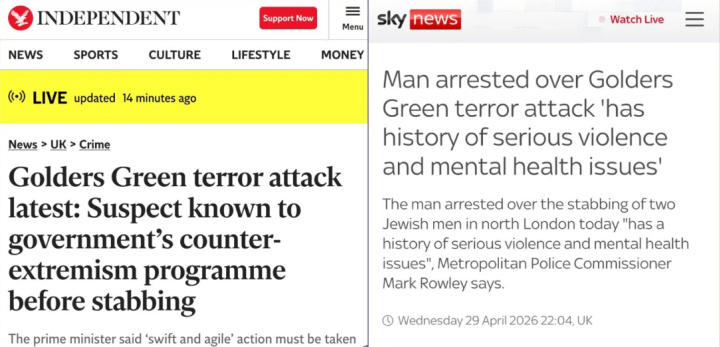
The BBC reported that “two people” had been stabbed, attributing key details to a “Jewish security group,” as though the identity of the victims was uncertain or subjective. Sky News similarly opted for “two people,” stripping the attack of its clear antisemitic context in the headline. Later, Sky went further, running a headline emphasizing the attacker’s “history of mental health issues” — a framing that deflects from the antisemitic motive. The Independent, while calling it a terror attack in its headline, still avoided explicitly stating that Jews were targeted.
You mean two Jews, @SkyNews. https://t.co/OdU8YWw7CT
— HonestReporting (@HonestReporting) April 29, 2026
This is not a minor omission. It is a pattern that repeats with disturbing consistency. When Jews are the victims, the language shifts. Attacks are softened, anonymized, universalized. Victims become “people.” Targeted violence becomes generic crime. The specificity disappears.
But antisemitism is not generic. It is not abstract. And it is not universal.
Jews are being targeted as Jews.
The data makes that impossible to ignore. According to the Community Security Trust (CST), 3,700 antisemitic incidents were recorded in the UK in 2025 – the second-highest total on record and a 4 percent increase from 2024. That followed 4,298 incidents in 2023, itself a historic peak. The trajectory is clear: antisemitic violence is escalating.
And it is visible beyond statistics. In recent weeks alone, Hatzola ambulances were firebombed, synagogues in Finchley and Kenton were targeted in arson attacks, and a building that formerly hosted a Jewish charity in Hendon was targeted. Now, Jews have been stabbed in one of Britain’s most prominent Jewish communities.
Yet even as this reality intensifies, large parts of the media still struggle — or refuse — to name it plainly.
Why?
Part of the answer lies in a broader narrative environment. For months, British audiences have been exposed to coverage that portrays the Jewish state as uniquely malevolent, often with little context or balance. Mass protests openly invoking “intifada” have been downplayed or sanitized. Extremism, when directed at Jews, has too often been reframed as legitimate grievance.
Within that climate, the reluctance to say “Jew” is not accidental. It reflects a deeper discomfort with acknowledging Jews as a distinct and targeted group.
But language matters. When the media erases victims’ identities, it erases the nature of the crime. And when the nature of the crime is blurred, so too is the urgency to confront it.
This is how normalization happens – not through a single headline, but through repetition. Through omission. Through the quiet reshaping of reality.
If the trend continues, the consequences will not remain confined to headlines. Britain’s Jewish community is already questioning its future in a country where anti-Jewish violence is rising — and where even that violence is not always named for what it is.
Two men were not simply stabbed in Golders Green. Jews were attacked for being Jews. And the media should be able to say so.
The author is a contributor to HonestReporting, a Jerusalem-based media watchdog with a focus on antisemitism and anti-Israel bias — where a version of this article first appeared.


