






Israel’s First Ambassador to Somaliland Acclaims Deepening Partnership, Broader Strategic Outreach in Africa
Error: Contact form not found.

 by Ailin Vilches Arguello

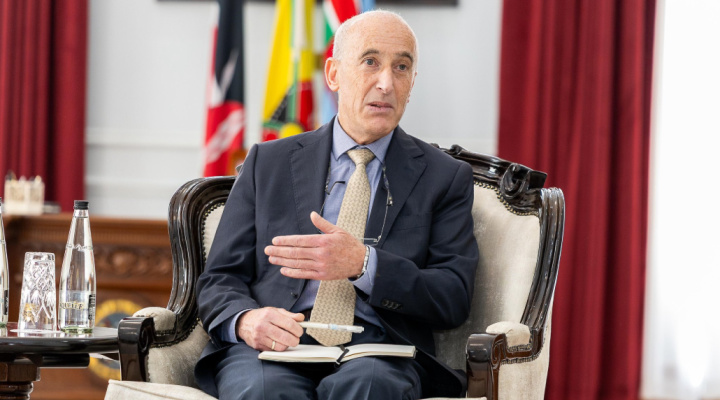
Israeli diplomat Michael Lotem in Kenya, July 2025. Photo: Screenshot
The relationship between Israel and Somaliland has rapidly evolved into a strategic partnership spanning security, energy, infrastructure, and economic cooperation, according to the Jewish state’s first ambassador to the self-declared republic, who noted the strengthening of ties was part of a broader outreach effort by Jerusalem across Africa.
“They are looking to deepen cooperation in nearly every field — from energy and infrastructure to technology, education, and communications — and their desire to work with Israel is stronger than ever,” Michael Lotem said of Somaliland in an interview with Israeli news outlet N12 published on Friday.
“Security discussions are naturally part of the relationship, but our political dialogue extends far beyond that into many different areas,” he added.
In December, Israel became the first country to officially recognize the Republic of Somaliland as an independent and sovereign state.
Somaliland, which has claimed independence for decades in East Africa but remains largely unrecognized, is situated on the southern coast of the Gulf of Aden and bordered by Djibouti to the northwest, Ethiopia to the south and west, and Somalia to the south and east. It has sought to break off from Somalia since 1991 and utilized its own passports, currency, military, and law enforcement.
Unlike most states in its region, Somaliland has relative security, regular elections, and a degree of political stability.
Last month, Israel appointed Lotem as its first ambassador to Somaliland, after the two governments formally established full diplomatic relations.
Lotem, who was serving as a non-resident economic ambassador to Africa at the time of his appointment, will now shift to work as a non-resident ambassador to Somaliland. He previously served as Israel’s ambassador to Kenya, Uganda, Tanzania, Malawi, and Seychelles, a position he concluded in August.
In his interview, Lotem described the growing bilateral relationship as part of Israel’s broader diplomatic and strategic push across Africa, saying the partnership also sends a wider message of legitimacy and engagement to Muslim-majority countries throughout the region.
“Over the past several years, Israel has invested significant diplomatic effort in strengthening its presence across Africa, an initiative that Foreign Minister Gideon Saar has strongly prioritized, and the results are already becoming visible very quickly,” the diplomat said.
He also pointed to what he described as major untapped potential for economic cooperation, particularly regarding Somaliland’s vast natural resources and minerals sector — including oil, gas, coal, iron, and gold.
“They are extremely interested in partnering with Israel across the entire minerals industry supply chain,” Lotem said, adding that there are also strong prospects for cooperation in energy, medicine, agriculture, education, water management, and communications.
“We hope more countries will come to recognize the strategic value and importance of this relationship,” he continued.
Although no other UN-recognized country has formally recognized Somaliland (Taiwan did so in 2020), several — including the United Kingdom, Ethiopia, Turkey, the United Arab Emirates, Denmark, and Kenya — have maintained liaison offices, allowing them to engage diplomatically and conduct trade and consular activities without full formal recognition.
According to experts, the growing Israel-Somaliland partnership could be a “game changer” for the Jewish state, boosting the country’s ability to counter the Iran-backed, Yemen-based Houthi terrorist group while offering strategic and geographic advantages amid shifting regional power dynamics.
“Somaliland’s significance lies in its geostrategic location and in its willingness — as a stable, moderate, and reliable state in a volatile region — to work closely with Western countries,” argued a report by the Institute for National Security Studies (INSS), a prominent Israeli think tank.
“Somaliland’s territory could serve as a forward base for multiple missions: intelligence monitoring of the Houthis and their armament efforts; logistical support for Yemen’s legitimate government in its war against them; and a platform for direct operations against the Houthis,” it continued.
Somaliland President Abdirahman Mohamed Abdullahi has previously said that the republic would join the Abraham Accords, calling it a step toward regional and global peace and affirming his government’s commitment to building partnerships, boosting mutual prosperity, and promoting stability across the Middle East and Africa.
The strategic partnership comes at a time when Israeli and US officials have warned of rising Islamist terrorist threats across Sub-Saharan Africa, placing the region at the forefront of global concern over jihadist activity.