




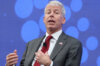


Anti-Israel Activist Indicted Over Michigan Threat Campaign Worked for US Senate Candidate Abdul El-Sayed
Error: Contact form not found.

 by Corey Walker


Former Wayne County Health Director Abdul El-Sayed, a Democrat now running for US Senate in Michigan, speaks at a “Hands Off” protest at the state Capitol in Lansing, Michigan, on April 5, 2025. Photo: Andrew Roth/Sipa USA via Reuters Connect
Abdul El-Sayed, a Democratic candidate for US Senate in Michigan, is facing fresh controversy after federal prosecutors charged a former member of his political operation as part of an alleged campaign of threats and intimidation targeting University of Michigan officials, local businesses, and the Jewish Federation of Metropolitan Detroit.
Mariam Odeh, a 24-year-old from Dearborn, Michigan, was among the eight people indicted on Wednesday for plotting to harass university administrators to cut financial and institutional relationships with the state of Israel. According to the information provided in the indictment, the El-Sayed campaign paid Odeh $153 on March 3 and $593 on March 13. The defendant worked for the campaign for 4 months, according to the indictment.
A spokesperson for the El-Sayed campaign clarified that Odeh was “hired in February as an hourly employee and left the campaign on April 15.”
Federal prosecutors say that Odeh and the other defendants carried out an 18-month sustained campaign against top university leaders between October 2023 and April 2025. Those allegedly targeted included then-University President Santa Ono, the university’s chief investment officer and provost, several members of the Board of Regents, and other senior officials, according to the government’s filing.
“In the dead of night, masked and hooded defendants allegedly threw noxious chemicals through the windows of families’ homes and taped demand letters to their front doors. At every step they attempted to cover their tracks and delete evidence of their crimes,” said Jennifer Runyan, Special Agent in Charge of the FBI Detroit Field Office. “Those who engage in coordinated campaigns of threats and intimidation should expect to be held fully accountable under federal law.”
US Attorney Jerome Gorgon Jr. added that the “alleged threats and attempts to terrorize government officials, businesses, and the Jewish Federation are anti-American.”
Federal authorities have charged Odeh with conspiracy to transmit threats in interstate and foreign commerce, a felony offense that carries a potential prison sentence of up to five years if convicted.
The charges stem from allegations that Odeh and the other defendants were involved in the vandalism of a facility operated by Rolls-Royce Solutions America in the Detroit metropolitan area in 2024. According to court documents, the group is accused of padlocking entrances to the building and spray-painting anti-Israel messages outside of the facility.
Odeh appeared alongside other protesters at a March 2025 protest, in which demonstrators swarmed the home of Ono, condemning Israel for so-called “genocide” and demanding an end to the university’s ties to entities affiliated or working with the Jewish state.
“The war machine has once again flooded our screens with unbearable images: children wrapped in white shrouds, parents screaming in agony, entire families wiped out in an instant,” Odeh wrote in a Michigan Daily opinion piece. “We have stood witness time and time again as journalists have went and given their lives to document and broadcast these horrors.”
The development has intensified concerns about the activist networks surrounding El-Sayed’s campaign at a time when the Democratic primary has been increasingly criticized on questions regarding leadership, judgment, and political extremism. While there is no indication that El-Sayed was involved in the alleged conduct, the connection has prompted critics to ask whether his campaign has exercised sufficient vetting and oversight of the activists and operatives associated with his political movement. Supporters of Israel and advocates for civil discourse have pointed to the case as another example of how increasingly radical anti-Israel activism can spill over into harassment and intimidation rather than democratic debate.
The controversy comes as El-Sayed has built his Senate campaign on a sharply progressive agenda that includes ending US military aid to Israel and embracing some of the Democratic Party’s most left-wing positions. His criticism of Israel and alignment with anti-Israel activists have made him a favorite of the party’s progressive wing, but they have also raised concerns among many Jewish voters and pro-Israel Democrats who view the US-Israel alliance as a vital strategic partnership.
El-Sayed has repeatedly accused Israel of committing “genocide” while providing no evidence. He has also refused to affirm that Israel should continue to exist as a Jewish state, instead suggesting that the country is not “‘consistent with any form of liberal values that we say we believe in here in the United States.”
For many Michigan voters, the issue extends beyond a single former staffer. The larger question is whether El-Sayed’s political movement has fostered an environment in which hostility toward institutions, elected officials, and supporters of Israel is increasingly normalized. As the Senate race enters a critical phase, voters will likely examine not only El-Sayed’s policy positions but also the company he keeps and the activists who have found a home in his political orbit.
Further, the controversy emerges at a time in which anti-Israel voices are ascendant in the Democratic Party. Graham Platner, the Democratic Senate nominee in Maine, has repeatedly condemned Israel for so-called “genocide” and has accused the Jewish state of “exterminating” Palestinians. In a social media post commemorating the anniversary of Hamas’ Oct. 7, 2023, massacre, Platner again accused Israel of “genocide” while providing no evidence.
Michigan Democrats face a choice between competing visions for their party’s future. Fellow contenders, Mallory McMorrow and Haley Stevens have been less adversarial toward the Jewish state during the campaign. Though McMorrow leveled unsubstantiated accusations of “genocide” against Israel, she has not made anti-Israel animus a central feature of her campaign and has acknowledged that people can have different perspectives of the ongoing war in Gaza.
At a Democratic primary debate last month, McMorrow acknowledged that her own party has a problem of rising antisemitism within its ranks.
Meanwhile, Stevens has positioned herself as explicitly supportive of Israel and has vowed to continue supporting the Jewish state if elected to office.


