









The Deal Trump Warned About Is Apparently Now His Own
Error: Contact form not found.

 by Micha Danzig

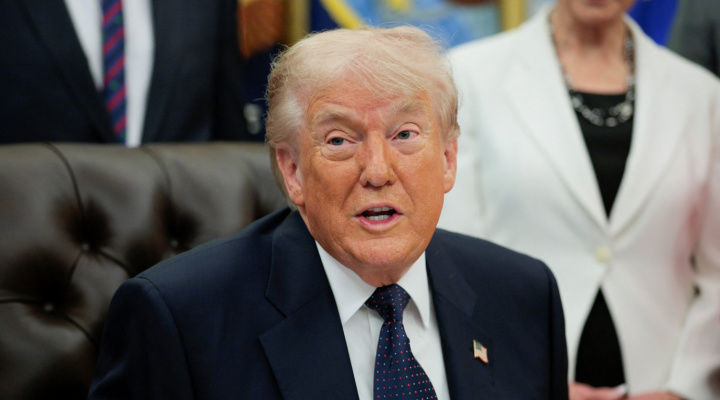
US President Donald Trump speaks during an event to sign a memorandum in the Oval Office at the White House in Washington, DC, US, May 5, 2026. Photo: REUTERS/Evan Vucci
For years, Donald Trump hammered what he saw as the central flaw in the Obama administration’s nuclear deal with Iran: that Iran would not keep its promises, and that the US could not allow Iran the means and ability to build a nuclear weapon.
Tehran has insisted for decades that it does not seek nuclear weapons. It made that claim while bound by the Nuclear Non-Proliferation Treaty, which already forbids them. The real issue was never rhetoric. It was capability — whether the openly messianic regime retained the means to build a bomb whenever it chose.
That distinction drove Trump’s criticism of the Joint Comprehensive Plan of Action (JCPOA). It was echoed repeatedly by Trump and his top officials, who argued that Iran could never be allowed to maintain domestic enrichment capacity.
And that’s why the newly announced memorandum of understanding (MOU) is so hard to reconcile.
Based on what has been publicly described, the administration appears not just willing to accept Iranian enrichment — but to recognize a right that it once insisted could never safely exist. If those descriptions are accurate, the administration is now marketing as a diplomatic success something it previously treated as a red line.
Iran’s assurances are not new. They never were. The question has always been whether anyone should take them seriously.
For more than twenty years, Iran concealed facilities, misled inspectors, obstructed investigations, and offered explanations that later unraveled. Against that record, presenting Iran’s agreement to keep making the same claims as a concession is hard to defend.
If the agreement is stronger than critics believe, publication will show it. If it isn’t, the public deserves to know that too.
Either way, the details matter more than the branding.
Once a regime like Iran’s has enrichment infrastructure, the question is no longer intent but timing. Centrifuges do not distinguish between civilian use and weapons production.
The issue has always been whether Iran retains the ability to pivot. That question doesn’t disappear because Iran repeats familiar assurances.
But the concerns raised by the MOU extend beyond the nuclear file.
For decades, US officials were blunt about Hezbollah: it is an Iranian proxy. Iran created it, armed it, financed it, trained it, and guides its operations.
After February 28, 2026, Hezbollah opened a second front against Israel on Iran’s behalf, showing little regard for the people of Lebanon. Its own leaders framed the campaign as part of Iran’s broader confrontation with Israel.
And yet, if current reporting is accurate, the MOU may give Iran leverage over how Israel responds to Hezbollah — a possibility that would have been unthinkable under the framework Trump himself once advanced.
That alone would mark a striking reversal.
For years, Washington insisted Hezbollah and Iran were inseparable. That clarity carried strategic consequences. If Iran controlled Hezbollah, then Iran bore responsibility for its actions.
Now the logic appears to require the opposite — that they be treated as distinct actors when it matters most.
That shift is not just theoretical. It surfaced in President Trump’s public frustration and anger after Israel reportedly targeted a senior Hezbollah commander — an individual responsible for the kidnapping and murder of American soldiers, long subject to a US bounty, and a senior figure in an organization Washington itself has spent decades defining as an Iranian proxy.
The inversion is hard to miss. Hezbollah attacks Israel at Iran’s direction. Iran frames Israel’s response as escalation. And the United States appears, at least in part, receptive to that framing.
Cause and effect are being turned on their head. The regime that built, funded, and directs Hezbollah is positioning itself as the arbiter of Israel’s right to respond to Hezbollah.
No sovereign state can accept that arrangement — least of all when the “arbiter” is the very source of the threat.
Which brings us back to the deeper contradiction.
Trump built his foreign policy identity on rejecting the idea that Iranian promises could substitute for hard constraints on Iranian capability. He was right to do so.
But now his administration appears to be drifting back toward that same logic. Iran keeps enrichment. Iran offers assurances. Iran backs Hezbollah — and may be gaining influence over how others respond to it.
If that sounds familiar, it should.
Perhaps this is all tactical — language used in pursuit of a deal. One hopes so. One hopes, too, that the final text of the MOU is far more stringent than descriptions suggest. Because if it is not, the implications are straightforward.
Trump’s original insight was simple and correct: the danger was never what Iran said. The danger was what Iran could do. That hasn’t changed.
If the MOU truly creates what the President calls “a wall against a nuclear weapon,” it should be able to withstand public scrutiny.
But if it allows Iran to retain enrichment, substitutes promises for enforceable limits and gives Tehran leverage over how Israel responds to the very proxies Iran created and controls, then the problem is not how the deal has been described. The problem is the deal itself.
And it would mean that the president who once warned that Iran could not be trusted has ended up negotiating an agreement that depends on trusting it.
Micha Danzig is an attorney, former IDF soldier, and former NYPD officer. He writes widely on Israel, Zionism, antisemitism, and Jewish history. He serves on the board of Herut North America.


