




Colombia to Withdraw Support for South Africa’s ICJ Genocide Case Against Israel as Ties with Jerusalem Are Restored
Error: Contact form not found.

 by Ailin Vilches Arguello

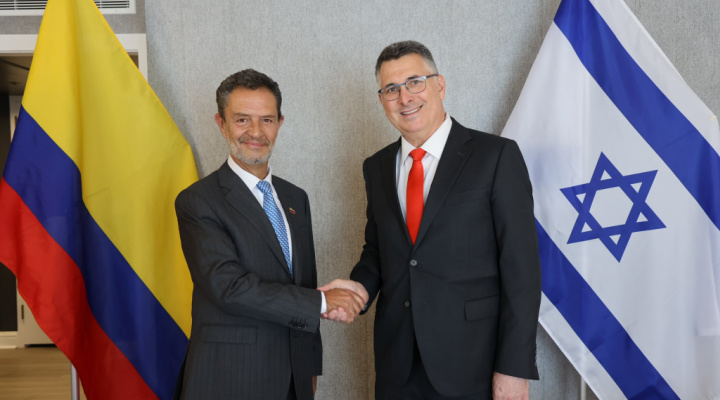
Israeli Foreign Minister Gideon Saar meets with Colombia’s incoming Foreign Minister Omar Bula in Washington, where the two sides agreed to restore diplomatic and economic ties after years of strained relations. Photo: Screenshot
Colombia’s incoming government has pledged to withdraw the country’s support for South Africa’s contentious genocide case against Israel at the International Court of Justice (ICJ), as Bogotá moves to restore diplomatic ties with Jerusalem and deepen bilateral cooperation.
According to the Israeli Foreign Ministry, the office of Colombia’s president-elect, Abelardo de la Espriella — who won last month’s runoff and is due to take office on Aug. 7 — said his administration would “return to a responsible position in the international arena,” including by ending the country’s involvement in the ICJ proceedings once he assumes office.
The announcement followed a meeting in Washington on Wednesday between Israeli Foreign Minister Gideon Saar and Colombia’s incoming foreign minister, Omar Bula, where the two sides agreed to fully restore diplomatic and economic ties, exchange ambassadors, and scrap mutual visa requirements after years of strained relations.
Colombia’s incoming administration also intends to open an embassy in Jerusalem — a move recognizing the city as Israel’s capital — according to the Israeli Foreign Ministry, marking a significant shift in Bogotá’s foreign policy toward the Jewish state.
Saar wrote that he and Bula had “outlined a detailed roadmap for the full and immediate restoration of diplomatic and economic relations between our two countries.”
I was pleased to meet with @omarbula, the incoming Minister of Foreign Affairs of Colombia, in Washington.
We outlined a detailed roadmap for the full and immediate restoration of diplomatic and economic relations between our two countries immediately following the inauguration… pic.twitter.com/u7i698cIer
— Gideon Sa’ar | גדעון סער (@gidonsaar) July 15, 2026
Historically, Colombia has been among Israel’s closest partners in Latin America, maintaining strong security, economic, and diplomatic cooperation for decades. Relations deteriorated sharply under outgoing leftist President Gustavo Petro, who filed a declaration of intervention in South Africa’s case in April 2024 and severed diplomatic ties with Israel the following month over the war in Gaza.
Since Dec. 2023, South Africa has pursued its case at the ICJ, accusing Israel of committing “state-led genocide” in its war against Hamas in Gaza.
Israeli leaders have condemned the case as an “obscene exploitation” of the Genocide Convention, arguing that Israel targets terrorists who use civilians as human shields.
In May, the ICJ granted South Africa an 18-month extension to prepare its next submission, pushing the case timeline out by years. Pretoria’s reply is now due Nov. 22, 2027, and Israel’s rejoinder is expected by May 22, 2029.
South Africa’s legal campaign has drawn support from several countries — including Belgium, Brazil, Ireland, Mexico, Spain, Turkey, Cuba, Libya, Bolivia, the Maldives, Chile, and “Palestine” — that have joined or backed the proceedings.
Even with a US-backed Gaza ceasefire in place — the most significant effort yet to halt the more than two-year war — South Africa has vowed to press ahead with its genocide case.
South African President Cyril Ramaphosa has repeatedly promised to keep seeking “justice for the people of Gaza,” while reiterating accusations — which Israel categorically rejects as false — that it committed genocide during its military campaign against the Palestinian terrorist group Hamas.
Israel has strongly rejected all allegations of genocide, calling South Africa’s case “baseless” and “politically motivated.”
Ramaphosa’s push comes amid international pressure, with the US, South African political leaders, and the country’s Jewish community voicing opposition to his government’s approach and accusing it of pursuing an anti-Israel campaign rather than addressing South Africa’s own pressing problems.
In Jan. 2024, the ICJ ruled there was “plausibility” to South Africa’s claim that Palestinians have a right to be protected from genocide.
The top UN court, however, did not rule on the merits of South Africa’s allegations — a process that may take years — nor did it order Israel to halt its military campaign. Instead, it directed Israel to ensure it prevents acts of “genocide.”