





The Story You Didn’t Know Behind a Famous Oslo Photograph
Error: Contact form not found.

 by Daniel Pomerantz

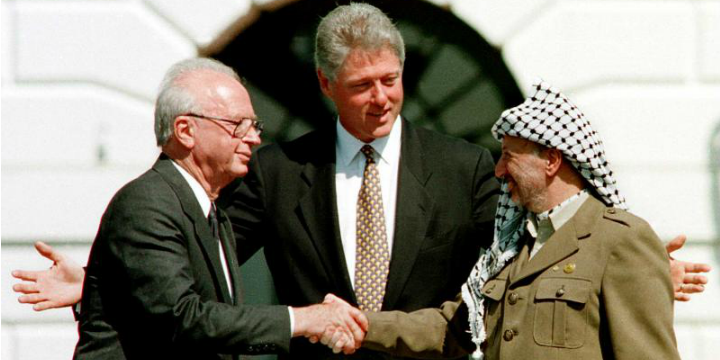
The signing of the Oslo Accords in Washington, DC, Sept. 13, 1993. Photo: Wikimedia Commons.
The below iconic photo of the Oslo era was actually staged. That’s why it’s perfect.
The “Palestinian boy” was actually a Jewish Israeli named Zemer Aloni, dressed in an “old man” style keffiyeh. Imagine a fake AI image of an “American child”” but wearing a bow tie and smoking a pipe — you’d have to be completely naive about American culture to be fooled even for a second.
Photojournalist Ricki Rosen openly acknowledged that her photo was staged, calling it a “symbolic illustration” for McClean’s magazine. Yet Israel, and the world, fell in love anyway — whether because we didn’t see what was in front of our eyes, or perhaps because we didn’t want to.

Photo: by Ricki Rosen for for McClean’s. Used pursuant to 17 U.S. Code § 107 (criticism or comment).
And that is the perfect metaphor: for both the Oslo Peace Process and much of the world today.
Rosen had to use a Jewish boy in a keffiyeh because Palestinian families (quite rightly) feared their neighbors would kill them for “collaborating” with the “zionist enemy.” As Israelis naively spoke of “taking risks for peace,” the vast majority of Palestinians openly spoke of turning Israel into an entirely Islamic state.
Both in the photograph, and in the Oslo Peace Process itself, we never really saw the Palestinians: We saw ourselves. We saw what we wanted to see. In fairness, we were imagining a worthy vision of a better future, but we were “making peace” only with our own fantasies.
Even today, we continue to pay a terrible price for that misstep.
The vast majority of Palestinians supported the Oct. 7 massacre, if elections were held today Hamas would win in a landslide, and Palestinians overwhelmingly oppose
But the problem is not only Israeli.
From US Presidents Lyndon Johnson to Barack Obama, from George W. Bush to Joe Biden, we’ve sloganized about “universal values,” and the fantasy that everyone in the world thinks exactly like we do. It makes a great soundbite, but it’s about as real as a staged photo of a Jewish boy in an old man’s keffiyeh.
We forget that our “universal values” were never universal — not even to us.
For millennia we lived to serve kings, czars and emperors. Dreams of freedom and peace, of prosperity and personal sovereignty, became commonplace only during the Enlightenment: an absolutely groundbreaking new philosophy which is only slightly older than America itself — the mere blink of an eye in human history.
Enlightenment thought (and its consequent freedoms and democracies) spurred innovations that have reduced poverty, hunger, disease, and oppression to levels never before imagined.
Yet even today, the Enlightenment has not taken hold everywhere.
One competing worldview is radical Islamism — not to be confused with Islam (which is a religion), Islamism is an ideology that envisions a violent Islamic conquest of the entire world. Not all Muslims are Islamists: To the contrary, Muslims tend to be its greatest victims. Yet Islamism is nonetheless a widespread and potent force.
That radical ideology stems from the battle of “Khaybar,” a 7th century massacre in which Mohammad annihilated an entire Jewish community: including mass murder, ritualistic beheadings, mass torture, mass rape, and taking captives.
Sound familiar? That’s because it is.
During the Oct. 7 massacre, Palestinian terrorists, civilians, and United Nations staff shouted “Khaybar, Khaybar, ya Yahud!” while carrying out exactly those same acts against Israeli victims.
Khaybar is also part of the foundational ideologies of the Islamic Republic of Iran, Al Qaeda, the Taliban, and ISIS. In all those states (or proto-states) the atrocities of Khaybar are recurring and commonplace. That’s why it shouldn’t have been surprising this week when Ahmad Vahidi, commander-in-chief of Iran’s IRGC, invoked Khaybar while explaining “Islam can be made to rule the world.”
If you have clean water and plenty of food today, if you aren’t in fear for your life or in agonizing pain, the Enlightenment has something to do with that. Our “universal” values, and their consequent innovations, have been the single greatest force for good in human history. Every human being deserves those benefits.
Maybe that’s why it’s so hard for us to accept that not everybody wants them.
Daniel Pomerantz is the CEO of RealityCheck, an organization dedicated to deepening public conversation through robust research studies and public speaking.


