





France, Canada Join UK in Expanding Trade Sanctions on Israeli Communities in West Bank
Error: Contact form not found.

 by Ailin Vilches Arguello

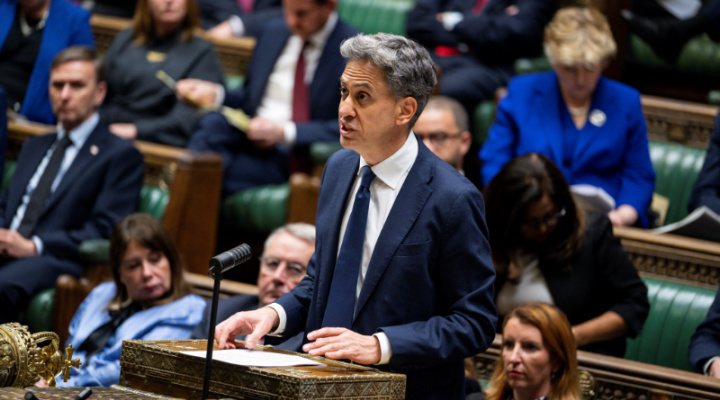
Britain’s Foreign Secretary Ed Miliband speaks at the House of Commons in London, Britain, Sept. 8, 2026. Photo: HOUSE OF COMMONS/Handout via REUTERS
France and Canada will join the United Kingdom in imposing new trade sanctions on Israeli communities in the West Bank, marking one of the most far-reaching Western measures yet as international efforts to boycott and isolate the Jewish state continue to grow.
During a speech in the British Parliament on Tuesday, Foreign Secretary Ed Miliband announced a sweeping package of sanctions targeting Israeli settlements in the West Bank, along with a series of additional punitive measures, in what marks one of London’s sharpest rebukes of Israel as relations between the two longtime allies deteriorate.
In a sharp break from Britain’s longstanding foreign policy, the country’s top diplomat accused the Jewish state of “unlawful occupation” of the West Bank, denouncing what he described as an “expansionist agenda via illegal settlements.”
Miliband further accused Israelis of fueling escalating violence against Palestinians, warning that “settler terrorism is rampant.”
“The British government agrees that there is ethnic cleansing of Palestinians in areas of the West Bank – perpetrated by settler terrorists,” Miliband said during his speech. “The Israeli government has turned a blind eye to this and, worse, members of it have made statements and taken actions to support the forced displacement of Palestinians.”
Unlike the current framework, a sweeping trade prohibition goes further by legally blocking goods produced in the West Bank from entering the British market, rather than simply imposing differentiated trade rules or labeling requirements — significantly tightening restrictions and fundamentally reshaping Britain’s trade policy toward the region.
Expected to take effect within six to nine months, London’s new policy measures will ban imports of goods from Israeli communities in the West Bank and impose sanctions on companies and individuals that “facilitate settlement expansion,” including those providing construction, infrastructure, financing, or real estate services for such development.
The British government will also deny licenses for arms and other exports deemed to materially support what British officials called Israel’s “occupation,” ban advertising for settlements in the UK, and sanction a group of “extremist settlers” accused of supporting or inciting violence against Palestinians.
Some analysts were quick to note that such actions will hurt Palestinian workers, thousands of whom work for Israeli employers in West Bank settlements and could lose their jobs as a result.
France and Canada have announced they will both join Britain in imposing their own import bans on goods from Israeli communities in the West Bank, adding to growing boycott efforts aimed at economically isolating the Jewish state.
The measures mark another escalation in the growing rift between Israel and the two Western allies amid the war in Gaza, with Paris and Ottawa backing efforts to recognize a Palestinian state last year and France also pressing within the European Union to end the bloc’s association agreement with Israel.
According to Miliband, several other European countries — including Denmark, Finland, Iceland, Poland, Portugal and Sweden — have also pledged to back the UK’s latest measures, signaling growing support for the British initiative.
“The unlawfulness of the occupation should be reflected in the economic relationships we choose to have with the occupied territories,” the top British diplomat said.
Eleven other countries ultimately joined the UK in saying they would “introduce national and/or support European restrictions on trade in goods with settlements which are illegal under international law, or that they are actively considering these and other measures, in accordance with their national procedures,” according to a joint statement.
Even as the bilateral relationship between Israel and the UK comes under increasing strain, Miliband said Britain would maintain trade with the Jewish state within the Green Line and continue to oppose the broader boycott, divestment, and sanctions (BDS) movement against Israel.
“Our argument is not with the people of Israel, with whom the UK has unshakable bonds,” he said. “Our argument is with the conduct of its government.”
Experts noted that the economy of Israel proper and the West Bank are inextricably linked, making it virtually impossible to take such punitive measures against the latter without affecting the Israeli economy.
Israeli Foreign Minister Gideon Saar sharply denounced the British government’s latest measures, announcing the closure of the British consulate in Jerusalem and warning other countries against taking similar action against Israel.
The top Israeli diplomat rejected Miliband’s accusations as “outrageous lies,” denouncing the British government’s “hostile actions” as driven by domestic political considerations in London.
“The British move is morally distorted, and constitutes blatant interference in the affairs of a sovereign state and its electoral process,” Saar said in a statement. “The message to every government that harms us is clear: You will lose your influence and relevance in the region.”
We reject outright the outrageous lies and actions of the British Labour Government.
The message to every government that harms us is clear: you will lose your influence and relevance in the region. pic.twitter.com/iIZkxh4AqN
— Gideon Sa’ar | גדעון סער (@gidonsaar) September 8, 2026
In coordination with Israeli Prime Minister Benjamin Netanyahu, Saar announced further retaliatory measures, including barring Britain from the US-led Gaza coordination mission in Israel, ending British training for Palestinian Authority forces in the West Bank, and banning 12 elected officials and British citizens involved in anti-Israel or antisemitic activities from entering the country.
US Ambassador to Israel Mike Huckabee had also warned that Washington could retaliate against Britain amid the escalating dispute, accusing the British government of “Jew hate” and describing its actions as “discrimination against the Jewish people.”
Britain’s Jewish community has also voiced strong opposition to the government’s latest measures, warning that they could undermine prospects for peace while further worsening an already hostile climate for Jews and Israelis across the country.
UK Chief Rabbi Sir Ephraim Mirvis accused British authorities of playing “gesture politics,” arguing that such measures only “embolden those, at home and abroad, who use hatred as a weapon against Jews.”
“The measures announced amount to little more than political flag bearing for mendacious anti-Israel rhetoric and those who harbor a dangerous obsession with the Jewish state,” Mirvis wrote in a post on X. “These measures will succeed only in bolstering the very extremism they seek to target.”
“On the eve of Rosh Hashanah and at a time when our community is more vulnerable than ever to the wave of extremism that has been building over recent years, these sanctions do nothing to advance the cause of peace. Nor do they make anyone safer – quite the contrary,” he continued.
This is truly a dark day for British Jews.
Today our Government has chosen to ignore the deep concerns expressed by so many of us.
The measures announced amount to little more than political flag bearing for mendacious anti-Israel rhetoric and those who harbour a dangerous…
— Chief Rabbi Sir Ephraim Mirvis (@chiefrabbi) September 8, 2026
So far, Ireland, Belgium, Norway and Spain are the only European countries to have advanced comprehensive legislative efforts aimed at banning trade with Israeli settlements, while Slovenia has encountered legal and political obstacles that have delayed similar measures.
The Netherlands is also expected to join such efforts, with a new law set to take effect on Sept. 22 that goes beyond similar measures elsewhere by banning imports from Israeli communities not only in the West Bank beyond the Green Line, but also from the Golan Heights.
According to market estimates, goods produced in Israeli communities beyond the Green Line account for about 1 percent of Israel’s exports, meaning exports from these areas to the EU are estimated at roughly $200 million annually, or about 0.3 percent of Israel’s total exports.
Under the current Israeli government, settlement construction in the West Bank has accelerated, with new housing approvals and the legalization of previously unauthorized communities expanding Israel’s presence in the territory — land Palestinians seek as part of a future independent state and which most of the international community considers a violation of international law.
Israel disputes claims that the settlements are illegal, pointing to historical and legal ties to the land as well as arguing they provide strategic depth and security considerations.
Earlier this year, the Israeli government announced plans to advance the E1 project, a settlement initiative east of Jerusalem that would effectively bisect the West Bank and sever its connection to East Jerusalem — a move that drew widespread international condemnation and renewed calls from some governments for sanctions against Israel.


