

Galvanized and Polarized: British Public Opinion on Israel After Oct. 7
Error: Contact form not found.

 by Daniel Staetsky


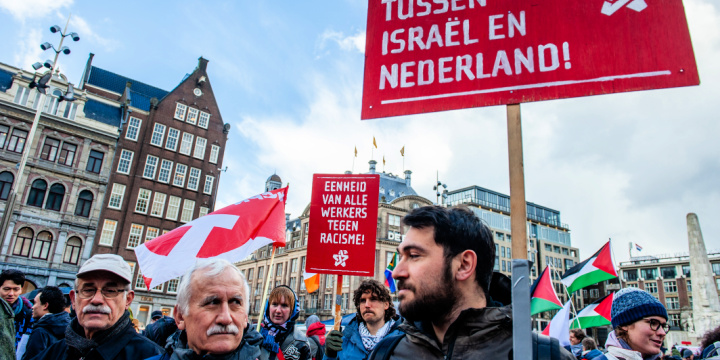
People attend the annual al-Quds Day (Jerusalem Day) rally in London, Britain, March 23, 2025. Photo: REUTERS/Jaimi Joy
“What is Britain? A small island of no interest to anyone.” These words were attributed by British journalists to a senior Russian official in 2013. If you believe British journalists, you may choose to believe this as well. David Cameron did. I personally believe it not because of the journalists, or even Cameron, but because I believe in the Russian wit.
As much as I appreciate the Russian sting, however, I do not share their minimalist view of Britain. Britain can still be great because it can teach great lessons. Which leads us, naturally, to the British Jews.
British Jews are a small population too: about 320,000 people, just 4% of the global Jewish Diaspora and about 20 times smaller than either the American or Israeli Jewish populations. Yet they represent something much larger: the Western Jewish world in miniature. They are also unusually well documented. Britain’s admirable obsession with counting things means that we know quite a lot about their demography, economics, and politics.
What happened to British Jews after Oct. 7, 2023, is that they increasingly felt left out in the cold. We know this because British Jews have been repeatedly surveyed. In 2012, only about 10% regarded antisemitism as a very big problem in Britain. By 2018, the figure was around 20%. In 2024–2025, it approached 50%. Those pesky Jews, supposedly always “quick to complain” — if intellectual antisemites are to be believed, apparently forgot to complain before Oct. 7.
Something changed for British Jews since Oct. 7.
There are many obvious candidates: the extraordinary intensity of British media coverage of Gaza, the BBC’s treatment of Israel, endless pro-Palestinian demonstrations across Britain, the political rise of explicitly anti-Zionist forces, the recognition of a Palestinian state, sanctions against Israel. British Jews have watched their country’s political relationship with Israel deteriorate while Israel fought wars on several fronts: Gaza, Lebanon, Iran, Yemen.
But what about ordinary Britons, not the British elite and the activists?
Here we are fortunate. YouGov, the British pollster, has repeatedly asked the British public whether their sympathies lie more with Israelis or Palestinians. Crucially, it was asking the question before Oct. 7, giving us something precious in social science: a benchmark.
And the resulting picture is more interesting than the familiar story that Britain simply “turned against Israel.” Most Britons do not take sides. Today, roughly half either sympathize with neither Israelis nor Palestinians, or do not know enough to express a preference. Before Oct. 7, however, this group amounted to almost 70%.
This is perhaps the biggest change in British public opinion produced by Oct. 7: People started paying attention. Call it galvanization.
But galvanization is not the end of the story. Once people begin paying attention, some begin taking sides. And that is exactly what happened, in both directions. The proportion sympathizing more with Israelis increased from roughly 10% to 17%. The proportion sympathizing more with Palestinians rose from approximately 24% to 30%.
In other words, Oct. 7 did not simply move Britain from Israel toward Palestine. It moved people out of indifference and into opposing camps. Both camps grew. That is polarization.
Britain remains, overall, more sympathetic toward Palestinians than toward Israelis. But the transformation is not adequately described as a great national swing from Israel to Palestine. It is better described as a movement from disengagement toward engagement, and from engagement toward polarization.
This also helps explain something about British Jews. Their perception that hostility has increased is not imaginary. The anti-Israel camp really has grown. What has also grown, however, is the pro-Israel camp. Jews are understandably unlikely to experience the latter development as intensely as the former. Nobody goes home shaken because somebody expressed solidarity with them.
Add to this the sheer, deafening volume of political conversation about Israel and Palestine. On Oct. 8, 2023, British Jews effectively woke up in a society suddenly preoccupied with the Jewish political drama in the Middle East — and in which a noticeably larger number of people were openly hostile to Israel.
I have my own miniature dataset illustrating this change. Since late 2018, I have kept what I call a “kipah diary.” I wear a kipah, that “tiny black hat” — as right-leaning antisemites sometimes describe it in their almost-endearing cluelessness. Being visibly Jewish has one methodological advantage: It attracts commentary. Before Oct. 7, commentary was rare. From January 2019 until May 12, 2024, about 64 months, I recorded precisely 25 unsolicited comments. Twenty-four were positive and one uncertain. People said “shalom,” asked about Judaism, or otherwise expressed friendly curiosity.
Then things changed. On May 12, 2024, a young man from Malawi (so he said) approached me on a main road in Cambridge, UK. “Are you a Jew?” I confirmed that I was. “It is tough for you now. I hope your nation is well.” He touched my arm and walked away. I went home and updated the spreadsheet. A demographer has his duties.
In the roughly 30 months since then, I have received about as many kipah-driven comments as during the previous 64 months. The volume more than doubled. And the comments became sharper, in both directions.
Negative comments, previously almost nonexistent or uncertain, appeared, including straightforward hate speech: “death to the Zionist scum” being one memorable example. But positive comments became more emphatic too: “I am with you all the way. God gave you that land” is no longer particularly unusual.
My kipah diary is obviously not a representative survey of Britain. It is one man walking around while visibly Jewish. But remarkably, its pattern resembles the YouGov data. More attention. More commentary. Less indifference. Stronger hostility. Stronger solidarity. Galvanization and polarization. This, I think, is the major lesson of Britain after Oct. 7.
The country did not simply become anti-Israel. Something more complicated happened. A conflict that for most Britons had been distant background noise became politically and emotionally salient. People who previously had no position acquired one. Some moved toward the Palestinians, others toward Israel.
For British Jews, however, this symmetrical statistical process produces an asymmetrical lived experience. The growth of pro-Israel sympathy is reassuring, when it is known. It cannot have the same effect as negativity. The growth of anti-Israel hostility can change how it feels to walk down the street wearing a kipah. Numbers measure both movements. Human beings do not necessarily experience them equally.
And perhaps that is why this small population on this supposedly small island is worth watching. British Jews may be experiencing, in miniature, something that other Western Jewish communities will recognize increasingly well.
“Take the utmost care and watch yourselves scrupulously so that you do not forget the things you saw with your own eyes and so they do not fade from your mind as long as you live. And make them known to your children and your children’s children” (Deuteronomy 4:9)
Dr. Daniel Staetsky is an expert in Jewish demography and statistics. He is based in Cambridge, UK.