







European Parliament Backs Calls to Put Muslim Brotherhood Entities on Terrorist List
Error: Contact form not found.

 by Ailin Vilches Arguello


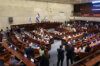
General view of the hemicycle during the debate on the European resolution proposal of the DR group aiming to include the Muslim Brotherhood movement on the European list of terrorist organizations at the National Assembly in Paris France on Jan. 22, 2026. Photo: Sami Karaali / Hans Lucas via Reuters Connect
The European Parliament on Thursday approved a resolution calling on the European Union to add people and entities linked to the Muslim Brotherhood to its list of terrorist organizations, amid growing concerns over the group’s influence and Islamist threats across the continent.
With the resolution passing 381-167, with 15 abstentions, the measure now goes to the European Council, which determines the EU’s political direction, after lawmakers called on member states to develop a joint strategy to counter what they described as “Islamist infiltration and Muslim Brotherhood networks.”
As part of the broader effort to counter the growing influence of Islamist networks, European officials have called on EU member states to develop a common strategy for identifying signs of infiltration, including “double messaging” — when individuals use moderate language in public or political settings but promote more extreme views in mosques or private settings.
The resolution also urges governments to strengthen cooperation against extremist networks and support Muslim intellectuals and activists who publicly defend democracy, freedom of conscience, and the rule of law.
Among the measures proposed is ending public funding for Islamic fundamentalist groups and increasing oversight of civil society and youth organizations that could be influenced by individuals who support terrorism.
Earlier this year, the United States also ramped up pressure on the Brotherhood, designating several of its branches and affiliated organizations in Egypt, Jordan, and Lebanon as terrorist entities, underscoring growing international scrutiny of the group and its networks.
Founded in Egypt in 1928 by schoolteacher Hassan al-Banna, the Brotherhood seeks to implement Islamic law around the world by any means necessary, embracing both violent terrorism and lawful political activity.
Today, the most influential Brotherhood-created group is Hamas, the Palestinian terrorist group that perpetrated the Oct. 7, 2023, invasion of southern Israel, the deadliest massacre of Jews since the Holocaust.
According to a recent report by Israel’s Ministry for Diaspora Affairs and Combating Antisemitism, the Muslim Brotherhood has built an extensive network of activists and organizations across Europe, including dozens of groups and individuals identified as affiliated with the movement’s European wing.
“The Muslim Brotherhood operates in Europe through deceptive methods that project an outward appearance of moderation and pragmatism,” Avi Cohen-Scali, the government ministry’s director general, said in a statement.
“This front is used to advance dangerous ideological goals. Despite its external ‘moderation,’ the movement consistently rejects liberal democratic principles and Western values, which conflict with its radical aspirations — including efforts to Islamize Europe,” he continued.
Israeli officials have repeatedly warned that these groups seek to expand their influence “from the bottom up” across Europe by investing heavily in education, religious outreach, youth engagement, and leadership development programs while maintaining a restrained and moderate public profile.
Although the organizations within the network appear, on the surface, to operate independently, their activities are in fact coordinated by a small group of senior activists that effectively serves as a “core leadership nucleus” directing the network as a whole.
These groups are also reportedly connected to pan-European Muslim Brotherhood structures, as well as organizations affiliated with the movement in Qatar and Turkey.
On the financial level, intelligence monitoring has identified an extensive economic infrastructure underpinning the Muslim Brotherhood network, spanning charitable associations, donation flows, real estate assets, and diverse business entities.
Israeli officials have also warned that these organizations tend to maintain a tightly controlled public profile, especially online, steering clear of explicit anti-Israel or antisemitic language while foregrounding narratives of moderation, interfaith cooperation, civic participation, and opposition to violence.
However, these groups are fully aware they remain under ongoing scrutiny by domestic security services, raising concerns among intelligence officials that more radical agendas may continue to be advanced in less visible environments beyond public oversight.


