





Colombia to Open Embassy in Jerusalem Next Week After Restoring Ties With Israel
Error: Contact form not found.

 by Ailin Vilches Arguello

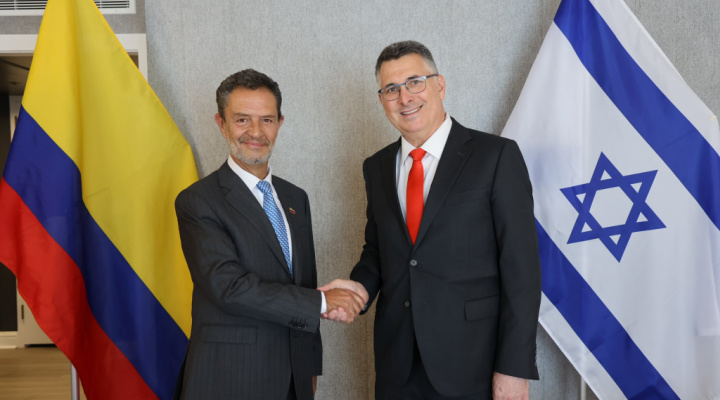
Israeli Foreign Minister Gideon Saar meets with Colombia’s incoming Foreign Minister Omar Bula in Washington, where the two sides agreed to restore diplomatic and economic ties after years of strained relations. Photo: Screenshot
Colombia will officially open its embassy in Jerusalem next week, recognizing the city as Israel’s capital and signaling a renewed partnership between the two countries under Bogotá’s new administration.
Israeli Foreign Minister Gideon Saar confirmed that Colombia will formally relocate its embassy from Tel Aviv to Jerusalem next Wednesday, calling the move “historic” as the two countries work to rebuild ties and strengthen their bilateral relationship.
“We are set to inaugurate Colombia’s embassy next Wednesday,” the top Israeli diplomat said at a press conference on Thursday, noting that the Democratic Republic of the Congo would also move its embassy to Jerusalem “very soon.”
“When I took office as foreign minister, there were five embassies in Jerusalem. Next week, that number will reach 10,” he continued.
According to a Colombian Foreign Ministry press official, Foreign Minister Omar Bula will travel to Jerusalem on Sunday to attend the embassy’s inauguration.
“This is a historic diplomatic milestone, but above all, it reflects the truth that Jerusalem is the capital of the Jewish people and the State of Israel,” Saar told reporters.
The embassy move would align Colombia with the United States and several other governments: Guatemala, Honduras, Kosovo, Papua New Guinea, Paraguay, Fiji, Nauru, and Somaliland, all of which have moved their embassies from Tel Aviv.
Under Colombia’s new president, Abelardo de la Espriella, who took office earlier this year, Bogotá has moved to fully restore bilateral relations with Israel, deepen cooperation across key sectors, and reverse years of diplomatic tensions under former left-wing President Gustavo Petro, whose anti-Israel policies and rhetoric severely strained one of Latin America’s historically closest partnerships with Israel.
Colombia’s new government has also withdrawn the country’s support for South Africa’s contentious genocide case against Israel at the International Court of Justice (ICJ), signaling a broader shift in Bogotá’s approach to Israel and its standing in international forums.
Historically, Colombia has been among Israel’s closest partners in Latin America, maintaining strong security, economic, and diplomatic cooperation for decades. However, relations deteriorated sharply under Petro, who filed a declaration of intervention in South Africa’s case in April 2024 and severed diplomatic ties with Israel the following month over the war in Gaza.
Across Latin America, several governments moved to downgrade or sever diplomatic ties with Israel following the outbreak of the war in Gaza, as part of broader efforts to pressure and isolate the Jewish state over its defensive military campaign against the Palestinian terrorist group Hamas.
Now, a broader geopolitical shift is unfolding across Latin America, as a growing number of conservative governments seek closer ties with Israel, allowing the Jewish state to build on this emerging trend by expanding cooperation, strengthening alliances, and deepening bilateral relations throughout the region.
This growing momentum in Israel’s relations with Latin America builds on the expanding reach of the Isaac Accords, a framework signed earlier this year by Argentine President Javier Milei and Israeli Prime Minister Benjamin Netanyahu to deepen ties with governments across the region while strengthening cooperation against antisemitism and terrorism.
Modeled after the Abraham Accords — a series of historic, US-brokered normalization agreements between Israel and several Arab countries — the new initiative aims to deepen political, economic, and cultural ties between the Jewish state and Latin American governments, with expanded cooperation in technology, security, innovation, trade, and economic development as countries across the region work together to address shared security challenges.
The Isaac Accords also seek to institutionalize expanding cooperation with Latin American partners through enhanced intelligence-sharing, security coordination, and joint law enforcement efforts targeting Iranian proxy networks and transnational criminal organizations operating across the hemisphere.


