








The Scientific Foreknowledge of the Jewish Sages
Error: Contact form not found.

 by Adam Jacobs

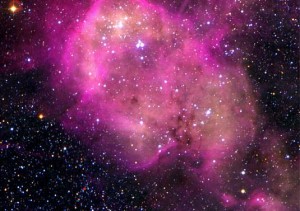
Brightt Nebula. Photo: European Southern Observatory.
There is something tantalizing in the notion that contrary to popular belief, ancient people may have been in possession of a far greater level of insight about the nature of reality than they have generally been given credit for. Though there is the danger for this exploration to rapidly veer off into the loony bin of UFO encounters, Atlantis theories and the like, there are some serious thinkers who have noted that some cultures seem to have been aware of aspects of the natural world that, all things being equal, they should not have been. The Israeli professor of engineering at Ben Gurion University, Haim Shore, is one of those people and he has recorded his findings in a fascinating work called “Coincidences in the Bible and in Biblical Hebrew.”
Though at no point does Professor Shore describe these data points as explicit proofs of anything, one is left wondering: if his examples are indeed true, what does it mean? How could human beings living hundreds or thousands of years ago have known about matters which they could not have verified through experimentation or that would have required knowledge of parts of the world that had not yet been discovered or phenomena that are fully invisible to the naked eye? One possibility is that they didn’t know anything about these matters and that it’s just wishful thinking or reverse engineering of facts that make it seem as though it were true. Another is that they speculated so often about so many matters that occasionally they just got lucky about a few random facts and supporters just cherry-pick the ones that work and have discarded the more embarrassing ones.
As it happens, in the cases described by professor Shore (and others), the Jewish People have been familiar with the quoted sources for an extremely long time – the Talmud, the Zohar and other ancient texts were well known and widely dispersed so it’s not as if the examples have been culled from some wholly esoteric source and then spun at some later date to sound like a more recent scientific discovery. The examples are also quite clear and specific – there is no convenient ambiguity that can be interpreted in a variety of ways. And while it is true that the sages discussed and believed much of the scientific wisdom of their day that is now known to be incorrect, (such as a belief in the spontaneous generation of lice or the advice that pregnant women should drink wine), they never claimed to have a lock on the totality of knowledge – scientific or otherwise. They only claimed that they were given the keys to certain aspects of life that in general would help them with their spiritual practice. It is interesting to note that in many examples they give which do appear to be correct they claim to know through tradition and not through any particular inquiry. If true, what would be logical to posit as the source of their knowledge? Here are three examples:
Number of Stars
The Naked eye is able to perceive about 4000 stars in the night sky. Though the ancients might have wondered if there were any others beyond our perception there is no logical reason to assume that the number that they would imagine would be in the quintillions. There is even less reason to imagine that they would have suggested a number that is close (on a galactic scale) to the number that cosmology currently posits. This is what the Talmud had to say about it almost 2000 years ago:
“I created 12 constellations in the firmament, and for each constellation I created 30 hosts (clusters of stars), and for each host I created 30 legions (30 legions of stars for each host), and for each legion I created 30 divisions, and for each division I created 30 battalions, and for each battalion I created 30 camps, and to each camp I have attached 365,000 tens of thousands of stars, corresponding to the days of the solar year, and all of them I have created only for your sake.” (Brachot 32B)
Doing the calculations we see that:
– each camp has 3,650,000,000 (1000 x 10,000)
– 30 camps x 30 battalions x 30 divisions x 30 legions x 30 hosts x 12 constellations = 291,600,000 camps
– 3,650,000,000 x 291,600,000 = 1,064,340,000,000,000,000.
It is interesting to note that in 1997 NASA concluded there were 10 to the power of 21. Other sources suggest both smaller and larger numbers. The Jewish sages said it was 10 to the power of 18. Whatever the actual number may be, what would have prompted them to speculate on such a massive scale?
Continental Drift
Genesis 1:19 says “Let the waters under the heaven be gathered together unto one place and let the dry land appear. And it was so.” Again, around 2000 years ago the Zohar Chadash (12:1) explained that “one single continent came out of the water, and from it seven continents were formed.” (There is a dispute between academics and religious scholars on the issue of the Zohar’s age, but either way, the texts are, by any standard, pre-scientific revolution). There are manuscripts and references to the Zohar that go back as early as the 14th century, yet the first scientist to talk about continental drift was Alfred Lothar Wegener in his book “The Origin of Continents and Oceans” in 1915. By what means would these sages have acquired the notion a) of a single land mass that broke apart, and b) the correct number of continents before they were even discovered? Why would they even discuss it?
The Law of Conservation of Mass and Energy
250 years ago Anton Lavoisier, (the father of modern chemistry), proved that matter that appears to have been destroyed continues to exist in a different form. It was a striking discovery due especially to the non-intuitive nature of the reality – when you burn a piece of paper it really does appear to be gone. 2800 years ago, King Solomon wrote the following in the book of Ecclesiastes “I know that whatever God does, it shall be forever; nothing can be added to it or taken away.” 1500 years later Rabbi Saadiah Gaon in his book of Beliefs and Opinions explained this verse to mean that “…a created object can never annihilate another object in any way. Even if it is burnt with fire, it can never be annihilated; because it is impossible to destroy something to the point that it becomes nothing; for only God [can do this], who himself created it from nothing.”
Other examples that strangely parallel with our modern, scientific understanding:
– The origin of the universe
– The exact length of the lunar cycle
– The existence of the outer layer of the sun
– Water in space
– Meteorites as a source of water on planet Earth
– The effects of sound waves on matter
– The weight of air
– How the conception of twins occurs
– The day when blood coagulation begins
Each one of these examples may be coincidental and there may be a variety of alternative methods of explaining them. But what if they are (as these sages claimed) the revealed wisdom of a transcendental power – one for whom this foreknowledge would be rather intuitive as it was the designer of the system in toto? Would that not be a simple and elegant solution to the question? At the very least, it’s intriguing.