



Europe’s Future, 70 Years After Wannsee Confererence
Error: Contact form not found.

 by Danny Ben-Moshe

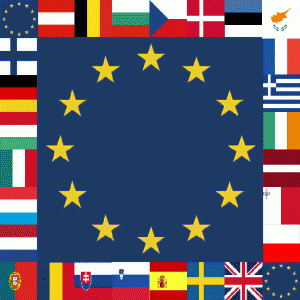
EU Flags. Photo: wiki commons.
On January 20, 1942, the Nazi leadership gathered in a villa on the outskirts of Berlin and adopted the “Final Solution to the Jewish Question.” The Wannsee Conference, as this became known, from the suburb where the meeting was held, formalized the process that exterminated so much of European Jewry.
As we mark the 70th anniversary of that 90-minute meeting in which 15 people condemned millions to death, there are many crucial lessons to learn from the Holocaust. I wish to highlight two.
Firstly, the killing of a people begins not with violence, but through race-based hatred, progressing to institutionalized discrimination and only then culminating in murder. This is why anti-Semitism, racism and institutionalized discrimination must be addressed, for if left to fester the consequences can be tragic, severe and widespread.
Secondly, the Nazis may have come to power hating Jews, and by the time they launched World War II virulent anti-Semitism was a central policy, but they neither came to power nor launched World War II with the aim of exterminating European Jewry. Hitler wanted Europe “Judenrein” but it was only after plans to deport Jews to places such as Madagascar failed and no one else was willing to accept these Jewish refugees, and only after the mass killing by bullets failed to raise the ire of the local international community, that the Nazis felt they had the green light to take genocide to an unprecedented place.
Today, as Europe teeters on the edge of an economic abyss, as the movement of refugees and asylum seekers literally racing to cross borders soars on a daily basis, and as anti-Semitism evolves and shows no sign of abating, it is imperative that the evolution, nature and consequences of the Holocaust remain clear. But Holocaust memory is under unprecedented attack. Crass Holocaust deniers like David Irving have been discredited since he lost his libel trial in London in 2000, but new trends in denial are alive and well in new-accession member states of the European Union, particularly the three Baltic countries, Lithuania, Latvia and Estonia, with much support from rightwing political forces in Hungary, the Czech Republic and others.
Articulated in the 2008 Prague Declaration, and actively pursued by the leadership of a number of Eastern European Union states, the “Prague Process” (as the Prague Declaration is referred to by its proponents) has been active in the European Union, most notably securing passage of a 2009 resolution calling for all of Europe to enact a single day of commemoration for Nazi and Soviet crimes. Other dangerous proposals being pushed include the effort to “overhaul” textbooks throughout the European Union to ensure “equal treatment” of Nazi and Soviet crimes, and efforts to criminalize the opinion that the Nazi Holocaust was the only genocide in 20th-century Europe.
HISTORICAL EXPERIENCE has made Jews empathetic to the suffering of others, and indeed the East European countries suffered brutally under four decades of Soviet rule. Hundreds of thousands of people lost their jobs, were deported, were forced into labor camps by Communist regimes whose cruelty was beyond doubt, and far too many perished or had their lives ruined. Soviet crimes were nothing less than horrible and should be remembered in their own distinct way. But there was no Soviet genocide. There was no Soviet Holocaust.
By blurring the definition of genocide, that earth-shattering term loses its meaning. If everything is genocide then nothing is genocide.
To mark the anniversary of Wannsee and to counter the dangerous trends in Europe today, I have released the Seventy Years Declaration on the Anniversary of the Final Solution at Wannsee, together with Professor Dovid Katz, author of the DefendingHistory.com blog. The declaration has been signed by over 70 parliamentarians from 19 European Union countries, including three former Europe foreign ministers, two vice presidents of the European Parliament and a vice president of the Bundestag. In addition to remembering the Final Solution plan with “humility and sadness,” the declaration explicitly rejects the notion of “double genocide.”
Seventy years after the Wannsee Conference, the reconciliation process for the crimes of World War II is not yet complete, particularly in the Baltics. Accordingly, the declaration calls for EU member states to “continue efforts to acknowledge their own roles in the destruction of European Jewry” and the “need for ongoing genuine Holocaust education and memorialization across the European Union.” The rise of anti-Semitism and other forms of racism and xenophobia in general, and the implementation of double genocide policies in Eastern Europe, makes this an urgent imperative.
Unfortunately most global Jewish organizations and the relevant branches of Israel’s government have yet to invest their resources in countering the threat of double genocide, which is necessary in order to preserve the memory of the Holocaust.
The time has come for them to join the European parliamentarians and put their names to this task. The way the Holocaust is remembered, and the success or otherwise of the Prague Process, is central not only to Europe’s past, but also its future.
This article first appeared in The Jerusalem Post. The writer is an associate professor at Victoria University in Melbourne, Australia and a documentary filmmaker whose latest film is ‘Rewriting History’ (www.rewriting-history. org). He can be reached at danny@identity-films.com. The 70th anniversary declaration can be viewed at www.defendinghistory.com.