


Hezbollah Is Using the ‘Ceasefire’ to Produce More Drones for War Against Israel
Error: Contact form not found.

 by Amine Ayoub

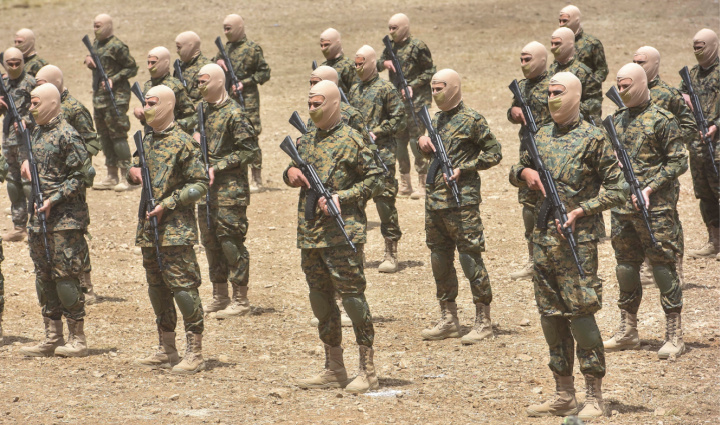
Lebanese Hezbollah fighters take part in cross-border raids, part of a large-scale military exercise, in Aaramta bordering Israel on May 21, 2023, ahead of the anniversary of Israel’s withdrawal from southern Lebanon in 2000. Photo: Fadel Itani/NurPhoto via Reuters Connect
Every ceasefire brokered over Lebanon in the last two decades has been sold to Western publics as a humanitarian achievement. In practice, every one of them has functioned, in operational terms, as a Hezbollah rearmament grant.
The pattern is not incidental. It is structural. And the international community’s reflexive demand for “de-escalation” is not a neutral diplomatic posture. It is, whether its advocates understand this or not, a subsidy to jihadist and terrorist infrastructure.
The latest iteration of this dynamic centers on first-person view (FPV) drones — the cheap, commercially derived quadcopters that have transformed low-budget militant organizations into precision-strike actors.
FPV drones cost between $300 and $500 per unit. They can be assembled in a bedroom. Their components pass through customs as hobby equipment. And Hezbollah, drawing on the organizational template pioneered by Iranian-backed groups in Iraq and Yemen, has spent the last several years building a decentralized manufacturing network across southern Lebanon and the Bekaa Valley that produces them at scale. Fragile truces are precisely what this kind of production requires: not peace, but the absence of interdiction.
The November 2024 ceasefire, brokered under heavy American and French pressure and nominally requiring Hezbollah’s withdrawal north of the Litani River, has already demonstrated its limits.
Israeli intelligence has documented continued Hezbollah military presence in areas from which it was supposed to have withdrawn. UNIFIL, the United Nations force whose mandate is to verify compliance, has neither the posture nor the political will to challenge an armed militia operating among civilian infrastructure. The result is a familiar tableau: international monitors certifying a calm that exists only on paper while Hezbollah’s engineers iterate on drone designs beneath it.
This is not a failure of implementation. It is a failure of concept. The assumption embedded in every ceasefire framework applied to Lebanon is that Hezbollah is a conventional actor whose military behavior can be modified through diplomatic pressure and monitored through neutral observation.
That assumption was wrong in 2006, when United Nations Security Council Resolution 1701 created the legal fiction that UNIFIL could disarm a militia Iran had invested decades building. It remains wrong today. Hezbollah is not a state that signs agreements. It is a revolutionary organization whose strategic doctrine treats truces as operational pauses, not political settlements.
The FPV proliferation problem sharpens this point considerably. What distinguishes the current threat from Hezbollah’s pre-2006 rocket arsenal is not just destructive capacity, but manufacturing resilience.
Rockets require supply chains. FPV drones require workshops. A decentralized factory network distributed across dozens of villages is categorically harder to interdict through airstrikes than a missile depot. Ceasefire conditions, which constrain Israeli freedom of action while doing nothing to constrain Hezbollah’s production, are thus actively advantageous for the militia. Every month of monitored calm is a month of undisturbed fabrication.
The Gaza buffer doctrine offers the only operationally coherent response: Israel’s decision to establish a sustained security corridor along the Philadelphi Route and to maintain permanent interdiction pressure within northern Gaza, regardless of international condemnation, reflects an understanding that the threat environment does not pause because diplomats wish it to.
The logic applied southward must now be applied northward. A permanent Israeli military presence along the southern Lebanese border, with active interdiction authority extending to any facility identified as a drone production or storage site, is not an escalation. It is the minimum necessary to prevent the next war from beginning with swarms of FPV drones targeted at Israeli communities.
The predictable objection is that such a posture would violate Lebanese sovereignty. This argument deserves a direct answer. Lebanese sovereignty, as a meaningful concept, ceased to apply to southern Lebanon the moment that the Lebanese state chose accommodation with Hezbollah over territorial control.
A government that cannot or will not prevent a designated terrorist organization from operating military factories inside its borders has forfeited the sovereign claim to those territories as a diplomatic shield. Treating that forfeiture as a reason to constrain Israel rather than to demand Lebanese state accountability is a moral inversion that the international community has indulged for far too long. If Lebanon begins acting like a state and actually confronts Hezbollah, the issue could be revisited.
The deeper failure here is intellectual. Western governments and international institutions continue to apply a conflict-resolution framework, built around the assumption that all parties want stability, to an organization whose foundational ideology requires the permanent prosecution of jihad against Israel. Hezbollah does not want a stable Lebanon. It wants a Lebanon that provides operational depth for a war it intends to resume on terms of its own choosing.
Ceasefires built on that misreading do not prevent wars. They schedule them. The FPV factory humming somewhere in the Bekaa Valley tonight is the proof.
Amine Ayoub, a fellow at the Middle East Forum, is a policy analyst and writer based in Morocco. Follow him on X: @amineayoubx


