



Modern Day Geopolitical Conflicts and Their Effects on Global Oil Prices

February 9, 2012 3:12 pm 0 comments

2009-2011 price chart (left) and Iran's top petroleom importers (right). Photo: Thomson Reuters.

In an election year, the last thing an incumbent President needs when running for re-election is a spike in oil prices.  As The New York Times pointed out a couple of weeks ago, that scenario is most likely being considered inside the White House when deliberating strategies to deter Iran’s pursuit of a nuclear bomb.  The Algemeiner hit the books to research historical spikes in oil due to geo-political crises and risk.  The numbers seen below are not adjusted for inflation.  Here’s what we found.

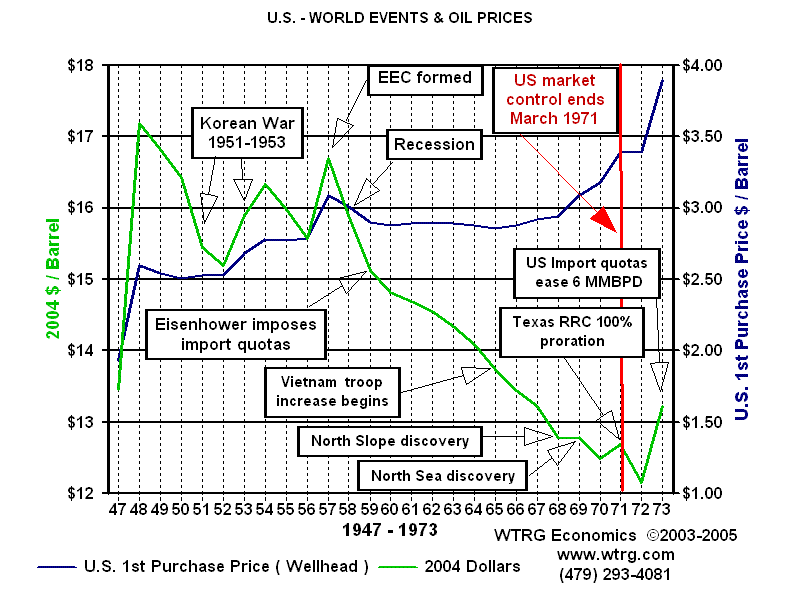
From 1951-1953, during the Korean War oil prices hovered between $17 to $19 in 2010 dollars. Prices were kept in check with price ceilings by The Office of Price Stabilization, which was modeled after the Office of Price Administration.  The OPA was established in response to America’s involvement in World War II and kept a lid on retail and rent prices in the U.S.

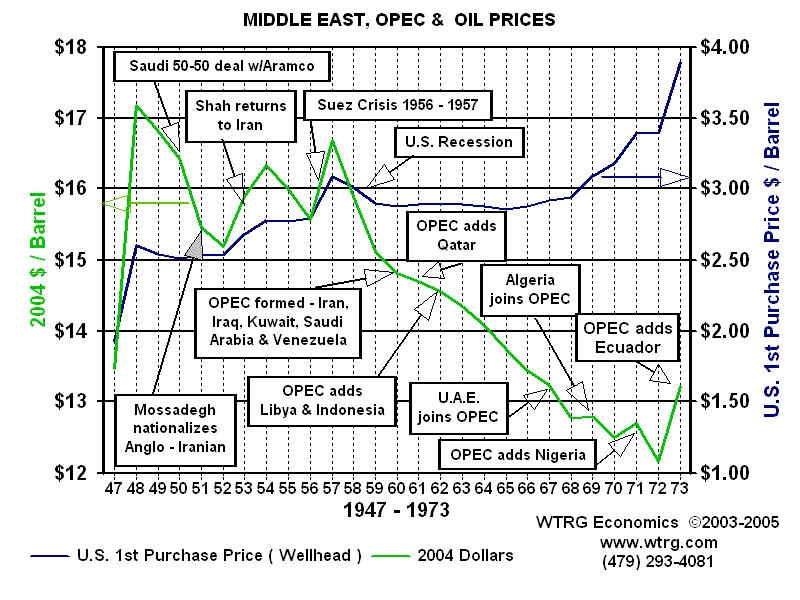
During the Suez crisis from 1956-1957 no noticeable price increase occurred as oil prices remained between $18 to $20 in 2010 dollars. The supplemental production from oil producers around the world helped to make up for the disruption of Middle Eastern oil supplies.

Following the Yom Kippur war, oil prices quadrupled during the six-month period from October 1973 to March 1974. This was because Arab countries imposed an oil embargo on countries that supported Israel during the Yom Kippur war. The net loss of four million barrels per day in oil production represented 7% of global oil production.

From 1974 to 1978, world oil prices remained stable. However, the nominal oil price more than doubled from $14 in 1978 to $35 per barrel in 1981 due to two major reasons. First, Iran’s oil production fluctuated wildly between 1978 to 1979 because of the Iranian revolution. Secondly, the Iran-Iraq war started in 1980 and both Iran and Iraq were producing “6.5 million barrels per day less than the previous year.” Global oil production was 10% lower in 1980 than in 1979. Both Iraqi and Iranian oil production have never reached their 1978 peak production levels.

During this time, from 1973-1981, the United States imposed price controls on domestic oil production.  This led to higher prices on imported oil left American citizens with a lower price on crude than the rest of the world.  The price controls were lifted in the early 80’s.

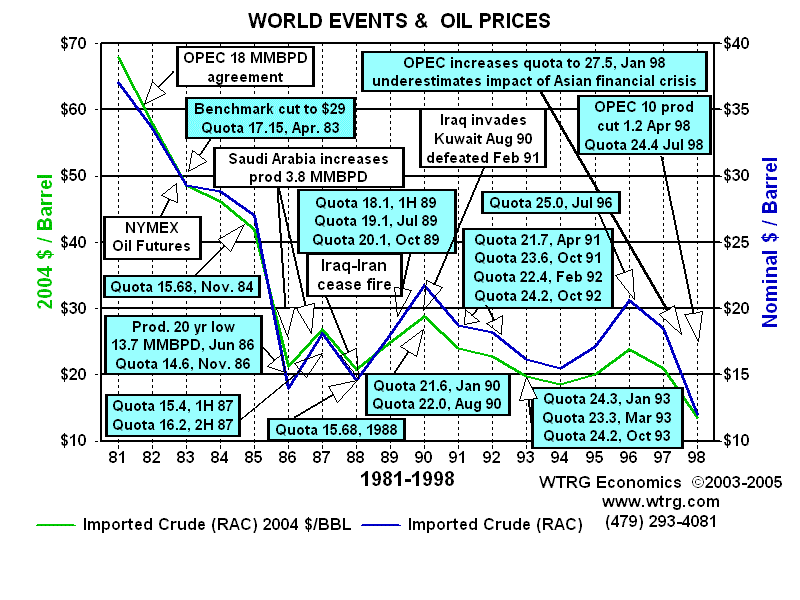
From 1981 to 1986, world oil prices declined from $80 to the $20-$30 range in 2010 dollars. This was a byproduct of declining global oil demand, increasing non-OPEC oil production and Saudi Arabia increasing its oil production from 2 million to 5 million barrels per day in 1986.

There was a brief spike in oil prices during the 1990-1991 Gulf War. However, after the Gulf War, oil prices continued a decline, reaching a low of $10-$15 (in 2010 dollars) in 1999 due to the Asian financial crisis.

Oil prices increased over the next two years but dropped following the September 11 attacks. From 2003 to 2008, oil prices began to increase sharply, partially due to the 2003 Iraq war. Other factors such as a weaker US dollar and Asian economic growth contributed to the oil price increase. Spare production capacity also declined from 6 million barrels per day in 2002 to 1 million barrels per day in 2005.

After reaching an all-time high of $145 in July 2008, oil prices collapsed to fall below $40 later in the year due to the global recession.

Prices spiked sharply in 2010 hitting $114 a barrel, partly due to the Libyan conflict, as well as a minor global recovery from 2008. Libya’s pre-war exports of “1.5 million barrels of oil a day, or 2 percent of global demand” were halted as rebel forces seized production fields. Prices started to decline again after some of Libya’s oil production was restored although in recent months oil prices have risen due to tensions with Iran.

In a potential future war against Iran, oil prices will almost certainly spike; possibly even reaching the $200 per barrel level predicted by some commentators. Following a potential war, the length of time it takes for the oil price to decrease and how much it declines depends on a number of factors. These factors include global spare production capacity, global oil inventory levels and the level of disruption to oil tankers moving through international waters.  The United States imports a quarter of its oil from Arab OPEC countries and it is self-sufficient in natural gas. However, global spare production capacity has declined due to supply disruptions in Libya, Yemen and Syria. Even if Saudi oil production was operating at full-capacity, Iranian military action could disrupt oil tankers trying to leave the Persian Gulf. An Iranian block the of the Strait of Hormuz would disrupt oil deliveries to China, a key Iranian ally, and India which is a major importer of Iranian oil.  This must be taken into account when analyzing the probability of an Iranian shutdown of the Strait.

Based on the results of previous price control measures, the United States should not impose price controls since it will have undesired outcomes. Instead the United States could try to increase its domestic oil production and increase energy efficiency in vehicles and factories.

Chart of oil prices from 1947-2011. Photo: wtrg.com

Leave a Reply

Please note: comments may be published in the Algemeiner print edition.


More...

  • Personalities Sports NBA Finals a Time to Remember Legendary Jewish Coach Red Auerbach

    NBA Finals a Time to Remember Legendary Jewish Coach Red Auerbach

    JNS.org - At the start of each nationally televised game of the 2013 NBA Finals between the San Antonio Spurs and the Miami Heat, ABChas aired a film-clip montage of basketball’s great players and coaches—a montage that includes Jewish coach Arnold “Red” Auerbach, the mastermind behind nine championship teams for the Boston Celtics. Red was one of four children of Marie and Hyman Auerbach. Hyman was a Russian-Jewish immigrant who left Belarus when he was 13. The couple owned a deli and [...]

    Read more →
  • Arts and Culture Jewish History The Marx Brothers and Jewish Identity

    The Marx Brothers and Jewish Identity

    JNS.org - The sons of Jewish immigrants from Germany and France, the Marx Brothers became zany masters of stage and screen who continue to captivate audiences. But in addition to providing comic relief, their films captured the drama of the entry of their marginalized religion into the U.S. Wayne Koestenbaum, author of the 2012 book The Anatomy of Harpo Marx, explains that the Marx Brothers’ Jewishness as a family “was evident, marked, thoroughly legible.” “Within a family already marked as Jewish within [...]

    Read more →
  • Arts and Culture Jewish Identity SuperJew

    SuperJew

    For my shekels, the question of whether the comic book character Superman, is Jewish or not shouldn’t even be questioned. Born and named Kal-El by his father Jor-El, “El” is one of the ancient names for God used throughout the bible and found in great prophets such as Samue-el, Dani-el and angels Micha-el and Gavri-el and of course, Isra-el. As Simcha Weinstein in his entertaining book, “Up, Up And Oy Vey” points out, “Kal” is the root of several Hebrew [...]

    Read more →
  • Israel Sports Formula 1 Road Show Thrills Jerusalem

    Formula 1 Road Show Thrills Jerusalem

    JNS.org – Some 100,000 people attended Israel’s first-ever Formula 1 Road Show in Jerusalem on Thursday and Friday. For several hours, the controversies that normally characterize Jerusalem were put aside, and a diverse mosaic of Israelis watched up close as the motor-sport stars temporarily conquered the city. “It was an amazing experience, the most fast and furious thing I have seen,” spectator Masada Porat told Israel Hayom. “It was a rare, extreme event that explodes in your face.” Spectator Irena [...]

    Read more →
  • Book Reviews Jewish Identity Klara’s Journey Casts Jews in Fast-Paced Adventure Through Russian History

    Klara’s Journey Casts Jews in Fast-Paced Adventure Through Russian History

    JNS.org – “If you’re sick, move away. Have some consideration for others,” a red army soldier scolds a slow-moving old man selling train tickets. “No, fires back the old man, proud, haughty, not realizing it’s a new country, a Bolshevik country where force heads the list instead of civility,” reads the following line in Ben G. Frank’s new novel, Klara’s Journey, released June 1. Reminiscent of Boris Pasternak’s Dr. Zhivago—whose backdrop is also a train ride across the Russian frontier during the [...]

    Read more →
  • Personalities Theater Nora Ephron, Famed Jewish Screenwriter, Remembered Through Tribeca Film Festival Prize

    Nora Ephron, Famed Jewish Screenwriter, Remembered Through Tribeca Film Festival Prize

    JNS.org – For filmmaker Meera Menon, no honor could have been more fitting than winning the inaugural award named after famed Jewish screenwriter and novelist Nora Ephron, the woman whose work inspired her. At the recent 2013 Tribeca Film Festival, Menon was named the first recipient of the $25,000 Nora Ephron Prize, given to a writer or director whose work embodies that of the late Ephron, who wrote the scripts for a number of hit films, including “When Harry Met [...]

    Read more →
  • Book Reviews Personalities Book Review: ‘Jewish Jordan’ Memoir an Important Guide for Players and Coaches

    Book Review: ‘Jewish Jordan’ Memoir an Important Guide for Players and Coaches

    JNS.org – Despite his friends’ and family’s doubts that a young Orthodox Jewish athlete could ever play college or professional basketball without compromising his religious values, between 1999 and 2009 the “Jewish Jordan” defied conventional wisdom and found his place on the court. In his new memoir, Jewish Jordan’s Triple Threat, Tamir Goodman describes his triumphs and disappointments in life, crediting his practice of Judaism for shaping his identity as an athlete and his understanding of basketball as a team sport. [...]

    Read more →
  • Blogs Sports Omri Casspi, ‘Jewish Jordan’ Partner on Basketball Camps to Inspire Youths On and Off the Court

    Omri Casspi, ‘Jewish Jordan’ Partner on Basketball Camps to Inspire Youths On and Off the Court

    Tamir Goodman (left) and NBA forward Omri Casspi—pictured on the court of the United Center, home of the Chicago Bulls—together run basketball camps that seek to inspire youths on and off the court. Photo: Courtesy Tamir Goodman. JNS.org – Before last year, basketball camps for Jewish youths never had an instructor quite like Omri Casspi, a forward for the National Basketball Association’s (NBA) Cleveland Cavaliers and the first Israeli-born player in NBA history. Casspi is a de facto ambassador for [...]

    Read more →
Sign up now to receive our regular news briefs.