








Struggling Hezbollah Diverts Cash From Lebanese Civilians to Rebuild Terror Arsenal
Error: Contact form not found.

 by Algemeiner Staff


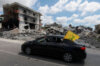
People display a Hezbollah flag from inside a car driving past rubble of destroyed buildings in Deir Qanoun al-Nahr, Tyre district, southern Lebanon, June 15, 2026. Photo: REUTERS/Aziz Taher
Hezbollah is delaying compensation payments to Lebanese civilians and slashing social benefits as the Iran-backed terrorist group directs increasingly scarce funds toward rebuilding its weapons stockpiles and preserving its military capabilities, according to a new report.
Lebanese residents have complained that money promised after their homes were damaged during the 2024 war with Israel has failed to materialize, even as Hezbollah continues paying its fighters, the Lebanese newspaper Nidaa al-Watan reported on Tuesday.
“So far, the compensation they promised us has not arrived, and the check they gave me since the war in 2024 is still in my bag and has not been cashed,” Lina, a resident of Lebanon’s Bekaa Valley, told the news publication. She said repeated attempts to get answers had gone nowhere and that she now expects to shoulder the cost of repairing her damaged home herself.
Following the 2024 war, Hezbollah announced that Al-Qard al-Hassan, the financial institution closely associated with the terrorist organization, would provide between $12,000 and $14,000 to families whose homes were destroyed. Some assistance was ultimately distributed, but selectively, leaving many families without the money they had been promised.
Hezbollah, meanwhile, has continued paying its operatives. Some fighters receive only $600 to $700, while higher-ranking members and those carrying out more significant missions are paid more, according to the report. But the organization has cut some stipends and social services traditionally provided to its Shiite support base.
The reason, according to a source cited by Nidaa al-Watan, is that Hezbollah is fighting for its survival.
Money still reaching the organization from Iran through indirect channels is now being directed largely toward replenishing weapons stockpiles and maintaining Hezbollah as a fighting force, while humanitarian assistance and social spending have been pushed aside.
The squeeze comes as authorities tighten scrutiny of Hezbollah’s traditional funding routes, including exchange houses, fuel stations, Beirut’s airport, and Lebanon’s land and sea crossings. The collapse of Bashar al-Assad’s regime in Syria, which long served as a so-called “land bridge” from Iran to Lebanon, and closure of several illicit border crossings have further complicated Iran’s ability to move funds to the terrorist group.
Despite those difficulties, Tehran has increased its financial support for Hezbollah over the past year, according to Lebanese, American, and Israeli officials cited by the Israeli news outlet Walla. But Hezbollah’s wartime expenses have risen even faster, leaving the additional Iranian cash insufficient to cover the organization’s needs.
The financial strain comes amid growing military and political pressure on Hezbollah inside Lebanon.
As The Algemeiner has previously reported, Lebanese leaders have declared that the state must ultimately establish a monopoly over weapons, while Israel has made Hezbollah’s disarmament a central demand in ongoing US-mediated negotiations with Beirut. Hezbollah has repeatedly rejected full disarmament and demanded that the Lebanese government abandon its direct talks with Israel.
The terrorist group also faces signs of eroding support beyond its traditional Shiite base. A May poll reported by The Algemeiner found that 58 percent of Lebanese respondents supported disarming Hezbollah, including large majorities of Christians, Druze, and Sunnis, although opposition remained overwhelming among Shiites.
At the same time, Hezbollah had been hoping for fresh Iranian cash. The Algemeiner reported in June that Tehran had promised to increase funding for the group as sanctions were eased and Iranian assets potentially became accessible under its agreement with Washington. US officials, however, warned that funds would not be released if they were destined for terrorist organizations.
According to the US Treasury Department, Iran transferred roughly $1 billion to Hezbollah in just the first 10 months of 2025 despite sweeping US sanctions.


