



Thinking, Fast and Slow – A Must Read
Error: Contact form not found.

 by Jeremy Rosen

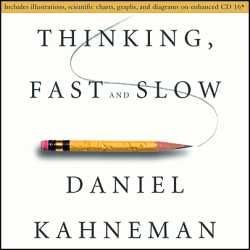
"Thinking Fast and Slow" by Daniel Kahneman. Photo: Amazon.
I must recommend Daniel Kahneman’s book, Thinking, Fast and Slow . I was won over at the very start when he describes his conversations with his late friend and collaborator Amos Tversky in the Rimon restaurant in downtown Jerusalem, just off Ben Yehudah. Ah, the memories flooded back of the many times I sat there for a quick lunch. But unfortunately it was one year before them; otherwise I might have become a wiser man.
The Israeli Nobel Prize winner for economics has written a popular analysis of how we fool ourselves into believing that we think rationally and our actions are logical, most of the time. It would fascinate me anyway because of its insights into human behavior. But, as always, I look for a religious angle and a rationalization for my own religious behavior. Many of the examples are old chestnuts. But I want to focus on two of them that relate to the function of religion.
The first is a much argued about study. In the 1960s, the psychologist Walter Mischel and his students exposed preschool children to a dilemma. They were given a choice between a small reward, one treat they could have right away, or a larger reward of two treats if they waited 15 minutes under stressful conditions–alone in a room facing a table with a single treat and a bell that the child could ring if it wanted the one treat. No toys or books or other distractions. The experimenter then left the room to return only if the bell was rung, or after 15 minutes to come with the other treat. Meanwhile the children and their antics during the waiting period were observed through a one-way mirror and recorded.
About a third of the children managed to wait 15 minutes for the bigger reward. Ten or fifteen years, later, a gap had opened up between the “resisters” and the “indulgers”; the resisters registered a higher degree of executive control in cognitive tasks, especially the ability to redirect their attention effectively, and they were less likely to take drugs. The children who resisted had substantially higher scores on college entrance exams and better “emotional intelligence”. Researchers from the University of Oregon took the experiments further and demonstrated a close connection between children’s ability to control attention and to control their emotions.
I am not interested here in the technical issues or whether one can argue that other factors count just as much, genes, environment, childrearing. I am only interested in the way this makes so much sense to me given my utilitarian attitude to ritual in religion.
I have always argued that the purpose of the many behavioral mitzvot, commandments, that regulate us from the moment we wake to the moment we sleep, are utilitarian. They are designed to get us to think before we act, to ponder, to appreciate our good health, good fortune, and to try to be positive. It is this that differentiates instinctive behavior from considered behavior. Even if one then acts merely out of habit, the habitual rituals reinforce one set of actions over another, which on balance are preferable for society. Giving charity out of habit is qualitatively more beneficial than not giving at all, although obviously it is better to give with thought, intent, and goodwill.
But more important is the issue of delayed gratification. Whether it is tantric sex or just pausing to say “thank you” before enjoying something, the benefits are huge. One of the aims of Jewish ritual is precisely this, not as Freud suggests, to deny pleasure, but quite the contrary, to increase it through delay, consideration, and heightened awareness.
The second issue is that of “priming”, influencing by suggestion, how people act. It is possible to affect the way people behave by giving them sets of words that suggest something. If the idea of EAT is on your mind you will be quicker than usual recognize a word such as SOUP when it is spoken in a whisper or presented visually with a blurred font. In an experiment conducted at NYU, collaborators between 18 and 22 were asked to assemble four-word sentences from five jumbled words. One group was given words that could suggest old age: forgetful, bald, gray, wrinkle, Florida. When they had completed their task there, they were sent down the hall to do a further experiment. It was the walk that mattered, because as the researcher, John Bargh, had predicted, those who fashioned a sentence out of the “elderly” words walked slower than those who made up sentences of completely different words. They were “primed” to think of infirmity and moving slowly. Another example, in Arizona in 2000, showed that voter support for a proposition to increase school funding was approved of far more when the polling station was in a school, with its images of classrooms, teachers, books, and pupils.
This explains a lot about the text and purpose of our communal prayers, as opposed to our private and personal ones. It is the value of the set and repeated text of formal prayer throughout the day that “primes” us with certain concepts and ideas that are at total variance with the language of the workplace. Even if one only concentrates on some of the words, one is being reminded, subliminally or consciously, of alternative, call them spiritual, values and concepts. So even if the intended aim of prayer, to communicate with or be conscious of a divine, spiritual dimension is not activated, at least the subject matter will have some impact.
The only problem with all this is I still have not explained why exactly the same rituals can have different effects on different humans. Why do some from identical backgrounds become more charitable or more aggressively evangelical or prefer prayer to study or vice versa?
But it does say to me that the intentions of the founders of our system were way ahead of their time in putting the emphasis less on theological abstractions and concepts and much more on human behavior. Freud accused Moses of imposing rituals to inhibit and repress. I would argue rather they were to help us liberate ourselves from that natural human tendency that Kahneman’s book is concerned with–to think fast, act out of impulse, and take the easiest options, rather than to think slower, harder, and more rationally to achieve greater self-control and considered action.