



The Hidden Threat of an Iranian Nuclear Bomb
Error: Contact form not found.

 by David Meyers

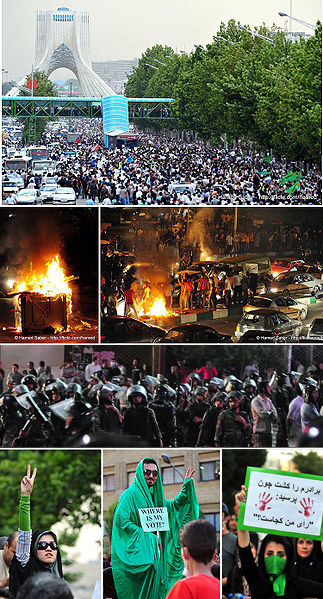
2009 Iranian election protests. Photo: Wikipedia.
As Iran races towards a nuclear weapon, it’s becoming clear that a diplomatic solution is implausible, if not impossible. The only way to stop the Iranian nuclear program, short of military intervention, is internal regime change. But given the failure of the 2009 Green Revolution, and the West’s acquiescence to the brutal suppression of the Syrian uprising, regime change in Iran seems unlikely.
Thus, opponents of military action are shifting to a new argument: we can live with a nuclear Iran. The argument, most recently articulated by Bill Keller in The New York Times, goes as follows: the Iranian regime is a rational actor and will not use a nuclear weapon against Israel (because of mutually assured destruction).
Next, although Keller agrees that a nuclear Iran would be emboldened to spread terror, violence, and bloodshed throughout the world, he argues that this alone does not justify military action. Finally, Keller argues that fears of a regional arms race are overblown, and that mutual nuclear capability will make both Israel and Iran “more cautious” about entering into direct conflict.
Some of these arguments are compelling, others less so (Iran is already the world’s leading exporter of terrorism; I hate to imagine what will happen when a nuclear Tehran becomes immune to Western and Israeli intervention).
But Keller and his ilk constantly ignore one crucial threat of a nuclear Iran: that a nuclear weapon will fall into the hands of terrorists or extremists.
It’s easy to imagine numerous scenarios of how this could occur. Perhaps, during a bitter leadership dispute, a nuclear weapon is smuggled to Hezbollah by an extremist sympathizer. Perhaps one day there is a democratic revolution in Iran, and amid their downfall, the Mullahs hand over a weapon to a terrorist group. Or perhaps Hezbollah raids an Iranian nuclear weapons facility with inside help or while the authorities turn a blind eye.
In any of these scenarios, terrorists obtain a nuclear bomb. A suitcase bomb, perhaps. And you can bet that their top target will be Israel.
This is where Keller’s argument completely fails. The whole premise of allowing Iran to obtain a nuclear weapon is based on the theory of mutually assured destruction (MAD): that Iran would never use a bomb against Israel because Israel would retaliate with its own nuclear weapons.
But if a suitcase bomb were to go off in Jerusalem, MAD simply does not work. Yes, Israel may suspect that the bomb came from Iran. But how can it know for sure? The bomb might, for instance, have been smuggled out of Russia.
Even if Israel traced the bomb back to Iran, how could they prove the bomb was used with Tehran’s blessing? The mullahs could argue that the bomb was stolen; a plausible argument. And even if Israel thinks Tehran sanctioned the strike, would Israel really respond with a nuclear attack unless it had concrete proof? Unlikely. And it’s also unlikely that concrete proof could ever be obtained.
In such a scenario, Israel would be forced to sustain a nuclear attack without any meaningful reprisal. And as resilient as Israel is, a nuclear attack is something that the country might not be able to recover from.
Thus, for Israel, there is no genuine deterrence factor when it comes to a nuclear Iran.
As Keller notes, there are serious consequences that would arise from a military attack on Iran. And I continue to believe that the best, and only foolproof, way to prevent a nuclear Iran is regime change.
But that being said, Israelis, Americans, and the world must understand that an Iranian nuclear bomb threatens Israel’s very existence. And Israel must take that into account as it considers its options for stopping Iran’s nuclear program.