







The Political Logic of the Palestinian Authority
Error: Contact form not found.

 by Dore Gold

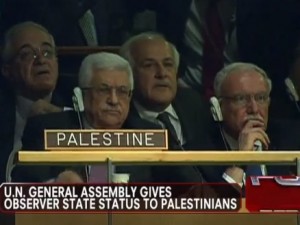
Palestinian Authority President Abbas at the United Nations.
The rumor that the Palestinian leadership systematically spread over the last few months was that immediately after the U.N. General Assembly upgraded the Palestinian delegation to the U.N., Mahmoud Abbas would renew negotiations with Israel without any of the famous pre-conditions he has set since 2009: prior Israeli agreement to the 1967 lines as the basis of negotiations and a settlement freeze including construction in Jewish neighborhoods in Jerusalem. Since these preconditions were never placed before any previous Israeli government, from Rabin to Olmert, there was a basis for questioning what were Abbas’s true motives in demanding them. By saying that they would be removed, Palestinian representatives could argue that the U.N. initiative was not seeking to wreck negotiations but rather to get them back on track.
This argument was particularly important to make with the European states like Germany, who were planning to oppose the Palestinians at the U.N., but were persuaded at that last minute to abstain. To secure their support for the upgrade resolution at the U.N., Abbas went public with this argument during November. After a meeting with Arab League foreign ministers in Cairo on November 12, Abbas himself said on the record: “if it is possible to start peace talks the following day then we are ready for that.” He was quoted by a reporter for Reuters News Agency. Later, Time Magazine reported on Nov. 28, a day before the General Assembly convened, that Abbas “promised to return to talks immediately after the U.N. vote.”
It should have come as no surprise that after the vote on Nov. 29, Abbas did not budge on his famous pre-conditions. He even used the U.N. resolution as future terms of reference that Israel must agree to if negotiations are ever to be resumed. There are many possible explanations for his behavior. After repeated rounds of negotiations with Israeli leaders over the last two decades, he may simply have lost faith in ever reaching an agreement with Israel. He knew the Palestinians’ demands and was familiar with the limits of what Israel could concede. In fact, back in 2009, he revealed to Jackson Diehl of The Washington Post that he turned down Ehud Olmert’s final proposal because the gaps were still too wide to conclude a peace treaty.
Looking at internal Palestinian politics, real negotiations with Israel in any case would also require Palestinian concessions. Yet since 2006, Hamas has become a growing force in Palestinian political life. With the demise of the regime of President Hosni Mubarak, in particular, Hamas’ advantages over Mahmoud Abbas have grown, further diminishing his room for maneuver. Indeed, after coming under attack from Hamas leader, Ismail Hanniyeh, the Palestinian Authority quickly backtracked from Abbas’ interview on Channel 2 with Udi Segal, which was being interpreted in Israel as though he had compromised the Palestinian demand for a “right of return,” by saying that he personally would not go back to live in Safed. In short, the last thing that Mahmoud Abbas needs at this point are real negotiations with Israel.
Looking at the way Israel and the Palestinians have acted over the last decade and a half it is clear that they have each been driven by two very different kinds of diplomatic logic. On the one hand, Israelis from the main political parties have been consumed with how to make negotiations work. They have tried to understand what the Palestinians need to reach an agreement and have frequently made concessions up front before sitting down with the other side. They used language as a confidence-building measure with the other side.
Thus when the Palestinians declared that they must obtain a full withdrawal from the West Bank to the 1967 lines, unfortunately, there have been a number of Israeli politicians who thought they should offer the equivalent territory, so that the Palestinians obtain the same amount of land regardless of where the final border is located. This kind of diplomatic flexibility was also used to prove a politician bona fide as a peacemaker with the Israeli public and with international elites.
However, by following this kind of thinking, long-standing Israeli diplomatic positions have been badly eroded and international expectations raised about the extent to which Israeli will concede. This approach involved ignoring U.N. resolutions, like U.N. Security Council Resolution 242, that supported Israel’s territorial claims as well as past U.S. guarantees that Israel would not have to withdraw to the 1967 lines.
On the other hand, the Palestinians were driven by an entirely different political logic. They did not feel that they had to prove to anyone the sincerity of their commitment to peacemaking. They did not have to take into account Israeli positions, thus while formal Israeli positions over the last decade and a half moved significantly, the Palestinians did not move one inch.
Moreover, Abbas felt confident enough to adopt a unilateralist strategy already in early 2009 while Olmert was still in power. In January, his minister of justice turned to the International Criminal Court (ICC) to get its prosecutor to already designate the Palestinian Authority as a state, which would allow the ICC to have jurisdiction in cases of Palestinian claims against Israeli officers. Undoubtedly, he already had his eyes on the U.N. doing the same.
Abbas also understood that part of the unilateralist strategy involved a long-term effort to win increasing Western backing for the positions he was advancing. That is why he never gave up on using the U.N. to adopt hostile resolutions against Israel, even during the height of the peace process in the 1990s. His advisers specifically say that Abbas put in a reference to the 1967 lines in the recent U.N. General Assembly resolution because of this “war of ideas” he was conducting. It was important to them to counter the Israeli claim that the territories are disputed.
Abbas’ war of ideas also involved elements of delegitimization of Israel, especially statements that denied the Jewish historical connection to Jerusalem and the State of Israel. An official Palestinian Authority book published this year insisted that the word “colonialist” be used when describing Israel, otherwise “the Zionist endeavor” will be turned from a “racist” project into “an endeavor for self-definition and independence for the Jewish people.” For the Palestinian side, words were not used as “confidence-building measures” but as instruments to be employed for political warfare.
Thus at every opportunity, Palestinian spokesmen hammered this point. Just recently, Nabil Shaath wrote an opinion piece in the Daily Telegraph against the Balfour Declaration, ninety-five years after it was issued, arguing: “Balfour, on behalf of Britain, promised Palestine — over which Britain had no legal right — to a people who did not even live there.” The Palestinians, he concluded, were a “victim of British colonialism.” In his twisted analysis, that was the context for the birth of Israel. Shaath was not trying to reach out to the Israeli side to make peace, but rather to fully discredit its national rights.
Currently, Israel’s problem is that it is being forced to suddenly change its diplomacy after years of talking about how to make negotiations work. If in the past there has been an Israeli reluctance to spell out explicitly what Israel’s territorial requirements for its security are, that will now have to change.
After all, how can Israel suddenly annex those areas in the future if Abbas decides to formally declare a state in an effort to alter the legal status of the West Bank right up to the 1967 lines? The Palestinian upgrade initiative at the U.N. did not go that far and did not alter the situation on the ground so far. But what if Abbas goes further down this path? What was thought to be helpful in the context of negotiations actually negates Israeli interests in a unilateralist scenario, which the Palestinians appear to have decided to adopt.
Moreover, Israel cannot wage an international struggle against a withdrawal to the 1967 lines, unless it explains why that would be a disaster for Israel’s future. Finally, as seen this week, it is hard to get international acquiescence to Israeli construction over the Green Line, even if it is confined to the settlement blocs, unless it is made clear repeatedly that there are parts of the West Bank from which Israel will not withdraw.
This article was originally published by Israel Hayom.