




Who Is Breaking the Illusion of ‘Breaking the Silence’?
Error: Contact form not found.

 by Sharon Levy


IDF Chief of Staff Lt. Gen. Herzi Halevi, center, speaking to commanders and soldiers in the Golan Heights on Dec. 13, 2024. Photo: IDF.
Throughout Israel’s history, IDF soldiers have worked to defend the country against those seeking its destruction. The terrorist organizations Israel faces today not only openly declare their intent to eliminate the Jewish state, but have repeatedly embedded themselves within civilian infrastructure and committed war crimes in pursuit of that goal.
The IDF, operating under a strict code of ethics and operational guidelines, is tasked with preventing atrocities such as the October 7 massacre from happening again.
Yet some Israeli non-governmental organizations (NGOs) work to undermine public confidence in the military by portraying soldiers as participants in immoral and systematic misconduct.
Among the most prominent is Breaking the Silence, which describes itself as an organization of former soldiers seeking to “expose the public to the reality of everyday life in the Occupied Territories.”
In practice, Breaking the Silence has become a conduit for allegations against Israeli soldiers and military policy, relying heavily on anonymous testimonies and broad claims that are often impossible to independently verify.
The organization’s influence on international media coverage is significant. From June 2025 through May 2026, HonestReporting.ai Labs found that Breaking the Silence or soldiers affiliated with the group were quoted 27 times in top-tier outlets, including The New York Times, CNN, and Associated Press, with a further eight appearances in stories syndicated through wire services.
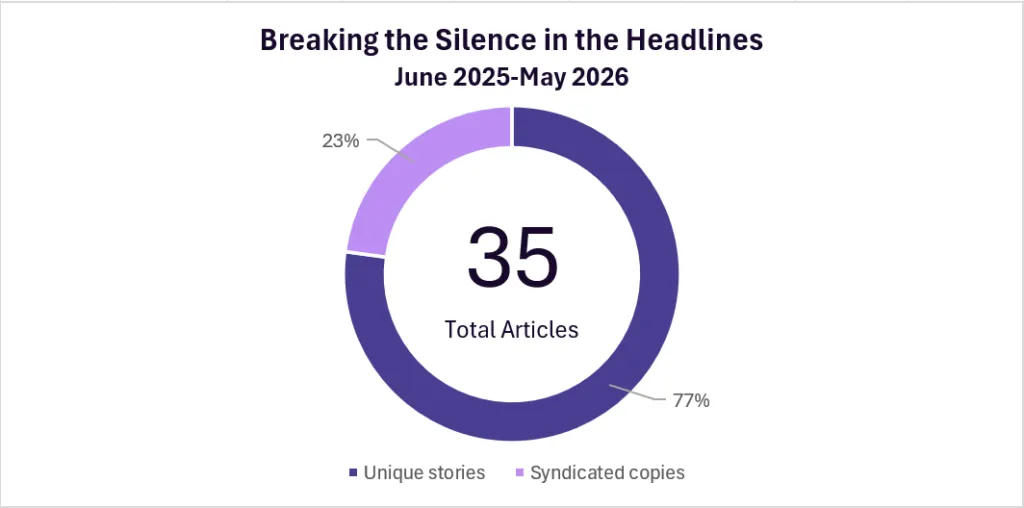
Graph based on data of top outlets from HonestReporting.ai Labs.
The gap between how Breaking the Silence presents itself and how it operates is far wider than most readers realize.
Anonymous Sources
Breaking the Silence’s latest media campaign has secured prominent coverage in The Economist and the Associated Press (AP).
Although the individual soldiers featured differed, the core allegation remained the same: that IDF troops intentionally and indiscriminately target civilians approaching the so-called yellow line in Gaza.
As is customary with Breaking the Silence, the testimonies were anonymous, making independent verification impossible.
The anonymity allowed AP to repeat claims that soldiers were “relishing the chance” to shoot those nearing the yellow line without independently substantiating the allegation. Nor did the article meaningfully address the ongoing threat posed by Hamas and other terrorist organizations operating in the area.
The IDF is not firing indiscriminately at civilians. It is targeting terrorists who approach the security zone in violation of ceasefire arrangements and military restrictions.
Yet when Breaking the Silence provides testimony, the broader security reality often disappears from the narrative.
At the same time, these allegations were being amplified, the IDF continued to uncover and dismantle extensive tunnel infrastructure, including networks extending close to or beyond the yellow line.
DISMANTLED: ~11km of underground tunnel routes east of the Yellow Line in the Beit Hanoun area in northern Gaza.
The area served as a central Hamas terrorist stronghold. An underground network built beneath residential homes, public institutions & roads, and used by the… pic.twitter.com/5B5IqPJWrj
— Israel Defense Forces (@IDF) May 26, 2026

Far from providing a comprehensive picture of the conflict, these anonymous testimonies offer international outlets sensational accusations that often cannot be independently confirmed.
The Amplification of Unverifiable Stories
The problem is not merely that the allegations are difficult to verify. It is that they are routinely elevated to headline news.
The most notable example came in a 2024 New York Times report alleging that Israel was using Palestinians as human shields in Gaza.
Relying heavily on anonymous sources connected to Breaking the Silence, the newspaper published photographs purportedly supporting the claim. The images themselves were so blurry that they provided little evidentiary value.
Here we go again. @AP‘s story on Israel’s alleged use of human shields is a repeat of an identical story from 2024 that appeared in @nytimes, @washingtonpost, @CNN & @guardian.
Even down to the same decontextualized photos supplied by politicized NGO @BtSIsrael.
— HonestReporting (@HonestReporting) May 25, 2025

That did not prevent the allegations from being presented as credible evidence.
More broadly, it highlights how Breaking the Silence’s claims are frequently treated as authoritative despite conflicting with both IDF procedures and testimony from other soldiers.
The IDF’s stated policy is to investigate allegations of misconduct whenever credible evidence is presented. Such investigations are routinely conducted.
Yet the tension between anonymous accusations and official policy is precisely what makes these stories attractive to international media.
The Economist’s recent profile of a Breaking the Silence soldier follows the same pattern. Readers are presented with dramatic allegations that cannot be independently verified, yet are framed as evidence of wider military conduct.
The objective is not to illuminate the complexities of war. It is to reinforce a narrative.
By elevating isolated, anonymous, and unverifiable testimonies, Breaking the Silence creates the impression that alleged misconduct is not exceptional but systemic.
Anti-Israel Intentions
Given Breaking the Silence’s record, it should come as little surprise that the organization consistently portrays Israel and the IDF in the worst possible light.
The NGO receives funding from foreign governments and political organizations, including substantial support from European entities. Such funding raises legitimate questions about the group’s priorities and intended audience.
If its primary purpose were to reform military conduct within Israel, one might reasonably ask why so much of its activity is directed toward foreign governments, media outlets, and international advocacy campaigns.
Nor is the methodology new.
A 2015 publication of testimonies relating to the 2014 Gaza war was criticized for relying on anecdotal and unverifiable claims.
Earlier collections of testimonies covering 2000–2010 similarly used broad allegations portraying Israeli actions as deliberate efforts to terrorize civilians. Other testimonies have been publicly challenged by soldiers who served in the same units.
The organization’s activism extends beyond soldier testimonies.
Its Hebron tours, for example, present the city as a “ghost town” and a “microcosm of the occupation, while omitting key historical context, including the ancient Jewish connection to Hebron and events such as the 1929 massacre.
As a result, Breaking the Silence has become a trusted intermediary for international journalists seeking criticism of Israel, even when the underlying claims cannot be independently verified.
The consequence is a distorted portrayal of the IDF, the ethical framework under which it operates, and the enemies it confronts.
Given the organization’s history, it is fair to ask whether that outcome is accidental – or exactly the point.
The author is a contributor to HonestReporting, a Jerusalem-based media watchdog with a focus on antisemitism and anti-Israel bias — where a version of this article first appeared.