






Exposing Child Predators Without Defaming the Innocent
Error: Contact form not found.

 by Eliyahu Federman

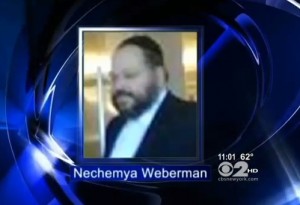
A report on Nechemya Weberman on CBS. Photo: Screenshot.
One Orthodox Jewish website exposes people accused of sex crimes against children, such as rape, even when no criminal charges have been filed. They do this in an effort to prevent sex offenders from evading the law by virtue of the statute of limitations, to fight years of institutional sex abuse cover-ups, to empower victims and to inform the public of potential dangers.
But is there a risk that an innocent person will be exposed in the fight to bring justice to victims?
Under its “Wall of Shame” Jewish Community Watch (JCW) lists convicted sex offenders, accused offenders with pending charges and others who have not been arrested and have had no formal charges filed against them. Thirty-two individuals are on the registry. JCW conducts its own investigations, including interviewing accusers, before listing un-arrested individuals on its “Wall of Shame.”
Last month, on the day Nechemya Weberman was convicted of repeatedly sexually abusing a girl he was supposed to be mentoring, the Brooklyn DA office presented an award of excellence to JCW, praising the organizations efforts of exposing child predators and assisting survivors in recovery. DA Hynes remarked that JCW’s work “has been instrumental” in creating change in the tight-knit Hasidic community.
JCW’s work marks major progress in the Orthodox worlds willingness to openly confront sexual abuse. Since JCW’s inception in 2011, the Brooklyn Orthodox community has seen as many sexual abuse-related arrests and reports as there have been in the past 20 years.
There is a need to inform the public of suspected sex offenders and empower victims on the one hand but also a need to ensure that innocent people aren’t wrongly exposed. How do you balance those two interests when un-arrested individuals are accused of sex crimes? When there is a public record, such as an arrest or conviction, there is no issue with reporting that information, but what happens when there is no public record of the alleged crime?
JCW’s published criteria for deciding whether to put up un-arrested individuals on the “Wall of Shame” is vague and evasive. Under the “Our Criteria” section, they don’t list actual criteria but instead argue that “listing our criteria would make it far easier for false allegations to be made” and “would enable said child molester to ensure that he or she did not meet any of those criterions.”
Shrouding their criteria in a veil of secrecy needs reconsideration. The lack of clear guidelines and transparency diminishes the organization’s credibility, exposes them to further legal liability, and feeds into fears of a witch-hunt mentality. If processes are not revealed for fear that alleged offenders may outsmart the system, at least all supporting documentation should be disclosed in an open and apparent manner.
The media often publishes accusations of un-arrested individuals but the stories are adversarial in nature, present all the facts, and usually give the accused an opportunity to respond. But even the media gets it wrong sometimes as they did in the high-profile Dominique Strauss-Kahn and Greg Kelly cases where the allegations of rape were ultimately dropped, but the journalistic process still minimizes the risk of error.
JCW certainly has a right to exercise their freedom of speech and the press when it comes to informing the community about abuse. They have demonstrated a commitment to protecting children in the Jewish community and have given a voice to the voiceless victims of sex abuse. Ultimately, someone wrongly accused can always resort to a defamation claim, but considering the tight-knit nature of the community, that person’s reputation would be tarnished forever. Extreme caution needs to be taken before publicizing alleged offenders.
Perhaps JCW should adopt a more journalistic approach where for example they publish statements by the therapist of a survivor, detailing how their patient is a victim of sexual abuse and why they believe the person accused is the one responsible for their trauma (of course with the patients approval).
Only report individuals that have multiple independent victims corroborating the allegations of abuse, which JCW implies that it does.
Publish detailed accounts of the allegations from all of the accusers.
They should even give the alleged offender an opportunity to issue a published statement responding to the accusations, so the public is able to better judge a claim and the accused has a chance to publicly respond. They should clearly state that the accused is presumed innocent unless convicted.
JCW protecting the identity of the victims is a good policy but at the same time they need to provide more information to the public. Maintaining the anonymity of an accuser is vital in protecting them from retaliation, intimidation and threats. The media and courts often maintain victim anonymity in sensitive sexual assault cases, especially those involving minors.
Of course the most error free approach would be to only publish information that is already a matter of public record, such as adjudicated sex offenders, arrests and public investigations. But this approach would give free reign to the countless sex offenders that have evaded the statute of limitations.
There is no easy answer in the quest to balance the need to inform the public of potential danger with ensuring the innocent are not defamed in the zealous pursuit of justice, but a high standard of journalistic integrity should be required before someone is publicly outed as a sex offender.
Eliyahu Federman has written extensively on subjects ranging for sexual abuse awareness, gender equality and improving police-community relations. He graduated law school in NY, where he served as an executive editor of law review.
One Orthodox Jewish website exposes people accused of sex crimes against children, such as rape, even when no criminal charges have been filed. They do this in an effort to prevent sex offenders from evading the law by virtue of the statute of limitations, to fight years of institutional sex abuse cover-ups, to empower victims and to inform the public of potential dangers.
But is there a risk that an innocent person will be exposed in the fight to bring justice to victims?
Under its “Wall of Shame” Jewish Community Watch (JCW) lists convicted sex offenders, accused offenders with pending charges and others who have not been arrested and have had no formal charges filed against them. Thirty-two individuals are on the registry. JCW conducts its own investigations, including interviewing accusers, before listing un-arrested individuals on its “Wall of Shame.”
Last month, on the day Nechemya Weberman was convicted of repeatedly sexually abusing a girl he was supposed to be mentoring, the Brooklyn DA office presented an award of excellence to JCW, praising the organizations efforts of exposing child predators and assisting survivors in recovery. DA Hynes remarked that JCW’s work “has been instrumental” in creating change in the tight-knit Hasidic community.
JCW’s work marks major progress in the Orthodox worlds willingness to openly confront sexual abuse. Since JCW’s inception in 2011, the Brooklyn Orthodox community has seen as many sexual abuse-related arrests and reports as there have been in the past 20 years.
There is a need to inform the public of suspected sex offenders and empower victims on the one hand but also a need to ensure that innocent people aren’t wrongly exposed. How do you balance those two interests when un-arrested individuals are accused of sex crimes? When there is a public record, such as an arrest or conviction, there is no issue with reporting that information, but what happens when there is no public record of the alleged crime?
JCW’s published criteria for deciding whether to put up un-arrested individuals on the “Wall of Shame” is vague and evasive. Under the “Our Criteria” section, they don’t list actual criteria but instead argue that “listing our criteria would make it far easier for false allegations to be made” and “would enable said child molester to ensure that he or she did not meet any of those criterions.”
Shrouding their criteria in a veil of secrecy needs reconsideration. The lack of clear guidelines and transparency diminishes the organization’s credibility, exposes them to further legal liability, and feeds into fears of a witch-hunt mentality. If processes are not revealed for fear that alleged offenders may outsmart the system, at least all supporting documentation should be disclosed in an open and apparent manner.
The media often publishes accusations of un-arrested individuals but the stories are adversarial in nature, present all the facts, and usually give the accused an opportunity to respond. But even the media gets it wrong sometimes as they did in the high-profile Dominique Strauss-Kahn and Greg Kelly cases where the allegations of rape were ultimately dropped, but the journalistic process still minimizes the risk of error.
JCW certainly has a right to exercise their freedom of speech and the press when it comes to informing the community about abuse. They have demonstrated a commitment to protecting children in the Jewish community and have given a voice to the voiceless victims of sex abuse. Ultimately, someone wrongly accused can always resort to a defamation claim, but considering the tight-knit nature of the community, that person’s reputation would be tarnished forever. Extreme caution needs to be taken before publicizing alleged offenders.
Perhaps JCW should adopt a more journalistic approach where for example they publish statements by the therapist of a survivor, detailing how their patient is a victim of sexual abuse and why they believe the person accused is the one responsible for their trauma (of course with the patients approval).
Only report individuals that have multiple independent victims corroborating the allegations of abuse, which JCW implies that it does.
Publish detailed accounts of the allegations from all of the accusers.
They should even give the alleged offender an opportunity to issue a published statement responding to the accusations, so the public is able to better judge a claim and the accused has a chance to publicly respond. They should clearly state that the accused is presumed innocent unless convicted.
JCW protecting the identity of the victims is a good policy but at the same time they need to provide more information to the public. Maintaining the anonymity of an accuser is vital in protecting them from retaliation, intimidation and threats. The media and courts often maintain victim anonymity in sensitive sexual assault cases, especially those involving minors.
Of course the most error free approach would be to only publish information that is already a matter of public record, such as adjudicated sex offenders, arrests and public investigations. But this approach would give free reign to the countless sex offenders that have evaded the statute of limitations.
There is no easy answer in the quest to balance the need to inform the public of potential danger with ensuring the innocent are not defamed in the zealous pursuit of justice, but a high standard of journalistic integrity should be required before someone is publicly outed as a sex offender.
Eliyahu Federman has written extensively on subjects ranging for sexual abuse awareness, gender equality and improving police-community relations. He graduated law school in NY, where he served as an executive editor of law review. Follow Eliyahu Federman on Twitter: www.twitter.com/elifederman


