










Washington Post Editorial Calls on Obama to Accept Netanyahu’s ‘Red Line’ Iran Strategy
Error: Contact form not found.

 by Zach Pontz

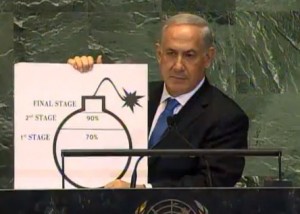
Benjamin Netanyahu at the United Nations General Assembly. Photo: screenshot.
That “cartoonish” illustration, as so many commentators have referred to it, at the center Benjamin Netanyahu’s speech at the U.N. last September might have actually packed more punch than once thought.
According to an editorial in the Washington Post, Netanyahu’s picture of a bomb in which he clearly marked a “red line” for Iran’s nuclear ambitions “appears to have accomplished what neither negotiations nor sanctions have yielded: concrete Iranian action to limit its enrichment.”
The Israeli prime minister said Iran could not be allowed to accumulate enough 20 percent enriched uranium to produce a bomb with further processing, adding that at the rate its centrifuges were spinning, Tehran would cross that line by the middle of 2013.
Iran too dismissed the graph, but, as the Washington Post writes “the regime began diverting some of its stockpile to the manufacture of fuel plates for a research reactor” and as a result the Islamic Republic “has remained distinctly below the Israeli red line, and it probably postponed the earliest moment when it could cross that line by several months.”
Sure, new technology that will make it easier for Iran to quickly produce bomb-grade uranium could change the equation, but for now the editorial suggests there are two lessons to be learned from Netanyahu’s strategy: “The credible threat of military action has to be part of any strategy for preventing an Iranian nuclear weapon, and clear red lines can help create the ‘time and space for diplomacy’ that President Obama seeks. Mr. Obama, who last year stiffly resisted pressure from Mr. Netanyahu to spell out U.S. red lines, ought to reconsider.”